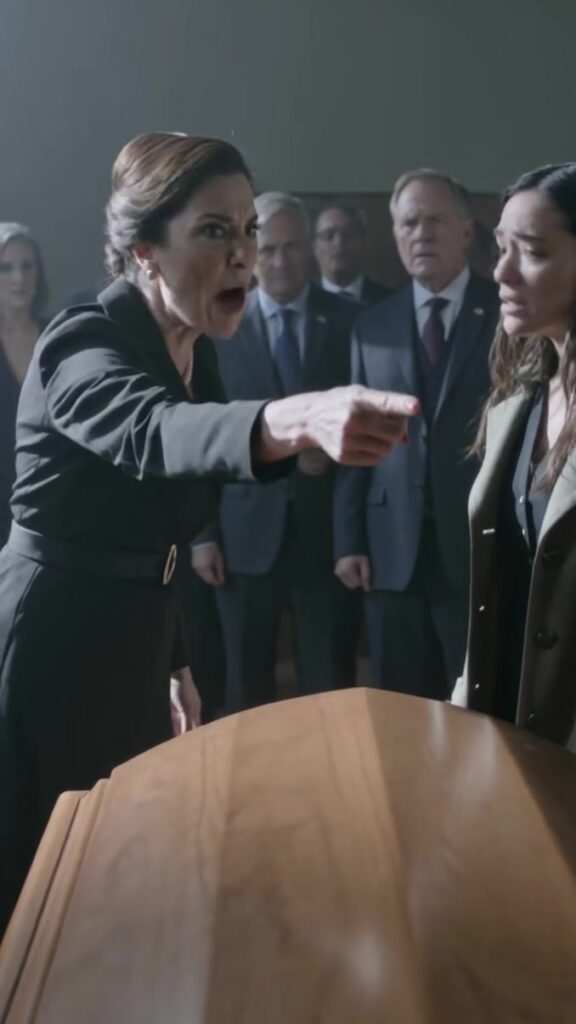
The shove came so hard the poor woman nearly hit the coffin.
It happened under a sky the color of cold ash, the kind of overcast that made the cemetery look drained of everything but duty. The casket—dark, mirror-polished—sat on a stand above the open earth, smothered in lilies and white roses arranged like an apology no one had earned. A row of umbrellas leaned toward it as if listening.
Margot Vance stood at the front in widow’s black, veil pinned tight, cheeks carved sharp by sleepless nights and the kind of anger that can pass for grief when grief becomes inconvenient. Her hands were still clenched from the shove, as if she’d pushed not a person but the whole day away from her.
The woman she’d struck—Lena, a slight figure in a threadbare coat that did not match the tailored darkness around her—staggered backward. Her palm slapped the coffin’s edge, wood thudding under skin. For a single breath she was suspended there, inches from falling against the floral blanket, eyes wide as if she’d been shoved into a dream she couldn’t control.
Margot’s voice cut through the hush. “You don’t get to perform sorrow here,” she hissed, loud enough for the first rows to hear. “You weren’t anything to him.”
The mourners shifted. A few faces tightened with the shame of witnessing something intimate; others brightened with the hunger for a scene. Phones rose with practiced stealth. Even the priest’s hands paused over his book.
Lena’s eyes were wet, but now heat flared behind them, a rage that felt ancient compared to the fresh grief. “You don’t know what he was,” she said, her voice trembling, yet steady in its refusal. “Not all of it.”
Margot stepped closer, as if proximity could rewrite reality. “I was his wife. I knew him. I knew everything.” Each word landed like a stamp, official and irreversible.
“You knew what he decided to show you,” Lena said. The sentence wasn’t shouted. That made it worse. It moved through the crowd like a draught through a cracked door.
Margot’s mouth tightened. Her hands went to Lena’s shoulders again, not quite touching this time, as if she was weighing whether to shove once more. “Then why are you here?” she demanded. “Why would you come today of all days?”
Lena’s breath came hard, fogging in the chilly air. She didn’t look at the widow. She looked at the coffin, at the flowers and the gleam and the finality. “Because he told me to,” she said. “If anything ever happened to him.”
Margot gave a laugh that was all splinter. “Of course he did. He had instructions for you too?”
Lena’s hand slid into her coat, deep and slow, as if she were reaching into something dangerous. The priest lifted his chin, ready to intervene. A man near the back muttered, “Don’t,” though no one knew to whom he spoke.
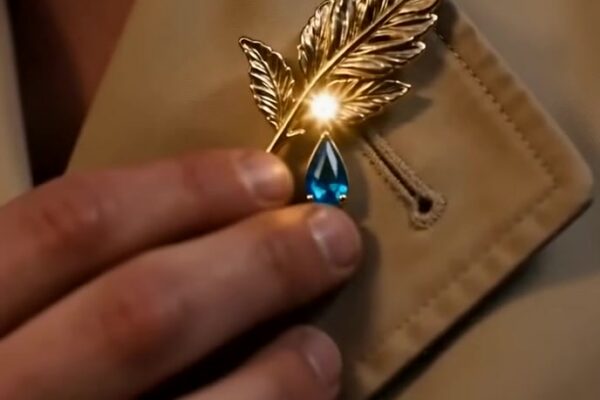
Lena drew out a small key, old-fashioned, its metal dulled by time and thumbprints. She placed it on the coffin lid with the careful gravity of someone laying down evidence.
The key made a tiny, bright sound when it touched the wood.
Silence fell as if someone had snapped a cord.
Margot stared. Her eyes flicked from the key to Lena’s face as though searching for a trapdoor.
“That opens a safe he never showed you,” Lena said, so quietly the nearest mourners leaned without meaning to.
An older man near the front, Mr. Harker—the attorney who had handled the estate, the one with liver-spotted hands and a face shaped by decades of bad news—stepped forward. He didn’t ask permission. He simply reached, lifted the key, and turned it in the thin daylight.
His fingers froze.
Color drained from his cheeks with astonishing speed, leaving his skin waxy. He looked at the key again, then at the coffin, as though the dead man might sit up and reclaim it.
“No,” Harker whispered. His voice sounded like paper tearing. “This… this belongs to his first identity.”
Margot’s veil quivered with her breath. “His what?” Her composure—carefully stitched on for the cameras, for the board members, for the world that would judge her on how elegantly she mourned—pulled at its seams.
Harker’s gaze slid to Lena, then away, unable to hold it. “There was a safe registered decades ago,” he said. “Not under the name we all know. Under a name that was… discontinued.”
The word landed wrong. Names weren’t milk.
Lena’s shoulders lifted and fell. “Ask him what name he used before he buried the first one,” she said, and though her voice was quiet it felt like the earth itself was speaking.
Margot took a step back, heel sinking into damp grass. “He didn’t have another name,” she said, but it came out as a question.
A young man in a black coat—Miles Vance, the dead man’s nephew—swallowed hard. “Aunt Margot,” he began, then stopped. His eyes were fixed on the key with the intensity of someone watching a match hover near gasoline.
Harker cleared his throat, a sound of reluctance. “There are provisions in the will,” he said, “sealed provisions. I was instructed to release them only if a specific person appeared at the funeral and presented—” his eyes dropped to the key “—that.”
Margot’s face tightened. “Why didn’t you tell me?”
“Because,” Harker said, voice cracking, “the instructions came from him, and they were explicit.”
Margot’s stare snapped to Lena. “Who are you?” The question was no longer contempt. It was fear wearing contempt like perfume.
Lena’s mouth pressed into a line. For a moment she looked younger, the way grief can peel years off someone and leave raw truth. “I’m the person he used to be,” she said. “Or the person who knew him when he was still learning how to erase himself.”
Murmurs rose again—controlled, horrified. A woman whispered, “Affair,” and another whispered, “Witness.” Someone muttered, “Criminal.” The priest’s lips moved without sound, perhaps praying, perhaps counting down to when he could end this.
Lena lifted her chin. “He changed his name after the fire,” she said, and Margot flinched as if the word were a slap. “Not the little house fire you read about in some old local paper. The one that took three people and left one child alive with a different story.”
Margot’s eyes widened. “That’s impossible,” she said. “He was—he was in college then. He showed me pictures. He had friends. He—”
“He built a life,” Lena said, and there was no admiration in it, only a weary recognition. “He built it on top of the old one and told himself the weight wouldn’t show.”
Harker stepped nearer to Margot, lowering his voice, but the graveyard held sound like a bowl. “There’s a safety deposit box,” he said. “And a safe at the old office in Harbor Street, the one he kept ‘closed for renovations.’ It was never closed. It was kept.”
Margot’s hand rose to her throat, fingers pressing at the seam of her collar as if she couldn’t breathe. “What’s in it?” she asked.
Lena looked past her, past all of them, to the coffin as if the answer was already nailed inside. “The truth he couldn’t stand to carry alone anymore,” she said. “A letter for you. A recording. And the documents that show what he did with the first name before he washed it clean.”
Miles made a sound—half laugh, half sob. “Uncle Adrian wasn’t—”
“Adrian Vance is the name on the headstone,” Lena said. “It’s not the name he was born with.”
Margot’s face hardened in a last attempt at control. “You expect me to believe you over my husband? Over the life we had?”
Lena’s eyes filled again, and this time the tears didn’t soften her. They sharpened her. “I don’t expect you to believe me,” she said. “I expect you to open what he locked away and decide what kind of widow you want to be. The one who protects a polished story… or the one who survives the truth.”
The wind picked up, tugging at coats and veils, lifting the scent of roses and wet earth. Somewhere a crow called, harsh and impatient.
Margot stared down at the key still in Harker’s hand. Her jaw worked, as if she were chewing on a word too bitter to swallow. Then, with the smallest movement, she nodded once.
“After this,” she said, voice low, not to Lena but to the coffin. “After you’re in the ground.”
Lena stepped back from the casket, hands empty now, the most dangerous thing she’d brought laid bare for everyone to see. She watched Margot with an expression that was neither victory nor pity.
“He thought you’d try to bury it with him,” Lena said. “That’s why he asked me to come.”
Margot’s eyes flashed. “And what did he think you would do?”
Lena looked at the open grave. At the black straps waiting to lower the weight. At the flowers trying to disguise what was inevitable. “He thought I’d make sure his first name didn’t die in silence,” she said. “Because silence is what made him.”
The priest finally opened his book again, but his voice shook as he began to speak. Around them, umbrellas tilted; phones lowered; people pretended they had not been listening as closely as they had.
Yet no one was looking at the coffin the same way anymore.
It wasn’t only a goodbye.
It was a lid over a secret that had started to rattle.
And the key—small, dull, ordinary—had already turned in all of their minds, loosening something they would not be able to tighten again.