The street was dressed for celebration, as if it had decided to audition for a postcard. String lights ran from awning to awning in gentle arcs, and every bulb carried a miniature halo in the night mist. Storefront windows poured honeyed reflections onto the sidewalk—golden rectangles that made the pavement look warmer than it was. People drifted past in couples and trios, their laughter clipped by scarves, their hands occupied with small luxuries: paper cups, glossy shopping bags, bouquets wrapped in tissue. It was a street built to reassure you that whatever darkness existed lived somewhere else.
Nora Vance walked it with her shoulders held tight anyway. She did that in crowds, as though her coat could become armor if she believed hard enough. The beige trench was too expensive for the way she tugged it closed, too clean for the fatigue that sat under her eyes. She had told herself she was only here because she needed air, because the office smelled like copier toner and judgment, because the city after work sometimes pretended to forgive you. But every reflective pane was also an accusation: a woman who never looked back, a woman who had learned to file family grief where no one could see it.
She was passing the bakery—cinnamon and butter rushing out each time the door opened—when something small collided with her purse. A dirty hand hooked the gold chain strap and yanked, hard enough to drag her off balance. Nora’s first instinct was pure heat. Her palm snapped down, gripping her bag like it was the last thing she owned.
“Don’t,” she said, voice sharp enough to cut. “Don’t touch me.”
The hand didn’t let go at once. Nora spun, ready to shout for security, ready to make a scene that would be justified by the glow of all those lights. But the child attached to the hand wasn’t running. He was thin, too thin for winter, his hoodie cuff torn, his cheeks streaked with old grime and something wetter. His breathing stuttered as if he’d sprinted from someplace far more dangerous than a shopkeeper. His eyes were already swollen, like crying had become a habit he didn’t bother hiding anymore.
He flinched at her tone—but held his ground. That was the first wrong note. A thief ran. A child who knew what fear felt like in his bones ran. This boy stayed, swallowing panic like it was medicine he couldn’t refuse.
“You… you have the same pin,” he said.
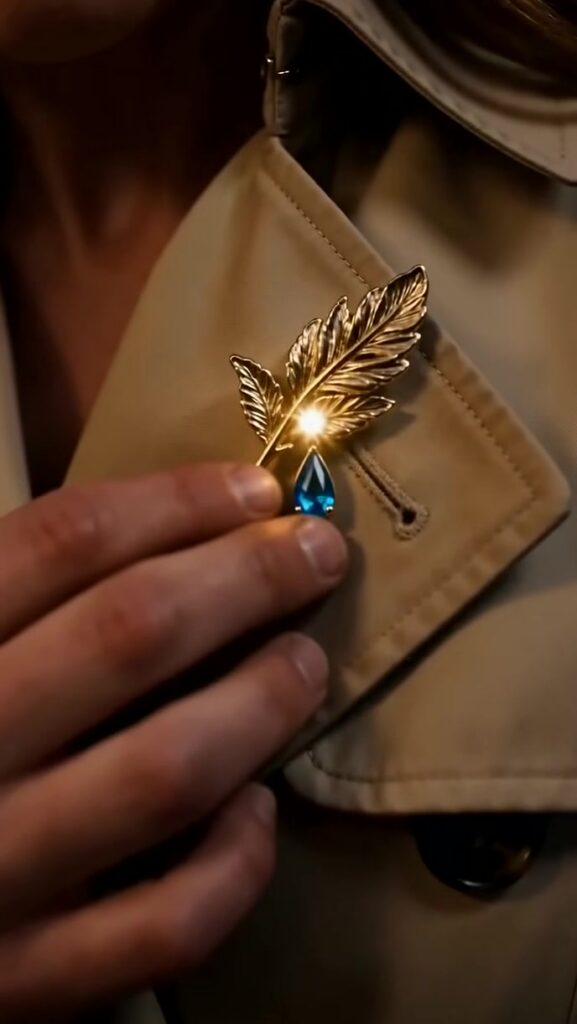
Nora’s anger hit a wall. Her gaze followed his trembling fingers—not at her bag, but at her collar. She felt her throat close as her own hand rose without permission. Under the lapel of her trench coat, fastened neatly where she always kept it, was a gold leaf with a blue teardrop stone. She had worn it for years like an invisible promise.
The boy opened his fist. In his palm lay an identical leaf, its blue gem dulled by grime but unmistakable. For a second the street’s music and chatter drained away, replaced by the sound of Nora’s pulse and the brittle squeak of her own breath.
“Where did you get that?” she asked, and hated how small the question sounded.
He swallowed, eyes fixed on her like he was trying not to disappear. “My mom has one. She said I’d find you.”
It was absurd, impossible in the way nightmares were impossible until they woke you up. There had only ever been two pins. Their mother had pressed them into Nora’s and Celia’s hands on the day she died, fingers cold and scentless of perfume for the first time. Two matching leaves, two blue stones, meant to keep sisters connected when everything else tore apart. Later came the divorce, the legal papers, the adult voices lowering when Celia entered a room. Then Celia’s disappearance—an event that had been repackaged so often it no longer had a single shape. She ran away. She was taken. She chose not to return. She’s gone. Don’t ask. Don’t dig. The second pin had never come back.
Nora’s mouth tasted like metal. “That can’t be true,” she whispered. “Celia—” She stopped saying the name as if speaking it would summon someone who had been dead all along.
The boy nodded, oddly calm about her disbelief, as if he’d rehearsed this moment in the dark. “She told me you’d say that. She said you wouldn’t believe. Not at first.” He raised the pin closer to Nora’s face, and she saw a tiny scratch near the stem—one Celia had made with a kitchen knife when they were girls, testing if gold was really soft.
Nora took a step closer before she realized she’d moved. The boy didn’t back away. He looked up, and for the first time Nora saw it: the shape of his eyes, the slight downward tilt at the corners, the startling gray-green that her family never had except for one person.
“She said the woman with the other pin…” he began, voice dropping to a hush as if afraid the street itself might overhear. “…is my mom’s sister.”
Nora went rigid. The pin on her collar suddenly felt like a weight meant to drag her under. The city returned in fragments: a bus sighing at the corner, a woman laughing too loudly, a bottle clinking in a bin. All ordinary. All cruelly ordinary.
“What’s your name?” Nora asked, and heard how it trembled despite every lesson she’d ever learned about control.
“Eli,” he said. “Eli Hart.” The surname struck like a slap. Hart—Celia’s childhood nickname from their mother, scribbled on lunch bags and birthday cards. Nora’s vision sharpened painfully, as if the lights had burned brighter.
Eli reached into his pocket and produced a folded photograph, creased enough that it had been opened and closed like a prayer. His hands shook so hard the picture fluttered. He held it out with both palms, offering it the way you offered evidence in a trial.
Nora unfolded it carefully, afraid the paper would tear and take her last certainty with it. In the image, Celia stood in front of a faded wall painted with a cartoon sun. She was older than Nora remembered, her face narrower, her hair cut blunt at the shoulders. But she was unmistakably alive. One arm wrapped around a child—around Eli—holding him close not as a pose but as a reflex, as if she expected someone to try to take him.
Behind them, half out of frame, was a door with a number: 7B. And taped to that door, like a warning meant for anyone who came looking, was a strip of paper with a single word printed in thick black letters: REMOVED.
Nora’s breath hitched. “Where is she?”
Eli’s eyes flooded. He blinked hard, but tears slid down anyway, carving clean lines through the grime. “She made me come,” he said. “She said if anything happened to her, I had to find you. She said you were the only one who might listen.” He hugged his elbows, suddenly shivering. “Men took her from our apartment. Not police. They had badges, but she said badges can be bought. She told me to run when I heard the third knock.”
The street’s beauty turned nauseating. The lights above them became a ceiling, the storefront reflections a stage set. Nora’s mind raced through old memories with new teeth. Her father’s warnings. Sealed files. A name that had been muttered once—Hart—as if it were a disease. The way her mother had cried when Celia left, not with anger but with terror.
“Did she say why?” Nora asked, though her voice already knew the answer would hurt.
Eli nodded, wiping his nose with a sleeve. “She said she’d kept a record. Of everything. People who hurt kids. People who paid to make problems disappear.” He glanced around, small body tensing each time someone passed too close. “She said the street would look pretty tonight. She said pretty is how they keep you from seeing what’s under it.”
Nora swallowed, tasting years of denial. Somewhere nearby a car horn chirped like a joke. She looked down at Eli, at the matching leaf pin in his hand, at the photograph that proved her sister had been breathing all this time in a world Nora had refused to imagine.
She unclasped her own pin and closed her fingers around it until the gem pressed into her skin. It hurt, and she welcomed the pain. Pain meant this was real. “Come with me,” she said, crouching so she could meet his eyes. “Right now. We’re leaving this street.”
Eli hesitated, a child weighing the danger of trusting an adult against the danger of being alone. Then he placed the pin in Nora’s palm like a key. When she stood, she kept her body between him and the crowd, her gaze scanning the shimmer of shop windows for reflections that didn’t belong. The lights above them glowed warmly, insisting on innocence.
And beneath that warm glow, Nora felt the terrible thing moving—quiet, practiced, already turning its attention toward the boy who had dared to bring the past back into the open.
She took Eli’s hand and stepped into the flow of pedestrians, pretending to be just another woman escorting a child through a festive night. But in her pocket, the photograph crackled, and in her fist, the gold leaf dug into her skin like a vow.
The street looked beautiful enough to hide something terrible.
Nora intended to drag that terrible thing into the light.