The scream hit the dining room like a thrown plate—sharp, impossible to ignore, too loud for a place where people paid to be whispered to. For a heartbeat the golden lamps and the violinist in the corner kept going as if nothing had happened, their warmth and polish clinging to the lie of calm. Then the room caught up. Heads turned. Forks paused midair. The soft murmur of money stopped breathing.
At the center table, where the candles were set in cut-crystal holders and the napkins were folded into obedient little swans, Celeste Hargrove had her fist wrapped in a young woman’s hair. She was elegant even in violence—diamond earrings flashing, a silk sleeve sliding back from her wrist as she yanked. The waitress staggered, her black apron twisting, shoes squealing on marble. She looked like someone who’d been tossed from a storm onto shore: drenched in panic, eyes huge, cheeks already wet.
“Say it,” Celeste hissed, dragging her around the edge of the table. “Say what you told him. Say what you tried to do.” Her voice didn’t tremble. It was trained. It knew boardrooms and charity galas and the kind of rooms where everyone smiled through their teeth.
A guest at the next table jolted backward, and a stemmed glass slipped from his fingers. It fell in slow, glittering disbelief and burst against the floor. The sound was smaller than the scream, but it made the moment real. Shards skittered under chairs like fleeing insects. Someone gasped, and then, as if an unseen director had shouted a cue, phones lifted into the air—rectangles of bright attention pointed toward the humiliation like spotlights.
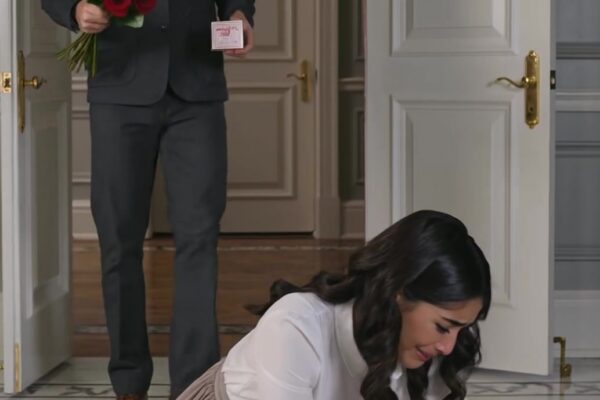
The waitress collapsed to her knees. One hand went up to shield her head, the other clawed at the air as if it could find purchase there. “I didn’t—” she choked. “I didn’t trap anyone. I swear.” Her voice was thin and raw, a voice that had called out daily specials and taken blame for other people’s stains. Celeste bent close enough that the pearls at her throat nearly brushed the girl’s temple.
“Then why are you here?” Celeste demanded. “Why now, of all nights?”
Because it was their anniversary, Mina thought, and the truth had a vicious sense of timing. Because she’d tried not to come. Because the manager had begged her to pick up the shift—an extra twenty dollars in tips, he’d said, and she had diapers in her cart online and a past-due notice taped to her fridge. Because the city was expensive and desperation was a leash.
Beside Celeste, Everett Hargrove stood with the kind of stillness people mistake for dignity until they look closer. His face had drained to a bloodless gray. His expensive suit seemed suddenly too clean, too tight, as if it were trying to hold him together. He stared at Mina not like a man looking at a stranger, but like a man watching a door he’d locked begin to open from the inside.
“Everett,” Celeste said, not turning her head. “Tell them. Tell them she’s lying.”
His mouth moved, but nothing came. The silence was its own confession, and it drew a low, hungry sound from the audience of diners—an almost inaudible inhale, a collective savoring. Even the violinist stopped, bow suspended, as if the next note might be inappropriate.
Mina’s throat burned. She tasted metal. She hadn’t planned to speak. She hadn’t planned to be dragged through a dining room like a mop. But her body, already stretched thin by fear and sleepless nights, found something hard and bright inside itself.
She reached into her apron pocket with trembling fingers. The paper was soft from being unfolded and refolded until its creases were tired. She pulled it out, and the action—small, careful—somehow made the room quieter. Celeste let out a laugh that was all teeth.
“Of course,” Celeste said. “She brought paperwork. How very modern.”
Mina didn’t look at the phones. She didn’t look at the chandeliers, the silver, the people whose eyes were eager and clean. She set the paper on the edge of the table and pushed it forward. It slid over the linen like a verdict, coming to rest beside Everett’s untouched glass of wine.
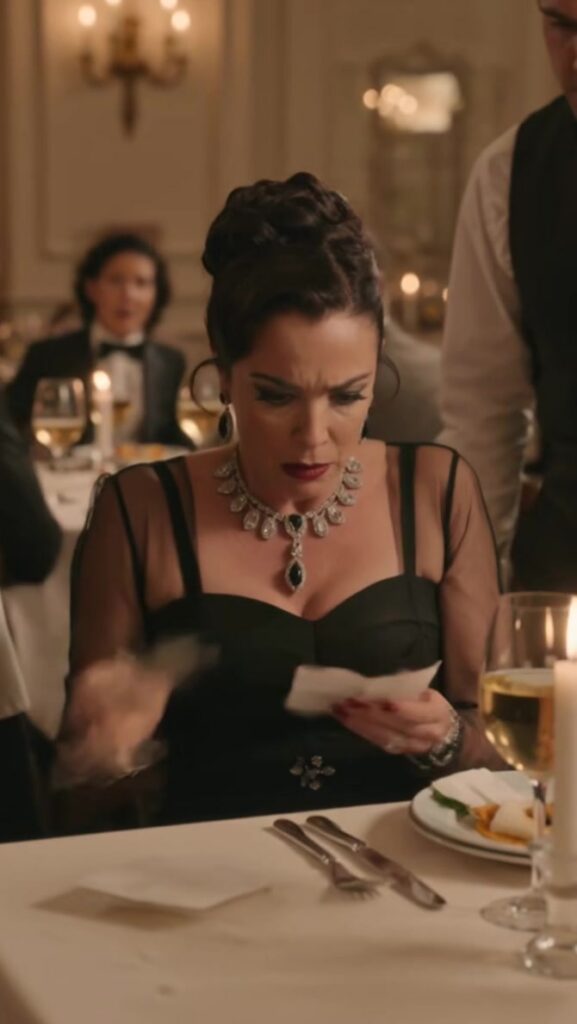
For one second no one moved. Then Celeste snatched it up, still wearing that public smile—a mask she’d worn for years, one that had never cracked for cameras or charity committees. She unfolded the page with a theatrical little shake, as though preparing to read a bad review aloud.
Her eyes skimmed the lines. At first she laughed again, short and bright. Then the laugh jammed in her throat and died. Her expression drained so quickly it was as if a lamp had been turned off behind her eyes. The page, held between manicured fingers, began to tremble.
“What is that?” Everett asked, the words finally escaping him, but they sounded broken—too late and too small.
Celeste didn’t answer. Her gaze stayed locked on the ink, as though the letters had rearranged themselves into something impossible. A server hovering nearby—Nolan, the head waiter, a man who had served politicians and celebrities without blinking—leaned in, perhaps to de-escalate, perhaps to protect the tablecloth from scandal. His eyes flicked down. He froze.
“Mrs. Hargrove,” Nolan whispered, and the way his voice shook made even the most bored diner lean forward. “That… that’s a paternity result.”
Words hit the air like falling cutlery. A hush slammed into place so hard it seemed to press on ears. In that quiet, Mina heard her own breathing, ragged and loud, and behind it the faint crackle of a candlewick.
Everett took a step back, and the chair behind him scraped. The sound was obscene in the stillness. His eyes darted over the page, then to Mina, then away, like a man searching for a door that had vanished. “No,” he said, not to anyone in particular. “No, Celeste, it’s—”
Celeste lifted her head slowly. The woman who had dragged a girl by the hair a moment ago looked, for the first time, uncertain of her own power. Rage sat in her face, but beneath it was something more frightening: fear with nowhere to go.
“You told me,” she said to Everett, voice low now, almost careful. “You told me there was nothing. You told me you handled it.”
Mina swallowed, and the movement hurt. “I didn’t come for money,” she said, surprised that her voice could hold any shape at all. “I didn’t even want to come tonight. I just—” She pressed her palm to her stomach, instinctive, protective. “I needed him to stop pretending I didn’t exist.”
Celeste’s gaze snapped to Mina’s hand. Something flashed there—recognition, calculation, a vicious arithmetic. “How far along?” she demanded.
Mina hesitated. Answering felt like placing herself back under Celeste’s grip. But hiding had brought her here anyway. “Twenty weeks,” she whispered.
A woman near the window covered her mouth. Someone else muttered, “Oh my God,” not in sympathy, but in relish. The phones stayed raised, unwavering, as if this were entertainment purchased with the cost of an entrée.
Everett’s face contorted. “Mina,” he said, and hearing her name on his tongue made her flinch. It was the same gentle tone he’d used in an office stairwell months ago, when he’d told her she was bright, she was special, she deserved better than late shifts and a leaky apartment. It was the same tone he’d used later, when he’d said he couldn’t ruin his life.
Celeste stepped toward him with the paper in her hand, the page now crumpled in her fist. “You knew,” she said. “You knew, and you sat here—” She gestured at the table, the candles, the expensive illusion. “You let me walk into this room like a fool.”
“I didn’t think she’d—” Everett began.
“Exist?” Mina finished, bitterness finally burning through her tears. “I tried to disappear. I tried to do it alone. But you kept sending messages, then stopping, then sending again like I was a mistake you could erase by ignoring your phone.” She shook her head, the motion loosening strands of hair from Celeste’s earlier grip. “I’m not here to be your secret.”
Celeste’s fingers flexed around the paper as if she might tear it in half and thereby tear the truth. She looked around and saw the room staring back—strangers, staff, witnesses, lenses. Her control, so carefully built, had been handed to the crowd. For a moment Mina almost pitied her. Almost.
Then Celeste’s chin lifted. Her voice, when it came, was polished again, but its edges were newly sharpened. “You,” she said to Mina, “will come with me. We will speak privately.”
Mina stayed on her knees, but she did not bow. “No,” she said, quietly, and the refusal felt like stepping onto solid ground. “You already made it public.”
Everett’s eyes flicked between them, a trapped animal searching for a way out that didn’t involve consequence. Celeste stared at him—really stared, as if seeing the man beneath the suit for the first time. The dining room seemed to hold its breath, waiting for the next disaster: another scream, another glass shattering, another woman dragged across marble.
Celeste’s hand loosened, and the paper slid free. It fluttered down, landing open on the table like a white flag no one had asked for. In the soft candlelight the printed result looked mundane, almost ridiculous—a clinical document that had just detonated a marriage.
Mina pushed herself to her feet, legs shaking. Nolan moved as if to help her, then hesitated, unsure which side of wealth was safer. Mina didn’t wait for permission. She straightened her apron, wiped her face with the back of her hand, and looked at the room full of strangers filming her pain.
“Turn those off,” she said, not loudly, but with a steadiness that cut. Some people did. Most didn’t.
Celeste’s gaze followed Mina as she stepped away from the table. “You think you’ve won,” Celeste said, voice low enough to be intimate, loud enough to be heard. “You have no idea what you’ve started.”
Mina paused by the broken glass, the shards glittering on the marble like fallen stars. She looked back once—at the ruined anniversary, the pale husband, the woman whose fury could not rewrite biology. “I didn’t start it,” Mina said. “I just stopped swallowing it.”
Then she walked out under the warm golden lights, leaving the restaurant to its silence, its cameras, and the truth lying exposed on a white tablecloth—unremarkable ink, unstoppable weight.