The slap cracked through the boutique louder than the music, a sound too human for a room engineered to feel untouchable. It ricocheted off mirrored walls and velvet drapes, chased the soft lounge beat into silence, and made every customer’s head pivot as if pulled on the same invisible thread.
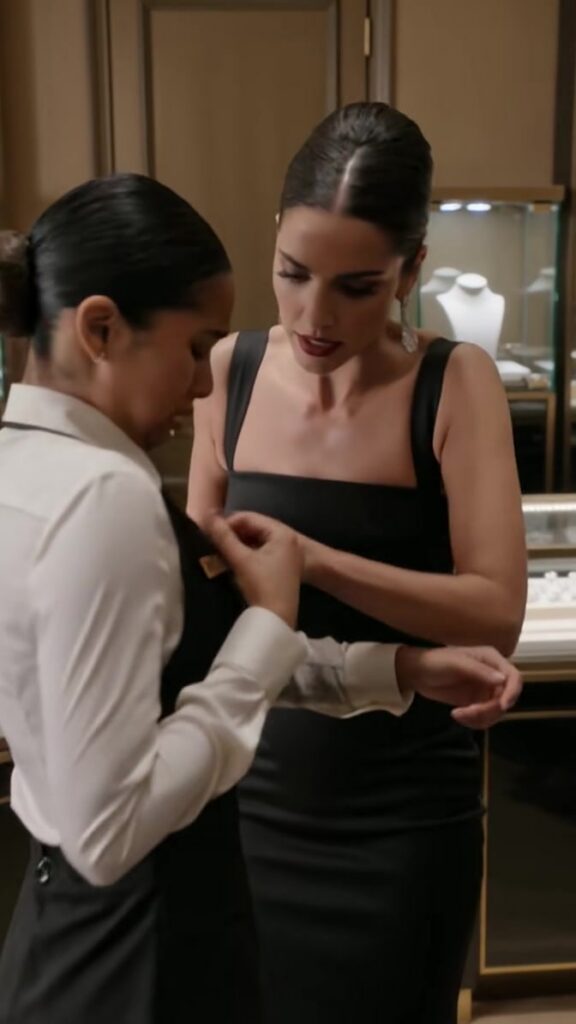
Under the warm gold lighting that made diamonds look like trapped stars, Lina—a junior sales assistant whose name tag still shone as if it had never known fingerprints—stumbled into a glass case. Her shoulder struck the edge; the display trembled but did not shatter, as if even the glass knew it was being watched. She clapped a hand to her cheek, eyes wide and unfocused, the sting blooming into heat that climbed her face.
In front of her stood a woman in a black dress cut so perfectly it looked like it had been poured. She had the poise of someone accustomed to being agreed with. Her lipstick didn’t smudge when she shouted. “You little thief,” she said, voice sharp enough to nick crystal. “Where is my bracelet?”
It was absurdly small—one missing circle of stones in a room of thousands—yet the accusation landed like a verdict. Lina’s lips parted and trembled. A second earlier she’d been lining up velvet trays, making sure each clasp faced the same direction the way she’d been taught. Now she could barely remember how her hands were supposed to move. “I didn’t take anything,” she managed, the words coming out thin. “Madam, I—please.”
The woman in black—her name, Lina learned later, was Signora Bianchi, spoken with the reverence reserved for money—snatched Lina by the wrist. The grip was not merely firm; it was possessive, like she was holding a handbag she’d paid for. She dragged Lina toward the boutique’s center, where the light was brightest and the floor shone like a still pond. With her free hand she yanked at the pocket of Lina’s uniform apron so hard the seam gave a sick little rip.
A pen clattered onto marble. A folded sales note fluttered down like a white leaf. A travel-size hand cream rolled and stopped at the toe of Signora Bianchi’s stiletto. Nothing else. The absence in the pocket became a new kind of evidence, as if the air itself could be contraband. Phones lifted—some discreetly, some boldly—and Lina saw her own humiliation reflected in their black screens, a silent audience gathering before anyone had decided what the story was.
“You’re hurting me,” Lina whispered. It wasn’t a plea for mercy so much as an astonished statement of fact, as if pain should not be possible in a place this expensive. Signora Bianchi leaned closer, perfume and anger mixing into something metallic. “Then tell me where it is,” she hissed. Lina shook her head, tears spilling down over her fingers. “I swear I never touched it.”
Signora Bianchi’s mouth curved, not into a smile but into a shape that suggested she enjoyed the geometry of power. “Of course,” she said, loud enough for the room to absorb. “Girls like you always say that.” The words were not about a bracelet anymore; they were about who deserved belief. Behind the counter, senior staff froze in polite horror, eyes flicking to one another and then away, as if looking directly would make them complicit. A security guard half-shifted, stopped, and folded his hands again.
Lina searched the room with desperate, wet eyes for someone with authority. She found only the boutique manager’s tight expression—an instinctive calculation of reputations and receipts. Silence settled, heavy and practiced. In luxury, truth often waits until someone wealthy speaks it aloud.
Then the private showroom door opened.
The sound was quiet: a latch, a soft click, the kind of noise no one heard unless they were already holding their breath. Every face turned. An older man stepped out, impeccably dressed in a charcoal suit that fit like tradition. His hair was silver and combed back, his hands steady. In his right hand he held a diamond bracelet, brilliant under the lights. In his left, a pale repair slip, folded once. He stopped as soon as he registered the scene: Lina in the middle of the floor with a torn pocket, cheeks streaked with tears, Signora Bianchi’s fingers still locked around her wrist like a cuff.
The jeweler’s gaze moved, slow and cold, from Lina’s reddened cheek to the phones to the woman in black. “Signora,” he said, voice calm in a way that made it more dangerous. “You seem to have misplaced your certainty.”
Signora Bianchi released Lina so abruptly the girl swayed back, rubbing her wrist where fingerprints were already blooming. The older man lifted the bracelet slightly, letting it catch the light. The room seemed to inhale. “This,” he said, “was not stolen.”
Signora Bianchi’s throat worked. “What are you talking about? That is mine.”
“It is,” the jeweler agreed, and the agreement made her shoulders loosen by a fraction, as if she expected an apology to follow. It did not. He unfolded the repair slip with the care of someone opening a verdict. “You requested it be resized and the clasp reinforced. Under your family account. The order was placed three days ago, and it was brought into the workroom this morning by your driver.”
Color drained from Signora Bianchi’s face so fast the perfect makeup looked suddenly like a mask. Her mouth opened, closed. “I—no. That’s—” Her eyes flicked to the customers, to the phones, to the manager, as if searching for a single sympathetic angle in the room.
The jeweler took one step forward, and although he did not raise his voice, the room leaned toward him. “You returned today,” he said, “during our busiest hour, and you announced loudly that your bracelet was missing. You chose the youngest assistant on the floor. You chose someone who would not have a lawyer in her pocket.” He turned his head slightly, eyes catching Lina’s trembling form. “You chose correctly, until you didn’t.”
Signora Bianchi’s hands clenched and unclenched. “Are you accusing me?”
“I am describing what happened,” he replied, the distinction landing like a blade. “Your account also shows an insurance inquiry placed yesterday for ‘lost jewelry’ matching this bracelet’s valuation.” He held the slip up. “It is remarkable how quickly paperwork appears when money is nervous.”
A murmur rippled through the boutique—soft, shocked, hungry. Lina stared at the bracelet as if it had transformed into something alive, something that could bite. Her tears slowed, replaced by a hollow disbelief. She had been so sure no one would rescue her. That certainty had been as suffocating as the hand on her wrist.
The manager finally moved, stepping out from behind the counter with a stiffness that suggested he was trying to become brave without wrinkling his suit. “Signora Bianchi,” he said, voice polite enough to be a shield, “we will need to ask you to come to the office.”
“This is outrageous,” Signora Bianchi snapped, but her words lacked their earlier shine. Her eyes darted to the phones again, and for the first time, she looked frightened—not of consequence, but of being seen. “Turn those off,” she barked at strangers who did not obey.
The older jeweler did not look away from her. “Before you go,” he said, and there was a quiet finality that made the room still, “you will apologize.”
Signora Bianchi’s jaw tightened, pride battling survival. She looked at Lina like she was something inconvenient on the floor. For a moment it seemed she might refuse simply because refusal had always been an option.
Then she saw, in the jeweler’s expression, that the boutique was no longer her stage. The power had shifted hands—not with a slap, but with evidence.
“I’m… sorry,” Signora Bianchi said, and the words fell without grace.
Lina did not answer. She stood with her arms wrapped around herself, cheek throbbing, wrist aching, uniform torn. But she lifted her chin. It was a small movement, nearly invisible, yet it rewrote something in the air. The jeweler turned to her, his sternness softening by a degree that felt like warmth after a storm. “Lina,” he said, as if saying her name correctly could stitch the room back together, “go to the back. Have someone bring you ice.”
As Lina walked away, the golden lights followed her like judgment and then, strangely, like mercy. Behind her, the boutique resumed its carefully curated quiet. But the crack of that slap remained suspended in memory—louder than the music, louder than the diamonds—proof that even in a room built on glittering silence, sound could tell the truth.