The rain had the patience of a debt collector. It tapped and tapped on black umbrellas and polished shoes, on the church’s ancient stones, on the marble angel that watched the courtyard with her mouth forever parted in warning. The air smelled of wet lilies and candle smoke, a strange sweetness fighting against the damp.
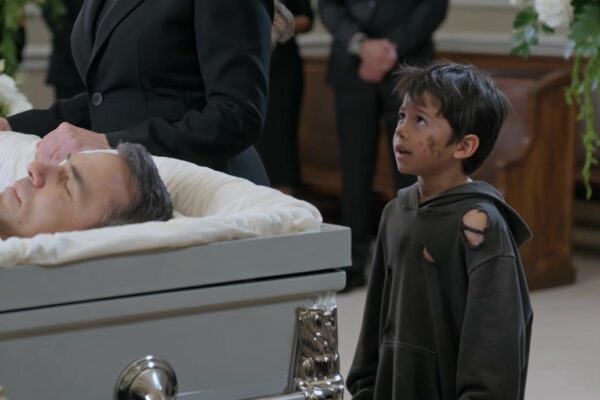
Inside the ring of mourners, the coffin looked almost too perfect to be real—walnut-dark, lacquered until the clouds could see themselves in it. Men in tailored coats stared at their hands as if they were learning what it meant to be empty. Women held tissues like white flags. The old priest’s voice moved through the prayer like a slow bell.
Elena Hawthorne stood nearest the coffin. Widow. Beneficiary. The woman everyone had rehearsed sympathy for. The veil at her cheek trembled as she breathed. She did not cry. Her eyes were dry and bright, fixed on the gold crucifix resting atop the lid.
It should have been the end of a story, the closing of a wealthy man’s book.
Then, near the iron gate, someone gasped as if water had entered their lungs.
A boy stood there—small, soaked through, his hair flattened into dark ropes against his forehead. He wore a jacket that might once have been blue. His shoes were too big, tied with twine. In his arms he held something tight to his chest as though it were a living thing: a wooden toy horse, charred and cracked, one leg blackened nearly to the knee.
For a moment no one moved. The hush that followed was heavier than the prayer.
“Who is that?” a man hissed.
“He shouldn’t be here,” someone else muttered, glancing as if poverty were contagious.
The priest paused mid-sentence. The rain slid off umbrella rims in steady drips. The boy took one step forward, then stopped, as if the courtyard had turned into a river and he had forgotten how to swim.
Elena saw him. It was not the slow recognition of a face; it was the instant recognition of an object. Her gaze locked onto the burned horse, and the skin beneath her veil drained as if someone had pulled a stopper from her throat.
“No,” she whispered—so quiet only the man beside her heard, and even he wasn’t sure it was real.
The boy’s voice was thin, broken by cold and courage. “I… I need to give this to him.” He nodded toward the coffin, not looking at the faces around him, only at the polished wood as if it were a door he had been promised would open.
Elena’s hand rose, sharp as a command. “Get him away from here.” Her voice cracked on the last word. “This is a private service.”
The boy flinched. Still, he did not run. He swallowed, and his chin trembled, but he lifted the horse higher. “He told my mother to keep it safe. He said… when he was gone, I should bring it to the church. He said it would make things right.”
A murmur rolled through the umbrellas. People glanced at one another, curiosity pushing aside reverence. The old priest stepped down from the stone platform, his cassock darkening as the rain reached him. He approached the boy with the careful gentleness of someone handling grief with bare hands.
“What is your name, child?” the priest asked.
“Cal,” the boy said. “Cal Mercer.”
The priest held out his palms. Cal hesitated, eyes darting to Elena’s pale face, then to the coffin, and finally to the priest. He surrendered the toy horse like a confession.
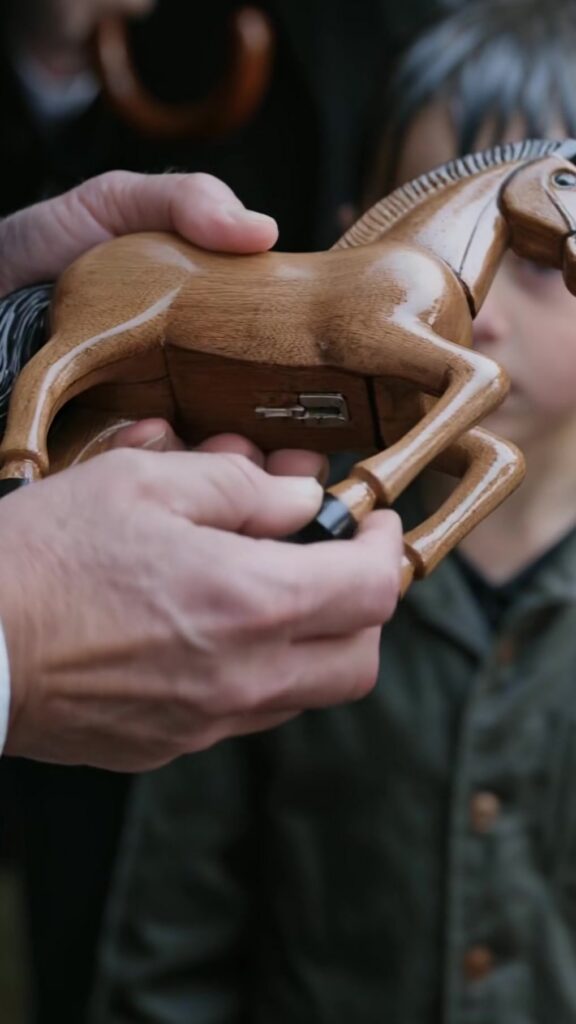
Up close, it was clearly handmade. The wood grain ran along the neck like tendons. One ear had been sanded smooth by years of touch. The char marks were uneven, not from age but from fire—an accident or an attempt.
The priest turned it over.
Something in him changed. Not fear, exactly. Recognition, as if the object had spoken a name he hadn’t heard in decades.
There, hidden under the belly, was a small brass catch, dulled by soot. A latch—precise, deliberate, too fine for a child’s toy.
Elena made a sound that didn’t belong in a church. Her fingers gripped the edge of her veil so hard the lace bunched in her fist. She stared at the latch as though it were a gun pointed at her chest.
“Father?” someone asked, impatience creeping into the sanctity. “What is it?”
The priest’s eyes lifted slowly to Elena’s face. His voice dropped, and yet it carried, because silence leaned toward it. “This is the horse that was meant to be buried.”
Elena’s lips parted. No words came out, only air.
Cal blinked through rain. “It was in the fire,” he said quickly, as if that explained everything. “Our room burned. Mama tried to save it. She said it mattered more than the blanket. She—” His voice caught. “She didn’t get out.”
A ripple of shock moved through the crowd. The Hawthornes were not known for charity. The papers had called the fire in the riverside tenement a tragedy, brief and forgettable, a footnote beneath the stock market report.
The priest held the toy horse as if it weighed as much as the coffin. “Cal,” he asked softly, “who told your mother to keep this?”
Cal glanced at the polished lid, then at Elena, and his brow furrowed as though the answer was suddenly dangerous. “Mr. Hawthorne,” he said. “He came at night. Not in his fancy car. He wore a cap like he was someone else. He cried when he saw Mama. He said he was sorry for leaving.”
Elena’s shoulders stiffened. “That’s enough,” she snapped. “He’s lying.”
But her voice had no authority left in it. Only panic.
The priest’s thumb brushed the latch. He did not open it yet. “The undertaker told me there was an unusual request,” he said, not taking his eyes from Elena. “A private item placed with the deceased. I assumed it was something sentimental.” He swallowed. “But when I asked you, you said there was nothing. You said he took nothing from childhood with him.”
Elena’s gaze darted to the men in suits—board members, attorneys, the ones who would rewrite reality if it protected their interests. Her mouth moved, forming excuses before she chose one. “It’s just a toy,” she said, but the words were brittle. “A burned toy from a gutter child.”
Cal’s eyes widened with hurt, then narrowed with a kind of fierce dignity. “He wasn’t just a toy,” Cal whispered. “Mama said he was proof.”
“Proof of what?” the priest asked.
Cal’s hands twisted together. “That Mr. Hawthorne wasn’t who everyone thought. That he tried to do something good at the end. That he had a son.”
The courtyard seemed to tilt. A woman’s hand flew to her mouth. Someone’s umbrella slipped, rain splashing their collar unnoticed.
Elena’s breath hitched. “Don’t,” she pleaded—not to Cal, not to the priest, but to the world itself. Her eyes shone now, not with mourning, but with the terror of being seen.
The priest finally opened the latch.
It gave with a small click, the sound of a lock surrendering. The belly of the horse split along a seam. Inside, wrapped in oilcloth to protect it from time and flame, was a folded paper and a tiny metal key. The priest eased them out as though extracting a heart.
He unfolded the paper. His eyes scanned, then froze. The old man’s throat worked as if the words had turned to stones inside him.
“This,” he said, voice hoarse, “is a letter witnessed and sealed.” He lifted the page slightly to show the signature at the bottom—Gideon Hawthorne, written in a hand that had fought its own tremor. “It names Cal Mercer as his child. And it names the woman in that tenement as his wife in the eyes of God.”
Elena’s knees buckled. A man reached out, too late, as she caught herself on the edge of the coffin. The gold crucifix rattled softly under her touch.
The priest continued, each word a nail in wet wood. “It states that the fire at the riverside building was not an accident.”
Cal’s face drained. “He said someone would try to burn it,” Cal whispered. “He said they’d rather burn people than let them live with the truth.”
All eyes turned to Elena. Her veil clung to her cheek, soaked through now. She shook her head, tears finally spilling, but they did not soften her expression; they sharpened it into something desperate and cornered.
“He was sick,” she said. “He was confused.” She looked around wildly. “You all know how ill he was.”
A lawyer cleared his throat. “Father, perhaps this is not the place—”
“It is exactly the place,” the priest said, and his gentleness was gone. “We stand over a man who tried to bury his final repentance inside a child’s toy because he did not trust the people closest to him.” He held up the small key. “This opens a safe deposit box. He wrote that the evidence is there—financial records, names, payments made to keep certain tragedies quiet.”
Cal stared at the coffin, rain on his lashes like beads of glass. “He promised me,” he said, so quietly it almost vanished, “that Mama wouldn’t be forgotten.”
Elena’s fingers slid off the coffin lid as if the wood had turned to ice. Her voice shrank to a whisper, meant for no one and everyone. “I didn’t mean for it to go that far.”
The confession hung in the damp air, heavier than the bells that would soon ring.
The priest stepped toward Cal, placing one hand on the boy’s shoulder. “You have done what your mother asked,” he said. “And what your father could not.”
Cal didn’t look comforted. He looked older, as if the truth had added years to his spine. He watched Elena, not with triumph, but with a child’s bewilderment at how adults could build mansions on top of ashes.
The rain continued its steady tapping. The lilies bowed under water’s weight. And beside the coffin, the burned horse lay open, its hidden compartment exposed, like a small, ruined creature that had carried the truth through fire and finally, at the edge of a grave, let it breathe.