The bell above the bakery door had a confident little chime, like it had never known a day without customers. Inside, heat rolled off the ovens and the glass display cases glowed with orderly abundance—cranberry scones set like jewels, butter-gold croissants, cakes iced so smooth they looked poured. Winter pressed its pale face against the windows, but the bakery wore light like a coat, bright and clean.
Marin Lark moved between the register and the back counter with the measured speed of a woman whose life had been arranged and polished into place. Her apron was tied in a crisp bow; her dark hair was pinned with a silver clip that matched the brand-new sign outside: LARK PATISSERIE. It was her name on the glass, her reputation in the air, her rules behind the counter.
When the line thinned, she let herself breathe. She watched a couple in wool coats consult over macarons, watched a man with cologne and a briefcase tap his card impatiently. She watched, too, the way the staff kept glancing toward the door as if something outside was tugging their sleeves.
“What is it?” Marin asked, not unkindly, but with an edge born of long hours and tight margins.
Inez, her newest assistant, nodded toward the front window. “There’s a kid out there,” she murmured. “She’s been standing for a while.”
Marin followed the direction of her gaze.
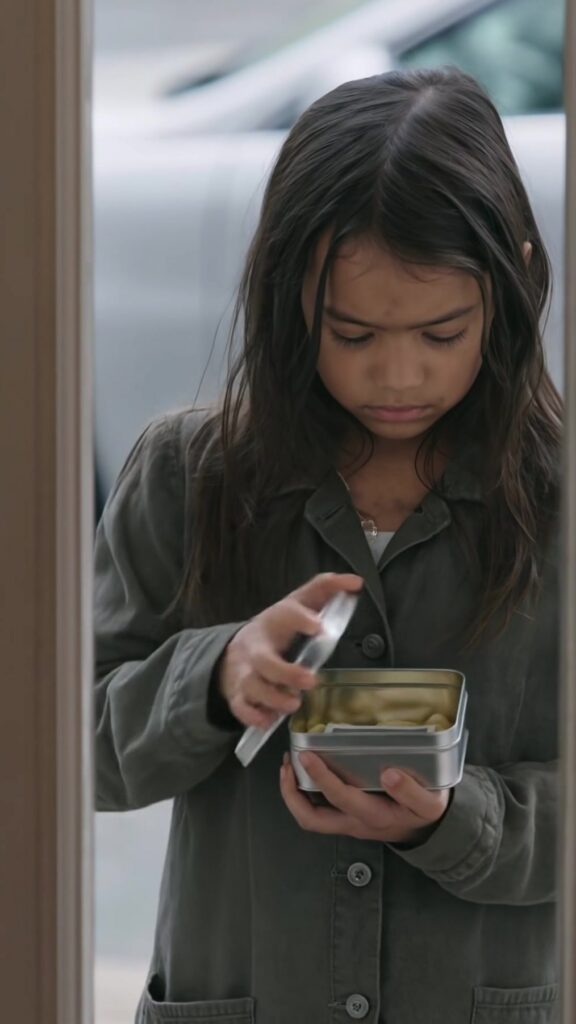
Outside, in the slab of cold between the lamppost and the bakery’s warm rectangle of light, a little girl stood perfectly still. She couldn’t have been more than eight or nine. Her hair looked as if it had been combed and then abandoned to rain; a cardigan hung off her shoulders like a borrowed idea of clothing. She hugged a round metal tin to her chest with both arms, as if the thing inside might break if she loosened her grip.
Marin’s stomach tightened with a familiar annoyance. The neighborhood had changed; so had the foot traffic. Ever since the shelter down the street started turning people away at night, Marin had been asked—sometimes politely, sometimes not—for loaves, for leftovers, for mercy. She gave when she could. But she didn’t like scenes. She didn’t like sob stories at her door. She had built this place with a loan that ate her sleep and hands that still ached in the mornings.
“We can’t,” Marin said quietly, before the child even touched the handle. “No free food. Not today.”
Inez’s mouth opened as if to argue. She shut it again.
The little girl lifted her head, and for a moment Marin thought she might come in anyway. But the child stayed outside, fingers whitening around the tin’s rim. She seemed to read the warmth through the glass like a book she wasn’t allowed to open.
Then she raised her free hand and knocked once, gently, like she didn’t want to disturb the air.
Marin could have ignored it. She almost did. But the bakery had gone quiet in the way crowded rooms do when they sense something about to happen. The couple at the macarons paused. The man with the briefcase turned his head.
Marin sighed, wiped her hands on her apron, and went to the door.
When she pulled it open, the cold rushed in, sharp as a reprimand. The child didn’t step over the threshold. She stayed planted on the sidewalk, as if a rule had been written there.
“I’m sorry,” Marin said, keeping her voice firm. “We don’t—”
“I didn’t come for food,” the girl said, so fast it sounded rehearsed. Her voice was small, but it didn’t tremble. “I came because… because you’re Marin.”
Marin blinked. “Who told you my name?”
The girl’s gaze flicked briefly to the sign. Then back up, as if embarrassed by how obvious that was. She swallowed and lifted the tin. It was a cookie tin, the kind sold around holidays, but old enough that the painted picture had faded—someone’s idea of cheerful snowmen softened by years.
“I need you to look,” the girl said. “Please.”
Marin hesitated. There were a hundred reasons to refuse. There was also something in the child’s eyes that did not belong to begging. It looked like purpose, like the kind of patience adults wear when they’re waiting for a verdict.
“All right,” Marin said, and held out her hands.
The tin was lighter than she expected, but it vibrated with the child’s grip, as if the girl had been holding herself together through it. Marin slipped her thumb under the lid. The metal gave with a soft sigh.
Inside, cushioned by a scrap of cloth that might once have been a handkerchief, lay half of a pendant shaped like a small, imperfect heart. The break down the center was jagged, as if the metal had been snapped in haste. Beside it was a photograph, worn at the edges, its glossy surface dulled by too many fingers and too much weather.
Marin’s breath stopped.
She knew the pendant not by sight, but by absence. She knew it like a missing tooth in the mouth of her memory.
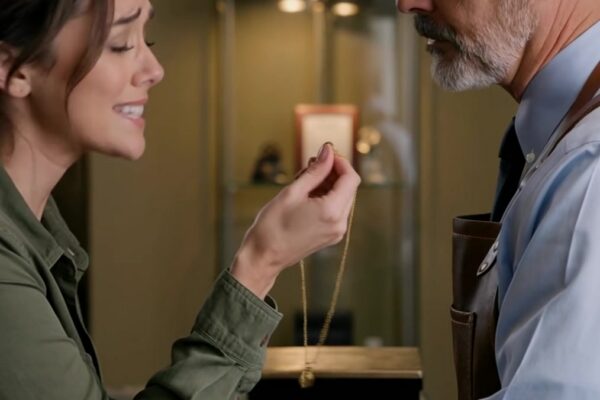
Her hand rose to her collarbone on instinct, fingers slipping beneath the thin chain she wore under her blouse. She hadn’t thought about it in years, not directly, not without the careful detours she’d built around that part of her life. But her skin remembered. The chain was there. And there, resting against her chest like a secret she never stopped touching, was the other half of a heart.
Marin drew it out with shaking fingers. The broken edge matched the piece in the tin so precisely it looked as if the two halves were straining to close the gap between them.
The bakery behind her went utterly still.
“Where did you get this?” Marin asked. Her voice came out raw, a whisper that scraped.
The girl raised the photograph. Marin saw, in the faded image, a baby wrapped in a blanket, eyes squeezed shut, mouth open in a yawn or a cry. A woman’s hand was visible in the corner, touching the baby’s cheek. On the back of the photo, Marin knew without turning it, there had once been handwriting—names, dates, hope.
Marin’s vision blurred. She gripped the doorframe with one hand and the tin with the other, afraid her knees would unlock in front of everyone.
“That belonged to my baby,” she heard herself say, and the words sounded like a confession, like an old wound being reopened by light.
The girl nodded once, as if confirming a fact. “I was told to find you.”
“By who?” Marin demanded. “Who are you?”
The child’s shoulders lifted, a tiny flinch against the cold. “My name is Junie,” she said. “I live at the St. Brigid’s rooms. The lady there—Mrs. Kline—she keeps old things in a box. She said I could have the tin when I helped clean. She didn’t know what it was until I opened it.”
Marin’s mind raced with names she hadn’t said in years. St. Brigid’s had been a home once, a “temporary residence” for women who had nowhere else to be. Marin had been there when she was twenty, when the world had narrowed to a single choice made under pressure and fear. She had left with nothing but a chain around her neck and a heart she refused to look at too closely.
“Mrs. Kline,” Marin repeated, tasting the name like something she’d swallowed long ago. “She’s still alive?”
Junie nodded. “She said you’d understand.” The child hesitated, then added, “She said you might be angry. But she said you’d want to know. Because the picture…”
“Because the picture is me,” Marin whispered, and it wasn’t a question. Her hand in the corner of the photo—the curve of the ring she used to wear, the way her thumb bent when she touched someone gently—was unmistakable. Marin’s throat tightened until she could barely breathe.
Junie’s eyes flicked to the pendant Marin held. “You kept it,” she said, wonder threading through her voice. “She said you might not have.”
“I couldn’t throw it away,” Marin said. She didn’t say: I tried. She didn’t say: I thought losing the rest of the story would make the ending bearable.
Behind her, Inez made a small sound. “Marin?” she asked, as if Marin were standing at the edge of something and could be called back.
Marin didn’t look away from Junie. “Mrs. Kline gave you this tin?”
“She didn’t give it,” Junie said carefully. “She forgot it was there. She forgets things. But when I showed her, she cried. She said the heart was meant to be kept together. She said one piece was given away.” Junie’s voice dropped. “She said it was for someone who had to leave fast.”
Marin closed her fingers around her half of the pendant until the metal pressed into her palm. “Did she say who the other piece was given to?”
Junie shook her head. “Only that it was tied to a baby.” She drew a breath, and for the first time her rehearsed steadiness cracked. “I thought maybe it was about me. But the picture isn’t me. I’m not the baby.”
Marin stared at her. The child’s face, now that Marin really looked, held no obvious resemblance. Different nose. Different shape of mouth. But something in the eyes—the set of them, the seriousness—hit Marin with a force that made her sway.
Not resemblance, her mind whispered. Echo.
Junie continued, words spilling out as if she’d been holding them too long. “I don’t have anyone. Not really. I thought if I brought it here, maybe… maybe it’s a clue. Maybe you’d know where the baby went. Maybe you could tell me why someone would break a heart and put it in a tin like cookies.”
Marin’s chest hurt. She looked past Junie into the street, where snow was beginning to fall in small, indecisive flakes. The world looked suddenly unreal, like a set built around this moment.
She remembered the night she’d left St. Brigid’s, the wind tearing at her coat, her hands shaking so violently she could barely fasten the necklace. She remembered tearing the pendant in two, not because she wanted to destroy it, but because she needed proof that something had been real, something had been hers. She had kept half like a punishment, like a promise.
But she hadn’t known the other half would become a breadcrumb trail for a child who wasn’t even her child—unless, some wild part of her argued, unless life had looped back in a way Marin had never dared imagine.
Marin lifted her eyes to Junie again. “You’re freezing,” she said, the words coming out softer than anything she’d said all day.
Junie tightened her hold on the tin as if expecting it to be taken away. “I’m okay.”
“No,” Marin said, and stepped aside, holding the door wide. The bakery’s warmth rushed out like an offering. “Come in.”
Junie hesitated at the threshold, looking at the polished floor, the shining cases, the customers who were suddenly pretending not to stare. Marin saw the child’s pride wrestling her need, saw the fear of being pushed out the moment she stepped in.
Marin crouched so they were at eye level. “Not for food,” Marin said, choosing each word with care. “For answers. For… for what’s in that tin. For what’s been broken.”
Junie’s eyes shone, not yet with tears, but with the strain of keeping them back. She nodded once and took a step into the light.
The bell chimed overhead, bright and ordinary, as if it didn’t understand what it had just welcomed inside.