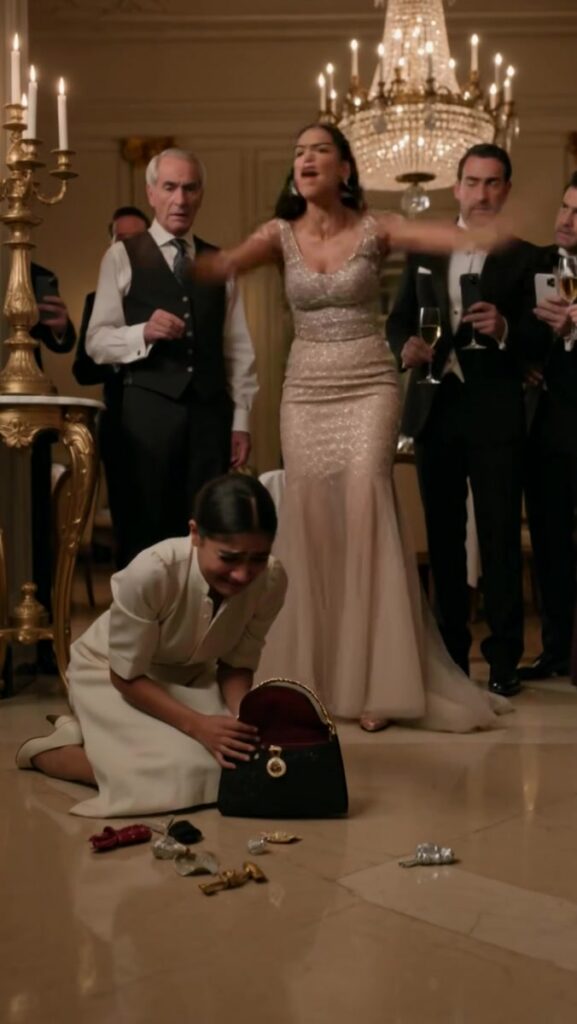
The handbag split at the seam with a sound too small for the violence it caused, and everything inside it scattered across the marble as if the floor had been waiting to claim it. A tube of lipstick rolled under a table leg. Coins chimed and spun. A creased bus ticket skated through a puddle of light and stopped beside a pair of patent shoes. A cracked wallet fell open like a tired mouth. A tiny bottle of hand cream bounced once and came to rest near the waiter’s station. And then a photograph—creased at the corners, kept too close to skin—fluttered down in the slow, humiliating way paper has when it knows it is being watched.
The dining room of Le Cygne d’Or had been built for reverence: chandeliers like frozen waterfalls, mirrored walls that doubled every gold detail, a ceiling painted with cherubs no one looked up at anymore. It was a room designed to make the poor feel temporary. When the young waitress dropped to her knees, the air changed. Conversations clipped off mid-syllable. Forks paused half-lifted. Faces tilted toward her with the careful interest people reserve for accidents that don’t involve them.
“Enough of this theater,” snapped the woman in the glittering gown, her voice sharp as the crystal on the tables. She stood over the waitress with the certainty of someone used to being obeyed. Diamonds at her throat flashed each time she moved, as if the light itself wanted to defend her. “You think you can slide through my evening with those hungry eyes and those quick hands? Show them. Show them where you tucked my necklace.”
The waitress—Mireille, though no one ever bothered to use her name loudly—shook so hard her hair came loose from its pin. Her cheeks were wet before she realized she was crying. “Madame, I didn’t—” Her words crumbled. She reached for the coins first, because coins were loud, and maybe if she could make the room hear something ordinary, it would remember she was human. But the room didn’t want ordinary. Several phones rose in the candlelight, polished glass reflecting her on the floor like a second humiliation. No one stood. No one asked what happened. The silence in Paris could be as cruel as shouting.
“Look at her,” the woman said, tipping her chin so her perfume and contempt drifted down together. “These girls come in from the edges of the city thinking they can take pieces of us. She’s here to steal from people she’ll never be.” Her laugh was short and confident. “Search her bag. Let everyone see.”
Mireille’s fingers closed around her wallet to tuck it away, and the photograph flashed again in her mind—her mother in a plain coat, smiling too hard in a doorway that looked nothing like their apartment. A man’s shadow behind her, the hint of a chandelier, a hand on her shoulder. Mireille had carried that photo for two years, ever since the funeral, ever since the whispered instructions that had come with the last of her mother’s things: When you’re ready, go there. She had come to Le Cygne d’Or to earn a wage, yes, but also to stand in the building where the photo had been taken, to feel if any memory would rise up through the stones.
As she tried to shove the wallet shut, something small and metallic slipped from the inner tear in the lining and dropped to the marble. It did not ring like a coin. It landed with a dull, final sound, then spun once under the chandeliers, catching the light with an old, exhausted gleam. It slid, slow and certain, across the floor and stopped at the toe of an elderly man’s shoe—polished, but not fashionable, the kind of shine that came from duty rather than vanity.
The maître d’ had been standing at a respectful distance, a silhouette shaped by decades of keeping other people comfortable. His name was Étienne, though the staff called him Monsieur Étienne as if the extra word could protect them. He looked down, and the practiced mask fell away. The color seemed to drain from his face in a single breath. He bent with the stiffness of age and picked up the object between trembling fingers.
It was a key. Brass, heavy, worn smooth at the teeth from years of turning in a lock that resisted and relented. A small engraving ran along its bow—two interlocked letters—almost erased by time. Étienne stared at it as if it had crawled out of a grave. The room waited, hungry now. Even the woman in the gown quieted, sensing a shift she hadn’t ordered.
“That key,” Étienne said, and his voice did not carry like an announcement. It moved like a confession. “I have not seen it in twenty years.” He held it up, and the chandeliers made it look briefly regal, as if it belonged to the building itself. “It opens the private suite upstairs. The one sealed the night Monsieur Delacourt’s first fiancée vanished.”
The name struck the dining room like a thrown glass. People who had been recording lowered their phones without meaning to. A soft, collective intake moved through the tables. The glittering woman’s lips parted; her throat worked as if trying to swallow a sudden taste of ash. Mireille stared up from the floor, her tears slowing, her fear changing shape.
“My mother kept it hidden,” Mireille said, and she hated how small her voice sounded in that vast room. She pushed herself upright on her knees and looked directly at the woman looming over her. “She said it was given to her by a man who swore he was protecting someone. She never told me his name. But she died with that key in her hand.” Her gaze did not flicker. “Why did your husband leave it to my mother?”
The glittering woman—Madame Delacourt—stood utterly still, as if movement would crack her. Her fingers went to her necklace instinctively, and for the first time everyone noticed that it sat too perfectly, as if it had been adjusted in a hurry. Étienne’s eyes moved from Mireille to Madame Delacourt with the weary sorrow of a man watching a storm return to a coastline he has rebuilt too many times.
“Because,” he said, and the word sounded like the opening of a door that had been bolted from the inside, “there was a night when the suite was not sealed to protect the public from scandal. It was sealed to keep the truth from escaping.” He turned the key in his palm, and the brass looked suddenly like evidence. “And because your mother did not receive it as a gift. She received it as a warning.”
Madame Delacourt’s eyes flashed, then went glassy. “You don’t know what you’re saying,” she whispered, but she was no longer speaking to Mireille. She was speaking to the room, to the cameras that might still be live, to the mirrored walls that remembered. “This is ridiculous.”
Mireille reached for the photograph on the floor, but another hand got there first—Étienne’s. He lifted it carefully, as if the paper could cut. His breath hitched when he saw it. The photo showed a young woman with Mireille’s eyes and a man with a familiar profile, standing in the doorway of a suite beneath a chandelier. Behind them, half in shadow, a third figure blurred—tall, in a gown that caught the light. Madame Delacourt’s gown. Or one identical to it.
Étienne looked up, and when he spoke again, it was no longer the voice of a man managing a dining room. It was the voice of someone who had carried a secret like a stone in his stomach for decades. “Mademoiselle,” he said to Mireille, “if you turn that key tonight, you will not only open a suite. You will open a story this city has paid to forget.” His gaze settled on Madame Delacourt with a terrible calm. “And some of us will finally learn who locked the door.”
In the stunned quiet, Mireille rose unsteadily to her feet. Her knees hurt from the marble. Her palms smelled like metal and spilled perfume. Around her, the guests stared as if she had transformed from a servant into a threat. Madame Delacourt’s face tightened into a smile that was more like a wound. Somewhere in the back of the room, a glass clinked against a plate—an accidental sound that felt like a countdown.
Étienne extended the key toward Mireille, and for a moment she hesitated, hearing her mother’s last cough, feeling the weight of words that had never been said. Then she took it. The brass was warm from his hand, and impossibly heavy with what it promised. She looked once more at the scattered contents of her torn bag—lipstick, coins, ticket, hand cream, wallet—and understood with a clarity that made her dizzy: the woman had wanted to drag her life into the open to prove she was nothing. Instead, the floor had spilled a question powerful enough to crack the gilding off the entire room.
“Upstairs,” Étienne said softly. “Before anyone can stop us.” And as Mireille stepped toward the staircase, she heard Madame Delacourt inhale sharply—one terrible second where it seemed the woman’s lungs had forgotten how to work—followed by the scrape of a chair and the rustle of expensive fabric, the sound of someone deciding whether to flee or follow the truth into a locked room.