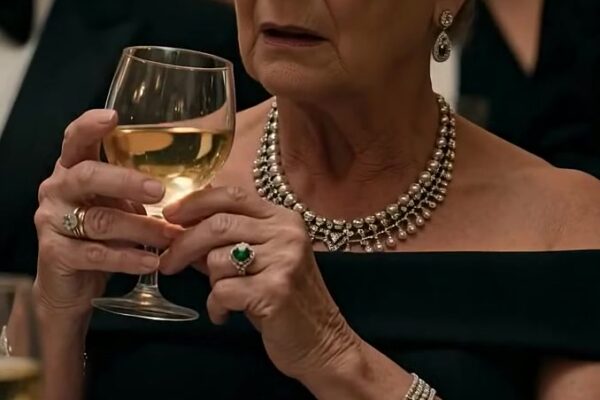
The entire restaurant fell silent the moment the old man stood up. It wasn’t the kind of silence that came from politeness, the soft hush that followed a toast. It was a sudden, stunned emptiness—as if the chandeliers had stopped humming, as if the clink of cutlery had been cut cleanly from the air. Even the pianist, halfway through a familiar standard, let his hands hover above the keys, uncertain whether he’d imagined the shift.
The room was a cathedral of wealth: marble that held the light like water, gold-leaf molding, a forest of crystal above. Yet when Henri Delacroix rose from his chair near the window, the place chilled. He was old enough that his movements usually invited patience. Tonight, he moved with a dangerous speed, his cane forgotten, his shoulders rigid, his eyes fixed on a pendant held high between two manicured fingers.
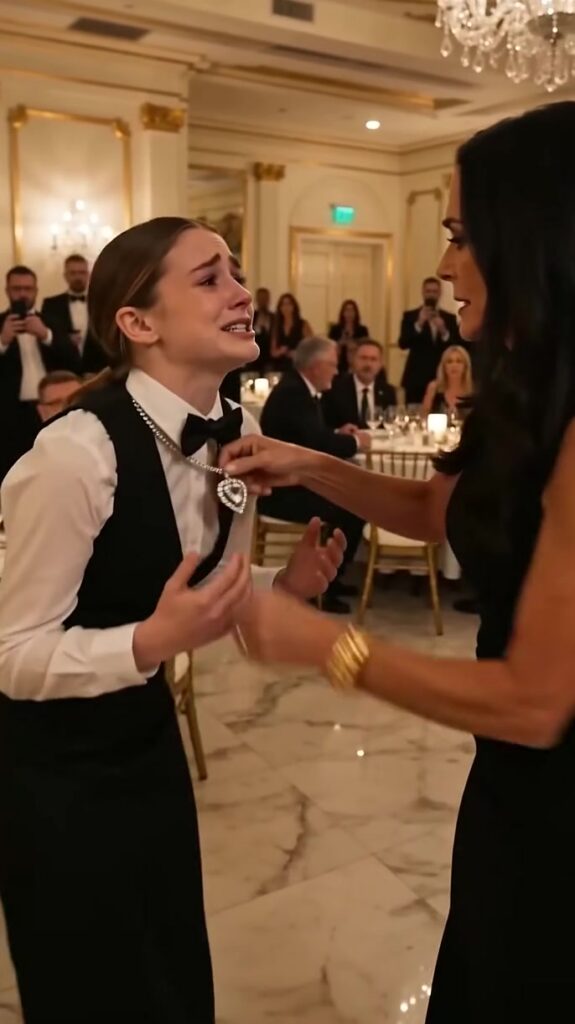
Camille Armand—black dress, diamond earrings, a laugh sharpened into a weapon—held the necklace like a verdict. “Found in her fist,” she announced, voice ringing against the lacquered walls. She did not need a microphone. She had never needed one. “Our charity auction’s centerpiece, and the girl thinks she can walk out with it.”
All eyes snapped to the waitress beside the table. She couldn’t have been more than twenty-two, her apron twisted in her hands, dark hair escaping its pins as if her own body was trying to flee. Tears streaked her face, and she braced herself on the edge of the white linen tablecloth, knuckles pale. “I didn’t—” she tried, but the words collapsed. Around her, the guests wore that particular expression the powerful reserve for the accused: disgust disguised as disappointment.
Henri stepped forward, his breath uneven. “The engraving,” he said, not loudly, but with a depth that made people lean in. “Let me see the engraving.” His gaze wasn’t on Camille. It wasn’t on the trembling girl. It was on the pendant itself, as if it were a living thing that had just spoken his name.
Camille’s smile flickered. “Mr. Delacroix, please. You don’t need to involve yourself. It’s my piece.” She lifted the necklace higher, an instinctive act of ownership. Henri reached anyway. His hand trembled so violently that a nearby guest half-rose to help him, then thought better of it. When Henri’s fingers finally brushed the pendant, he turned it over with the care of a man handling a bone found in ashes.
His lips moved around a phrase only he and one other person should have known. Not initials. Not a date. A sentence, private as a vow. His face blanched, and the room, sensing a story behind the accusation, tilted its attention away from Camille with a kind of cruel hunger. Henri’s gaze lifted from the pendant to the waitress. He stared at her eyes—their color, their shape—and something in him seemed to rupture. “My God,” he whispered. “Those eyes…”
Camille’s composure snapped into anger, brittle and loud. “This is absurd. She’s a thief. Don’t indulge her theatrics.” But Henri was no longer listening. He was somewhere else, far from the marble and the perfume, back in a Paris winter when he was young, arrogant, and surrounded by a family that measured love in bloodlines.
Twenty-three years earlier, at a charity ball that smelled of lilies and ambition, his wife Lucienne—pregnant, radiant, frightened—had vanished after a vicious argument with his mother. Henri had searched. He had shouted. He had threatened to tear down doors. And then a letter had appeared, placed neatly on his desk, claiming Lucienne had run away. The handwriting was similar enough to bruise his hope, yet wrong in small ways that made his throat close. His family told him to let her go, to protect the Delacroix name from scandal. And because he had been taught obedience as devotion, he had hesitated just long enough for the world to swallow her whole.
Now, with the pendant in his palm, hesitation died. The waitress found her voice, thin as thread. “My mother said… if someone ever recognized it… I should ask why he never came back for us.” Her gaze darted between Henri and the necklace as if both could strike her. “She said the night she disappeared, she was already carrying your child.” A murmur rippled through the tables. A glass slipped from someone’s hand and shattered, the sound cruelly bright in the silence.
Camille’s face drained, then hardened again. “Lies,” she snapped. But it came out too quickly, too sharp, like a door slammed on an inconvenient room. Henri’s eyes didn’t leave the girl. He opened the pendant’s clasp with shaking fingers, and the motion revealed something he had not expected: behind the clasp, tucked where only a maker’s thumb might ever rest, a second line had been etched. Newer. Deeper. As if carved in anger.
He read the first word and went still, his horror not theatrical but physical—his chest tightening, his mouth parting as if his body could not decide between breath and prayer. The word was not a declaration of love. It was a warning. “RUN.”
The waitress made a small sound, something between a sob and a gasp. “My mother never told me about that part,” she whispered. “She only said the necklace was proof. Proof she wasn’t… making it up.” She swallowed. “She died last year. She begged me to keep it hidden unless I had no other choice.”
Henri looked up, and for the first time, he saw Camille as more than a patron of his foundation, more than a glamorous donor who arrived with photographers and left with applause. He saw her now as a knot in the same rope that had dragged Lucienne away. His eyes slid to Camille’s wrist, where a familiar signet ring flashed—an old Delacroix crest, the one his mother had always worn when she wanted to remind everyone what power looked like.
Henri’s voice came out rough. “Where did you get that ring?”
Camille’s fingers tightened around the air. “It was given to me,” she said. “By someone who believed in me.”
“By my mother,” Henri corrected, and a low, collective intake of breath moved across the room like wind through reeds. The pianist, forgetting his hands, pressed a single key by accident; the note hung, lonely and accusing. Henri’s mind arranged memories like evidence: his mother’s sudden “illness” after the ball, her insistence on handling all correspondence, the way she’d insisted Lucienne was unstable, ungrateful, disloyal. Camille had been there back then, younger, less polished, always hovering near the family as if waiting to be invited in.
The waitress—no, not waitress, not anymore, not in Henri’s mind—took a trembling step forward. “My name is Elodie,” she said, as if naming herself could anchor her. “I came here because I saw the foundation’s scholarship list. Delacroix. I thought… maybe it meant nothing. Maybe it was coincidence.” Her voice broke. “I didn’t come to steal. I was holding it because she—” She pointed at Camille. “She grabbed my wrist and called me trash and said she’d show everyone what happens when girls like me try to touch what isn’t theirs.”
Camille lifted her chin, but her eyes darted. “You’re manipulating them,” she hissed, and for the first time her polished accent cracked, revealing something raw beneath. “You think a sob story will—”
Henri raised his hand. Not a shout. Not a plea. A command. The kind of gesture that had once bent boardrooms. “Call the police,” he said to the maître d’. Then, without looking away from Camille, “And call my attorney. And—” his voice thickened “—my mother’s nurse.”
Camille’s laugh attempted to return, but it was ragged. “On what grounds?” she demanded, too loudly. “For a necklace? For a childish fantasy?”
Henri held the pendant up so the nearest guests could see the etched warning. “This isn’t about jewelry,” he said. “This is about a woman who vanished while carrying my child. A letter I never believed. A warning carved where only desperation would place it.” He turned to Elodie, and the softness in his next words made the room ache. “Your mother tried to tell me. She left me a map and I let my family burn it.”
Elodie’s shoulders shook, and she looked as if she hated him for that confession and needed it at the same time. “So what now?” she asked, a challenge trembling inside the question.
Henri looked around at the tables, at the witnesses, at the world that had watched and done nothing for too long. Then he looked back at her. “Now,” he said, voice steadying as if the warning had become a vow, “we find out who carved ‘RUN.’ We find out who made her disappear. And this time, I don’t hesitate.”