At first, the man thought he was hearing things.
The storm had turned the neighborhood into a tunnel of noise—rain striking the pavement like thrown gravel, wind dragging branches across fences, the old streetlights trembling in their halos. He had killed the motorcycle a block away because the engine felt too loud for the hour, and now he jogged up the driveway with his helmet dangling from his fingers, boots slapping puddles that had become shallow pools. The house ahead looked normal: porch light on, curtains drawn, a warm rectangle of life behind glass.
Then it came again, thin as a whistle pushed through a crack.
“Dad—!”
He stopped so abruptly his breath punched out. The sound had to be the wind, or a television left on too loud, or his own brain still buzzing from the ride home. He told himself that as he squinted through the rain. The yard was a black blur. The porch steps shone slick. The sliding door at the back of the house glimmered faintly, and movement flickered there like a shadow in a fish tank.
Another cry—this one raw, pitched high with the kind of fear that doesn’t practice.
“Daddy!”
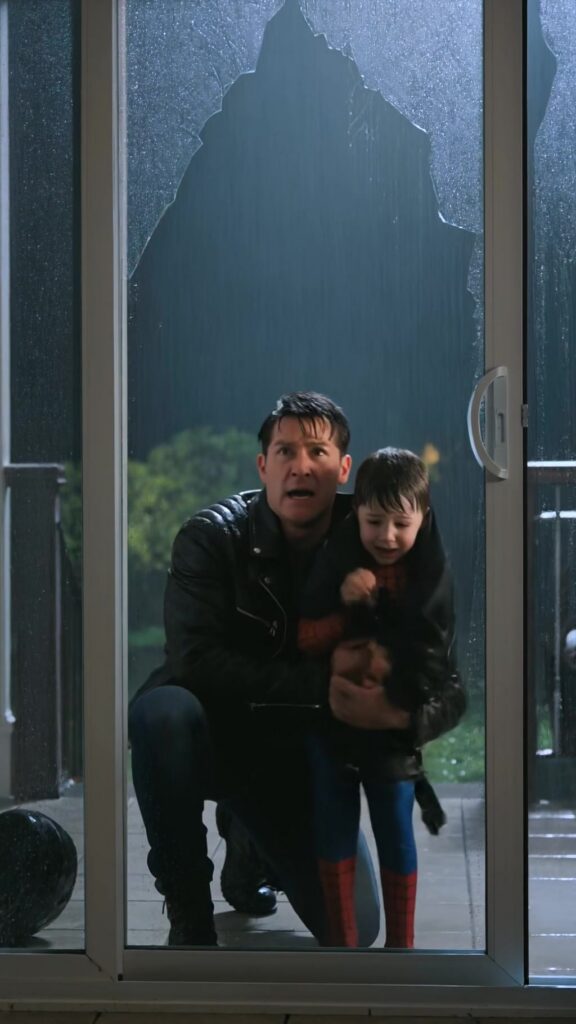
His heart seemed to snag on a rib. He ran around the side, past the trash bins rocking in the wind. Lightning briefly sketched the deck rails in white. And there, outside the sliding glass door, stood his son.
Caleb was five and small for his age, usually all knees and questions. Tonight he was a soaked, shivering bundle in a Spider-Man costume, mask shoved up over his head so his hair plastered to his forehead. He pressed both hands to the glass and beat at it in short frantic taps, like a bird against a window. His lips were bluish. His eyes were huge.
For a second Mark couldn’t move. The scene made no sense, so his mind tried to refuse it, the way it refuses a nightmare. Warm light washed the kitchen behind the glass. A pot sat on the counter. A bowl of fruit. A half-empty wineglass. Someone had been in there, recently, comfortably.
Mark yanked at the handle. Locked.
“Buddy—oh God—” His voice broke. He dropped to his knees on the wet deck boards, ignoring the water that instantly soaked through his jeans. He shrugged off his leather jacket with shaking hands and wrapped it around Caleb’s shoulders, pulling him close. The boy’s body trembled hard, like a motor stuck at full throttle. His tiny fingers clamped onto Mark’s shirt as if the fabric was the only solid thing in the world.
“I’m here,” Mark whispered, pressing his cheek to the boy’s cold hair. “I’ve got you. I’ve got you.”
Caleb tried to speak but his teeth chattered too hard. Mark glanced at the door again, at the lock, at the glow inside. He listened. Faint music—something upbeat, something that belonged in a clean kitchen with a bottle of white wine. Laughter, low and private, drifting from upstairs.
Mark’s fear drained out and left something sharper in its place. It didn’t flare; it settled, heavy and clear, like ice forming in a glass.
He lifted Caleb and carried him to the small covered corner of the porch where the rain hit less hard. He set him down on the doormat and crouched so their eyes were level. “Stay right here,” he said, making his voice steady with effort. “Don’t move. I’m going to open the door.”
Caleb nodded once, eyes fixed on his father’s face as if memorizing it. His shoulders hunched under the oversized jacket.
Mark stood. His hands were still trembling, but now they trembled with direction. He stepped to the glass, braced his foot, and kicked.
The first impact spiderwebbed the pane; the second drove it inward. Glass burst and scattered, singing across the tile floor. Rain gusted into the house, carrying the smell of wet leaves and asphalt. Mark stepped through as if he’d been born in storms.
The kitchen was warm enough to make his wet clothes steam. A playlist chirped from a speaker on the counter. On the table sat two plates with the remains of something rich and buttery. A folded napkin. A lipstick print on a rim. The normality of it made his jaw clench until it ached.
He moved fast, barefoot shards crunching under his boots, water dripping from his hair onto the hardwood as he crossed the living room. He took the stairs two at a time. The laughter upstairs faltered, then stopped, replaced by hurried whispers.
The bedroom door at the end of the hall was half closed, light spilling through the gap. Mark didn’t knock. He kicked it open hard enough that it rebounded against the wall.
Rachel sat upright in bed, sheet yanked to her chest. Her hair was tousled, cheeks flushed, eyes wide with the panic of someone caught in the exact act they’d convinced themselves they’d never be caught in. Beside her, a man Mark recognized from the hardware store—a smiling, harmless face that had once helped Mark load lumber into the truck—froze with his hands half-raised, as if surrender could undo time.
Mark stood in the doorway, rainwater still falling from his sleeves, his expression so controlled it felt dangerous. “He was outside,” he said quietly. “In this weather.”
Rachel swallowed. “Mark, I—”
“He was locked out,” Mark corrected, each word precise. His gaze stayed on her. “Don’t tell me it was a mistake.”
The other man’s mouth opened and closed. “Listen—”
Mark lifted a hand without looking at him. “Not you.”
From downstairs came a small sound—Caleb’s voice, carrying through the broken door and the storm, loud only because the house had gone so still.
“Dad?”
Mark’s throat tightened. He turned his head toward the hall as if he could see through floors. “I’m here, buddy,” he called, and then, because Caleb was a child and honesty was his native language, the boy added something else, something that fell into the house like a dropped plate.
“Mom said I had to wait until you were gone.”
Silence snapped into place. Even the music downstairs seemed suddenly obscene, as if it hadn’t gotten the memo that the world had changed.
Rachel’s face drained. “Caleb doesn’t understand—” she began, voice thin.
Mark took one step into the room. “He understands exactly what he felt,” he said, and the cold in him made his words sound almost calm. “He was scared, and he was cold, and he was alone. And you were here.”
Rachel’s eyes darted to the man beside her, to Mark, to the door. “I didn’t think you’d come back tonight,” she whispered, and the confession, small and unguarded, was worse than any excuse.
Mark nodded once, as if filing it away. “So you planned for my absence,” he said. “You planned for a storm and a locked door.”
The man in the bed stammered, “It’s not—she said you two were—”
Mark looked at him then, finally, and the hardware-store friendliness collapsed under the weight of Mark’s stare. “Get dressed,” Mark said. “Now. And leave through the front. If you step near my son, I will forget every rule I’ve ever lived by.”
The man scrambled for his clothes like a boy caught stealing. Rachel made a broken sound, half protest, half plea. Mark didn’t answer it. He left the doorway, not because he was finished, but because there was something more important than rage.
He went down the stairs, the wet prints of his boots stamping a path. The broken glass glittered on the kitchen tiles like ice. Caleb stood exactly where Mark had told him to, clutching the leather jacket closed with both hands. His costume stuck to him like a second skin. He looked at the ruined door with a child’s awe and fear.
Mark knelt in front of him and checked his hands, his ears, his cheeks, rubbing warmth into them. “You did good,” he murmured. “You waited. You called. I heard you.”
Caleb’s lower lip trembled. “I thought you couldn’t,” he whispered. “It was loud.”
“I hear you,” Mark said again, and this time it was a promise that reached farther than the storm. He scooped Caleb up, holding him close, feeling the boy’s heartbeat steady against his chest. Over Caleb’s head, Mark looked up the stairs toward the bedroom, toward the life that had been happening while a child stood outside in the rain.
The wind shoved at the broken door, and cold air rolled in. Mark adjusted his grip and carried his son toward the hallway closet where the spare blankets were kept, toward warmth he would make with his own hands. Behind him, somewhere upstairs, a door creaked, footsteps hurried, and a woman began to cry.
Mark didn’t turn around. Not yet.
The storm had taken the old world away in one violent sweep, and what remained was sharper, darker, and utterly clear: Caleb’s voice had cut through the rain, and Mark had heard it. Now he would make sure no one ever chose not to again.