He rehearsed the apology at every red light, turning it over like a coin he didn’t quite trust. I’m sorry I missed the appointment. I’m sorry work ran long. I’m sorry I let your messages sit unread until the screen went dark. The roses on the passenger seat were absurdly hopeful, their petals packed tight as promises. The small box—navy velvet, modest and weighty—rested in his palm as if it could steady his nerves through sheer intention.
He pictured Emma’s face when she opened it. Not the tired smile she’d worn lately, the one that looked like it hurt to hold up, but her old smile, wide and unguarded. He could almost hear her laugh echoing through the hall of his childhood home, where his mother insisted they come for Sunday tea even after Elias moved out. “Family,” she’d say, as if the word alone were enough to make a life fit.
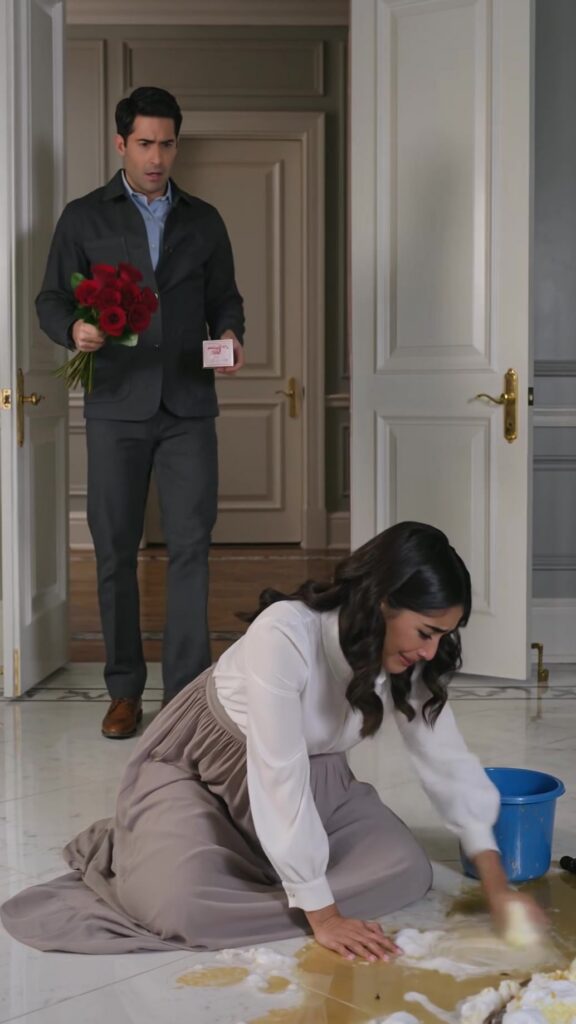
The front door swung open on air that smelled faintly of lemon polish and expensive candles. Too bright inside. Noon sunlight flooded the foyer and bled into the sitting room, turning the marble floor into a mirror. Elias stepped in, still wearing joy like a coat he hadn’t taken off. Then he saw the bucket. The collapsed cake. The streaks of white frosting dragged across stone like someone had tried to erase an accident with their bare hands. And on the floor, knees pressed to marble, hands raw and trembling, was Emma.
She was visibly pregnant now—rounded and undeniable—her dress pulled tight over her belly as if even fabric had become a constraint. Tears shone on her cheeks, dropping soundlessly into the wetness she spread with a cloth. Two maids in crisp uniforms stood near the doorway, rigid as statuary. On the sofa, in a red dress that matched the ruined cake as if by design, his mother sat with a teacup balanced in her fingers. Her posture was the same one she used at charity luncheons when she listened to donors describe tragedies from a distance.
“Hurry up, Emma,” his mother said, eyes on the saucer. “You’re so slow.”
Elias stopped so abruptly the roses slid against his wrist. For a half-second he waited for someone to laugh, to reveal a misunderstanding, a rehearsal for something tasteless. The silence answered him instead—thick, disciplined, complicit. “What is this?” he managed, and hated the thinness of his own voice in his mother’s immaculate room.
Emma looked up as if his face was a window she’d been staring at for hours in the dark. There was no anger there at first. There was something worse: the kind of hurt that comes when the person you’ve been counting on arrives and still stands in the doorway, still needs the scene explained. Elias tried to jam the moment into a harmless shape. “She’s just… cleaning,” he said, because shock makes cowards of everyone for a breath too long.
Emma’s mouth parted. The words didn’t come out right away, like they’d been tied and tightened until they could barely move. One maid glanced at the small box in his hand and then immediately lowered her gaze. Emma’s voice finally slipped free, thin as thread. “Was that for the baby?”
His grip on the velvet tightened. The box had been meant to make everything real. Inside, nestled in satin, was a tiny silver locket shaped like a crescent moon. He’d spent two lunch breaks searching for it, because Emma once said she wanted something to keep close when she felt afraid—that the baby was too quiet, that she was doing everything wrong, that she wouldn’t be a mother anyone could respect. On the back of the locket, he’d had an inscription etched so small it was almost secret: I’m here. Always.
His mother finally looked up, as if the conversation had bored her until it turned interesting. “Don’t dramatize,” she said. “She dropped the cake. It was for the garden club. Do you know how long it takes to arrange those meetings? How many people expect me to host properly? If she wants to live in this family’s orbit, she can learn basic care.” She stirred her tea once, slowly. “Besides, a little bending isn’t going to harm her. Women have done far worse for far less.”
Elias felt something in him split cleanly, like a seam that had been holding back years. He saw suddenly how many times he’d translated his mother’s cruelty into something palatable. She’s just strict. She means well. She doesn’t know how to show love. He heard, as if from a distance, all the small concessions he’d made to keep the peace, and how each one had bought his comfort with someone else’s humiliation.
He walked into the room. The roses hung limp at his side, their fragrance clashing with the sharp scent of cleanser. He crouched beside Emma, careful not to startle her, and put the velvet box into her shaking hands. “It was for you,” he said. “For both of you.” He took the cloth from her fingers as gently as he could. Her knuckles were red, the skin around her nails split. He couldn’t unsee it. He didn’t want to. He needed the image to burn.
His mother’s voice sharpened. “Elias. Don’t encourage—”
“Stop,” he said, and the word came out with a force that surprised even him. He stood, still holding the damp cloth, and faced the sofa. The room remained bright, unforgivingly bright, as if sunlight had decided to witness the truth. “This ends,” he said. “Now.”
“Don’t be ridiculous,” his mother replied, but a slight flush climbed her neck. “She’s emotional. Look at her. Always crying, always making a scene. You can’t build a stable home on instability.”
Elias looked at the maids, at their lowered eyes, at the way they’d learned not to exist when it was safer. He looked at Emma, who had stopped scrubbing and simply held the box to her chest like a life raft. He understood then that stability, the kind his mother prized, was just another word for obedience. He heard his own breath and chose his next words with a clarity he’d never had in this house.
“You don’t get to decide what my family looks like,” he said. “You don’t get to punish her for being here. And you don’t get to use my silence as permission.” He dropped the cloth into the bucket, the splash echoing in the polished room. “Emma, stand up. We’re leaving.”
His mother rose for the first time, the teacup set down with a click like a gavel. “If you walk out with her,” she said, each syllable careful, “don’t come back expecting anything. This house, the trust, the—”
“The leash,” Elias said quietly. “Call it what it is.” He swallowed, feeling the old fear claw at his ribs, the fear of being cut off, of being nobody without the scaffolding of her name. Then he looked at Emma’s wet sleeves, at the tremor in her shoulders as she tried to rise, and fear changed its shape. “I’d rather be nothing,” he said, “than be this.”
He offered Emma his hand. She hesitated, not because she doubted him, but because she had learned the cost of hope. When she finally took it, her fingers were cold. He steadied her, one arm supporting her back, and guided her toward the doorway. The maids moved aside as if relieved to have permission to breathe again.
In the foyer, Emma’s tears came harder. “I tried,” she whispered. “I tried to be… I thought if I just kept my head down—”
“I know,” Elias said, and the words tasted like regret. He held the roses out to her with a clumsy tenderness, thorny stems and all. “I should’ve been here sooner.”
She clutched them, and the petals brushed her cheek, absurdly soft against the rawness. In her other hand she held the velvet box. She opened it with trembling care, and when she saw the locket, her face crumpled into something like grief and relief braided together. She pressed it to her belly as if the metal could speak through skin.
Elias opened the front door. Outside, the sky was a hard, ordinary blue—no thunder, no cinematic omen, only a quiet afternoon waiting to be claimed. Behind them, his mother’s footsteps stopped at the threshold, unwilling to chase what she couldn’t control. Her voice followed anyway, sharp as thrown glass. “You’ll regret this.”
Elias didn’t turn. He led Emma down the steps, each one a small severing. He felt, with every footfall, the weight of what he was losing and what he was choosing. At the bottom, he paused long enough to loop his jacket around Emma’s shoulders, to shield her from nothing and everything. “Maybe,” he said, speaking not to the house but to the life ahead. “But I’d rather regret leaving than regret staying.”
They walked to the car together. The roses trembled with each step, scattering a few petals like red punctuation in the driveway. Emma’s hand found his, and held, and held. The day hadn’t been made better the way he’d planned. It had been made true. And for the first time, Elias understood that truth—bright, merciless, undeniable—was the only foundation he could build his family on.