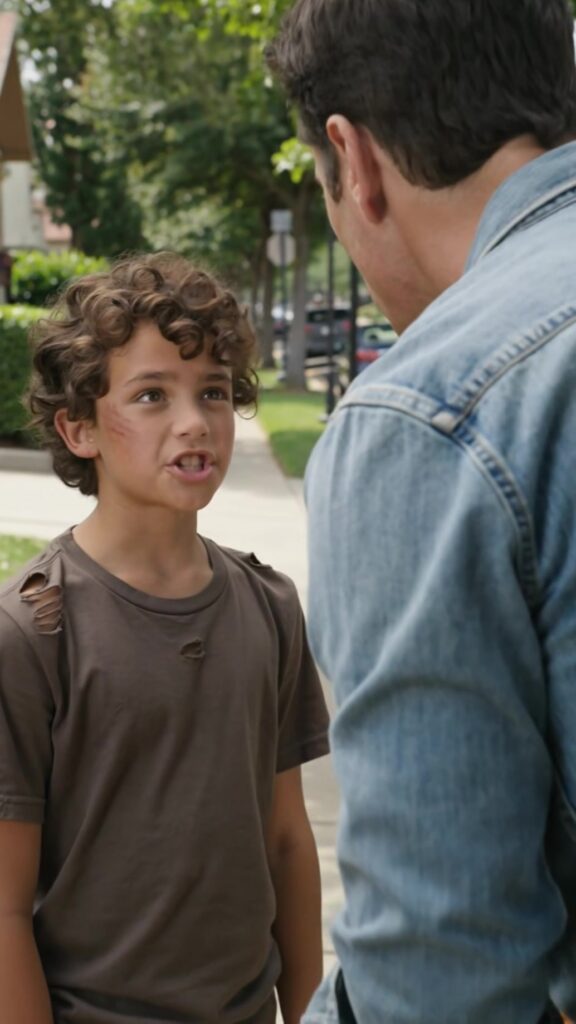
The strange thing was not that the dirty boy accused him.
Accusations had followed Daniel Mercer for months the way leaf litter followed the curb—collecting in corners, refusing to be swept away. Strangers muttered when he guided his daughter across Crosswell Avenue. A cashier once leaned over the register and said, too softly, “She’s awfully steady for a blind child.” A neighbor had asked why the girl always wore sunglasses even on cloudy days. Daniel could bear all of it because the routine held: the cane tapping, the yellow hoodie zipped to the chin, the careful pause at each intersection while he narrated the world she could not see.
That afternoon the light was clean and sharp, and Daniel kept one hand hovering near Nora’s shoulder, steering her around a broken seam in the sidewalk the way he always did. Nora’s cane swept ahead in a practiced arc. She moved with the measured calm of someone who had accepted a smaller universe and learned it by touch and sound.
Then the boy stepped into their path.
He was small but carried a kind of hardness that made him seem larger, like a rock wedged into a stream. His hair stuck to his forehead in sweaty strings. His shirt, once brown, was more dust than cloth, and the skin on his knuckles looked raw as if he’d been punching walls. Daniel registered all of that in an instant—the neighborhood’s usual warnings made flesh—and reached reflexively for Nora’s elbow.
The boy didn’t look at Nora. He fixed his stare on Daniel and spoke with a certainty that felt rehearsed. “Your kid isn’t blind.”
Daniel stopped.
Not because he believed the boy. Not because he feared being exposed in public. He stopped because the sentence landed on a fault line already running through his life, and he felt the tremor of it.
“Excuse me?” Daniel’s voice came out harder than he intended. “Move along.”
The boy did not move. The sun caught the dried mud on his knees, turning it pale. His eyes were too old for his face. “She can see,” he repeated. “She just doesn’t want to look at you when your wife is around.”
Daniel’s throat tightened. He had been good at keeping his panic behind a wall of logistics: doctor’s appointments, insurance forms, school accommodations. But hearing someone speak Claire’s name—his wife, Nora’s mother—like a key in a lock made something inside him unlock unwillingly.
“You don’t know my wife,” Daniel said. “You don’t know anything about my daughter. Get away from us.”
The boy’s gaze slid, at last, to Nora. And that was when Daniel noticed the other strange thing: Nora didn’t flinch at the raised voices. She didn’t angle her head toward Daniel the way she usually did when she relied on his tone to map the room. She stood too still, the cane planted like a stake. Her face turned slightly—toward the boy—like she’d located him without sound.
It wasn’t the stillness of fear. It was the stillness of recognition.
Daniel’s anger faltered into something colder. He had seen that stillness once before, the morning Nora had “lost her sight.” She’d been eight. Claire had called him at work, voice shredded with urgency: Nora had woken screaming, knocking over a glass of water, saying the world had “gone away.” Daniel raced home to find his daughter sitting on the kitchen floor, sunglasses already on her face though it had been raining, Claire kneeling beside her with a hand on her back like a claim.
Doctors had found nothing structural. No injury, no infection, no tumor, no explanation that fit the terror in Nora’s voice. They wrote phrases Daniel had come to hate: functional blindness. conversion. stress response. They asked about home life, about arguments, about trauma. Claire answered for both of them, calm as varnish.
Now the dirty boy shifted his weight and spoke quietly, as if he didn’t want anyone else to hear. “Ask her what she sees when she hears your wife’s name.”
Daniel looked down at Nora. The sunglasses reflected the sky, blank and unreachable. “Nora,” he said, and the word felt like a rope thrown into fog. “Honey. Who is that?”
Nora’s fingers tightened around the cane. The knuckles blanched. Her lips parted, then closed again. Her chest rose and fell too quickly.
“Tell me,” Daniel pressed, gentler now, because something in him had begun to fracture. “Do you know that boy?”
“No,” Nora whispered, but the denial had the fragile pitch of something forced into shape. “I don’t… I don’t know.”
The boy exhaled like he’d been holding his breath for weeks. “She does,” he said. “She just can’t say it while she’s wearing that.”
Daniel stiffened. “While she’s wearing what?”
The boy nodded at the sunglasses. “Your wife gave them to her.”
Daniel’s stomach turned. The sunglasses were a constant—part of the performance, he had thought, part of the shield. He had never questioned them because Nora insisted, because Claire insisted harder, because it was easier to let the child keep whatever made her feel safe.
Daniel crouched so he was level with Nora. He could smell her shampoo, the same brand Claire bought in bulk. “Sweetheart,” he said, “I’m going to take them off for a second. Just for a second. Is that okay?”
Nora’s head jerked back as if he’d threatened her. Her hand flew up, palm hovering near the frame. The motion was fast—too fast for a girl who supposedly navigated by sound and memory.
Daniel froze. The boy’s words rang, and with them came Daniel’s own buried observations: Nora never bumped into doorframes when she was angry. Nora could find Claire in a room without being spoken to. Nora never turned her face toward Daniel when Claire was present, as if looking at him were forbidden.
“Nora,” Daniel whispered, voice breaking. “Can you see me?”
Silence yawned between them, full of traffic noise and distant lawnmowers. Then, very faintly, Nora said, “Not when she wants me not to.”
Daniel’s heart hammered. “Who?”
Nora swallowed. Her mouth trembled, and for the first time she sounded like a child again. “Mom.”
The dirty boy watched Daniel with an expression that wasn’t triumph. It was grim relief, like someone handing over a burden he’d been forced to carry.
“Tell him,” the boy said to Nora, and his voice softened. “Tell him about the bathroom.”
Nora’s shoulders rose as if she were shrinking inside the hoodie. “I promised,” she whispered.
“Promises made to keep you quiet aren’t promises,” the boy said. He rubbed at his wrist, and Daniel saw a faint mark there, the pale outline of a bandage long removed. “She makes you swear and then she says it’s love.”
Daniel’s vision narrowed. “What bathroom?” he demanded, but the demand felt useless; the truth was already coming, unstoppable now that a crack had opened.
Nora’s voice came in little pieces. “She… she puts the drops. When you’re at work. She says it’s medicine. It burns. Then everything is… bright and smeared, and I can’t focus. And she says, ‘See? You can’t see. You need me.’”
Daniel’s mouth went dry. Drops. Brightness. Smear. The doctors had asked about chemicals once, had asked if anything could be irritating her eyes. Claire had laughed, offended, and Daniel had been too exhausted to imagine his wife capable of such careful cruelty.
“Why?” Daniel croaked. “Why would she do that?”
Nora’s chin quivered. “Because when I look at you,” she said, “I look like you. And she hates it.”
The sentence landed like a stone. Daniel remembered Claire, after Nora was born, studying the baby’s face as if searching for betrayal in the curve of her nose. He remembered Claire’s comments in later years—how Nora’s eyes were “too much like his,” how she would be “taken from her.” Daniel had always dismissed it as postpartum darkness, as stress, as words that didn’t mean what they sounded like.
The dirty boy stepped closer, lowering his voice. “I was at your house,” he said. “Not like that. I was there because my mom cleans for people sometimes, and your wife—she paid her cash. I saw the cabinet under the sink. The bottle. I told your daughter, and she cried like she’d been holding her breath for years.” He glanced down. “Your wife saw me. She said if I ever spoke, she’d make sure nobody believed me.”
Daniel stood, slowly, as if rising too fast might break the fragile reality that had just formed. The street felt suddenly exposed—too bright, too ordinary for what had been said on its pavement. His phone was in his pocket, heavy as a weapon and a lifeline.
Across the road, a minivan turned the corner—Claire’s minivan. Daniel recognized it by the cracked tail light and the little sticker on the back window that read PROUD MOM. It rolled toward the curb like it owned the street.
Nora’s breath hitched. She angled her face not toward the sound of the engine, but toward the direction of the sun, as if the light itself had become dangerous.
Daniel placed himself between his daughter and the approaching vehicle. His hand closed around Nora’s wrist—not to guide her now, but to anchor her. “Listen to me,” he murmured. “No more secrets. Not today.”
The minivan slowed, and Claire’s silhouette appeared behind the windshield. Daniel couldn’t see her eyes, but he felt them, precise and assessing.
The dirty boy took a step back, ready to vanish like smoke. Daniel caught his sleeve. “Don’t go,” Daniel said, surprising himself with the steadiness in his tone. “I’m going to need you to tell someone else what you told me.”
The boy’s jaw tightened. “She’ll say I’m lying.”
Daniel looked down at Nora, at the trembling mouth, at the cane gripped like a last defense. “Then we’ll tell the truth louder,” he said. He pulled his phone free and began to dial, not caring who watched, not caring how the scene would look. “And this time,” he added, as Claire’s van kissed the curb and the driver’s door clicked open, “my daughter will be the one who decides what she sees.”
Nora’s hand, still clutching the cane, reached up and touched the edge of her sunglasses. For a moment she hesitated, as if waiting for permission from an invisible authority. Then, with a shuddering breath, she lifted them off. Her eyes—Daniel’s eyes, clear and frightened—met his in raw daylight.
Claire stepped out smiling, the kind of smile that had fooled Daniel into so many years of calm. It wavered when she saw Nora bare-eyed.
Daniel didn’t smile back. He kept dialing, kept Nora behind him, and stared at his wife like he was seeing her for the first time.
The strange thing was not that the dirty boy accused him.
It was that the accusation had finally given Nora a way to stop pretending she couldn’t see.