The Saturday market had the messy music of ordinary life—knives thudding into cutting boards, fishmongers slapping scales clean, a radio somewhere losing its battle with the crowd. Rain had fallen earlier and left the cobbles slick, reflecting awnings in puddles like broken stained glass. People flowed between stalls as if no one could ever truly be stopped. Then, at the edge of the spice vendor’s tent, a shriek cut through the noise and the air turned sharp.
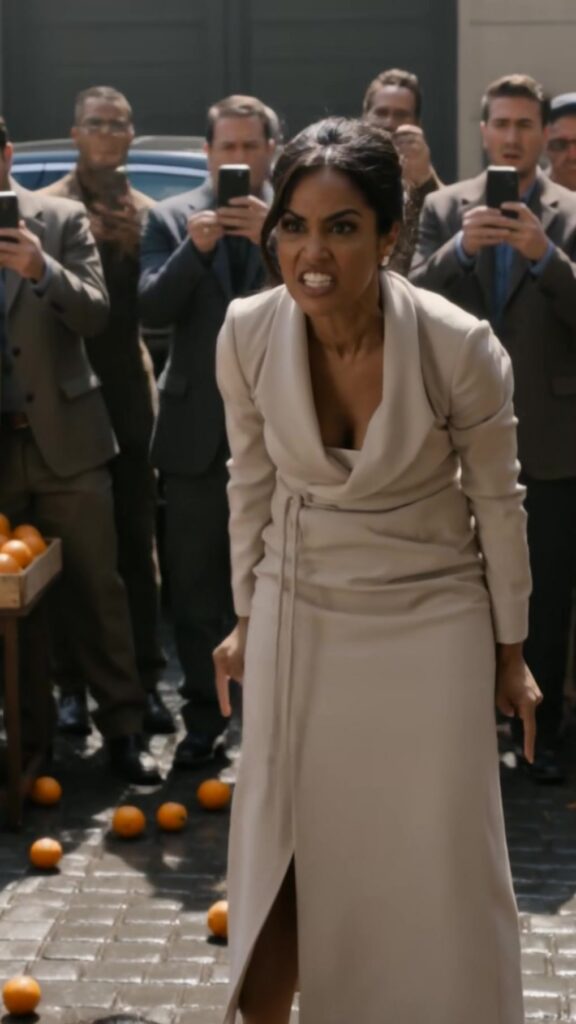
A woman in a tailored coat the color of spilled wine surged forward with a violence that made strangers recoil. She grabbed another woman—slender, carefully dressed but worn at the seams—by the hair and hauled her backward. The dragged woman’s heels skidded; her palms slapped wet stone. Baskets toppled. Tangerines burst free like small suns, rolling under boots and cart wheels. The wealthy woman’s face was hard with fury, the kind that had been practiced in boardrooms and private dining rooms, now unleashed in public.
“Give it back,” she shouted, not at the woman’s eyes but at her hand. “Take it off. Now.” Her manicured finger stabbed toward a plain gold ring on the dragged woman’s left hand—unremarkable at a glance, yet it seemed to catch what little light the clouds spared and hold it like a secret. Several shoppers lifted their phones without thinking, instincts trained by scandal. A child began to cry near the carrots. Someone muttered a prayer. The dragged woman tried to curl her fingers inward, shielding the band as if it were a wound.
She hit her knees with a wet crack and sucked in breath that sounded like it tore. Mud smeared the hem of her dress. Her eyes, wide and dark, flicked from face to face, searching for mercy that did not exist in a circle of spectators. “Please,” she said, voice too low for the crowd to catch, but her lips formed it clearly. The rich woman jerked her head higher, exposing the other’s scalp. “That ring was supposed to be with my sister,” she spat. “Buried. Sealed. Not walking around on the hand of a stranger.”
The accusation traveled like electricity. Grave theft. A corpse’s keepsake. A family scandal made suddenly communal. People leaned in, hungry and horrified. The dragged woman swallowed, throat working as if every word had barbs. “It was given,” she managed, trembling. “I didn’t—” Her sentence vanished under the rich woman’s laugh, a sound that held no humor. “Given? By whom? The dead?”
That was when the old goldsmith emerged from between two stalls, his apron speckled with filings that glittered like frost. He moved slowly, as if the market’s chaos had thickened into syrup around him. A loupe hung at his chest, bouncing with each step. He pushed through the onlookers with the quiet authority of age and trade, his gaze fixed on the ring as though it were pulling him by the pupils. When he got close enough to see the inner band, his expression collapsed.
Color drained from his face in a single heartbeat. His hands—steady hands that had set stones and soldered seams for fifty years—began to shake. He lifted the woman’s knuckles gently, not like an appraiser but like someone touching a relic. The rich woman barked at him to confirm her rage, to bless it with expertise. The goldsmith’s lips parted and nothing came out at first, only a faint breath. Then he whispered, “No… that cannot be.” The words were so soft they were almost lost, yet the crowd felt them like a hush.
“What did you say?” the rich woman demanded, tightening her grip. The goldsmith swallowed hard, eyes glassy. “I made this,” he said at last, voice cracking on the confession. “Not years ago. Not some copy. I engraved this band the night your sister’s coffin was closed.” A silence fell so absolute it seemed to press the market flat. Even the vendors stopped pretending to mind their stalls. The rainwater in the gutters looked suddenly still, as if the street itself had decided to listen.
The rich woman’s mouth opened and failed to produce a sound. Her fury faltered, replaced by something like fear—fear of being wrong, fear of being right. The dragged woman’s shoulders quivered as she cradled her hand to her chest. “I told you,” she whispered, not with triumph but exhaustion. The goldsmith stared at her as if seeing her properly for the first time. “Who are you?” he asked, and the question carried a weight the crowd could feel, a heavy stone lowered into a well.
Before she could answer, an engine purred at the edge of the gathering. A black car eased to the curb with the deliberate calm of power. Its windows were so tinted they looked like shut eyes. A door opened, and a man stepped out wearing a black coat despite the damp warmth. He was not tall, but he moved with the economy of someone used to rooms falling silent. As he approached, people parted without deciding to. He stopped beside the goldsmith and looked down at the kneeling woman with a face that did not ask for permission to be believed.
“Enough,” the man said, and the rich woman’s grip loosened as if her fingers had forgotten their purpose. He crouched, his gaze shifting to the ring. “Show me,” he instructed, and the kneeling woman extended her hand. The man did not touch it at first. He simply read the inside of the band the way some people read scripture. His jaw tightened. “Mara,” he said, and the name struck the rich woman like a slap. Her eyes darted, desperate. “That’s my sister’s name,” she choked.
The kneeling woman flinched at the name, as though it belonged to her and did not. “It was mine,” she said, and at last she lifted her face to the crowd. Her features were delicate but bruised by poverty and worry; still, there was a stubborn dignity in the way she held her gaze. “Before the fire. Before the hospital. Before they told me I was dead.” She turned to the rich woman, voice brittle. “You buried someone. But you didn’t bury me.”
The rich woman staggered back a step, shaking her head violently. “Impossible,” she breathed. “We identified—” Her sentence dissolved as the man in black rose and produced a thin folder from inside his coat. He opened it with the care of a surgeon. Inside were photographs, official stamps, a scar diagram, a record of a blood type that matched a mother’s. “You paid to close the case,” he said, voice low enough to feel like thunder. “And you paid to keep her from returning.” He looked at the ring again. “But you forgot one thing. Metal remembers. And so do the hands that carve it.”
The goldsmith wiped at his eyes with the back of his wrist, leaving a smear of gray. “There’s a flaw,” he murmured, pointing with a trembling finger. “A tiny seam where the mold split. I fixed it without telling anyone. That seam is mine. No thief could know it.” He looked at the rich woman with a grief that was almost tenderness. “Your sister stood at my counter and asked for no stone,” he said. “Only a band strong enough to survive being buried.”
The market exhaled in fragments—whispers, gasps, the sound of a phone hitting the ground. The rich woman’s face crumpled, rage and shame and disbelief warring for the same skin. “Why would you come back?” she asked, smaller now. The woman on her knees—Mara, or the ghost of Mara—closed her fingers around the ring and pushed herself upright with shaking legs. “Because you don’t get to decide who lives,” she said. “And because you dragged me through the mud for what you thought was proof. So let the street see the truth.”
It felt, then, as if the whole block had frozen: not by magic, but by the sudden weight of consequence. The carts, the oranges, the shouting—everything held in place by a single circle of gold. The man in black gestured toward the car, and two figures in plain clothes emerged, their badges flashing briefly like cold light. The rich woman did not run. She stood rooted on wet stone, staring at the ring as if it had turned into a mirror and forced her to look at herself. Mara walked past her without touching her again, and the market—still, stunned—made a path.
When the car door closed and the engine rolled away, sound returned in uneven waves. Vendors began to speak in hushed tones. The child stopped crying. Oranges were gathered up and set back into crates, their bright skins smeared with mud. The goldsmith remained where he was, watching the empty space Mara had occupied, his fingers forming invisible letters in the air. The street was moving again, but something had changed: the crowd had witnessed the moment a ring became a verdict, and no one could pretend they hadn’t seen it.