The toy store was full of color, music, and happy noise. It spilled out into the mall like a parade—glittering banners, plastic drums thumping from a demo booth, a looping lullaby from a display of wind-up animals. The air smelled like cinnamon pretzels and fresh cardboard, and every shelf seemed to grin: bright dolls with painted lashes, plush bears lined in obedient ranks, model rockets poised to launch into children’s palms.
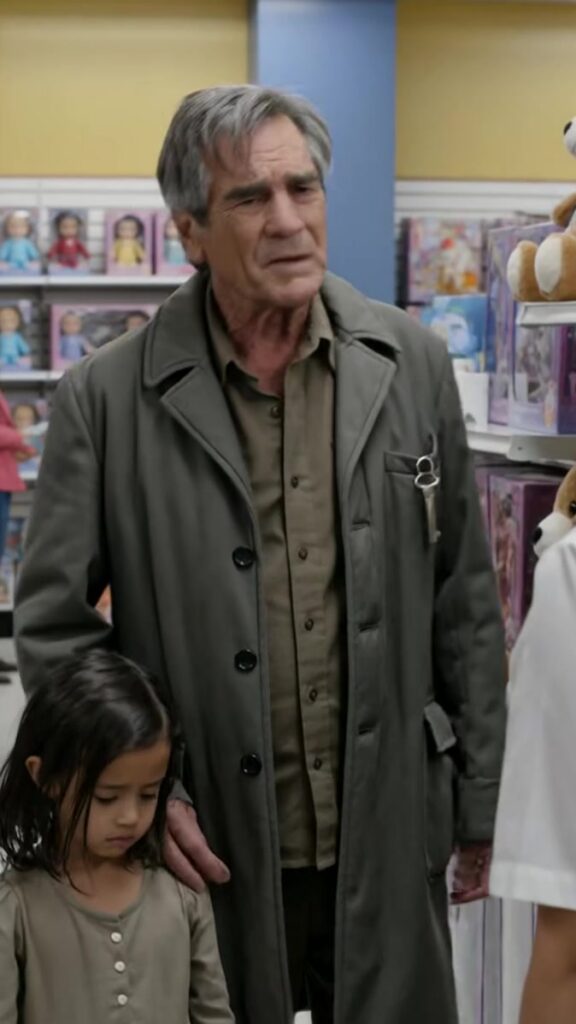
At the center of that bright commotion stood a man who didn’t match any of it. His coat had been mended more times than the seams could count, the cuffs shiny with use. His shoulders carried a careful heaviness, as if he’d learned to make himself small without ever bowing. Beside him, his granddaughter’s hand—warm, soft, trusting—was nested in his. Lila’s braid swung as she leaned closer to the glass case where a small music-box doll waited like a secret.
The doll wore a pale blue dress edged with silver thread. Behind her back, a tiny crank caught the light. Lila lifted her eyes to her grandfather’s face, searching the lines there for permission, for a story, for a clue. “Grandpa,” she breathed, “she looks like the one Mommy used to sing about.”
The old man’s fingers tightened—not in anger at Lila, but in reflex, the way a scar aches before rain. He blinked once, hard. For a moment the music in the store seemed to thin, as if the air itself listened. He turned his head slightly, pretending interest in a rack of toy trains while something raw passed across his eyes. “Your mother had many songs,” he managed, and his voice came out soft as worn fabric.
A sharp step cut through the aisle. An employee in a crisp polo and a name badge that read KARA stormed up, her mouth already shaped into disapproval. “If you’re not buying, don’t block the case,” she snapped, loud enough to gather attention like a hook. “This isn’t a museum.”
Lila’s shoulders jumped. Her hand slipped away from the glass as if she’d been burned. Around them, a boy with a toy dinosaur paused mid-roar, and a couple near the puzzles turned their heads. Two cashiers stopped scanning, their eyes flicking between Kara and the old man. The store’s cheerful soundtrack kept chirping, oblivious.
The grandfather straightened. His spine rose like a quiet wall. “Please,” he said, voice even, “don’t speak to her like she’s done something wrong.”
Kara’s lips curled, the kind of smile that didn’t reach the eyes. “Then don’t bring kids in here to stare at things they can’t afford,” she said, louder now, with the casual cruelty of someone who believes the crowd will back her. “We get it. Sad story. Move along.”
The words landed with a force that didn’t need shouting. Lila looked down at the floor tiles, the pink in her cheeks turning hot with shame. Her small mouth trembled as if she were trying to swallow an apology she didn’t understand. The grandfather didn’t move. He became still in a way that wasn’t weakness. It was the stillness of a man who had carried blame long enough to know the weight of each syllable.
A door clicked open behind the register area. The store manager stepped out, adjusting his tie, ready to intervene with the bored authority of someone used to petty disputes. Then he heard Kara’s last line and saw the faces turning. He opened his mouth—and stopped.
His gaze locked on the old man’s pocket, where a metal keychain hung from a frayed loop. It was heavy, old enough to be almost out of place in this glossy, modern shop. Scratches webbed its surface. A faded number was stamped into it, and beneath the number, a tiny carved star—worn smooth by years of touch. The manager’s expression shifted as if a door had opened in his mind and cold air rushed out.
“Where did you get that?” he asked, and the sharpness of his tone startled even Kara. The music from the toy pianos seemed to pull back, leaving a hush between notes.
The old man didn’t answer immediately. His thumb brushed the star, slow and familiar. “It was given to me,” he said at last, “by the woman who built the first toy shelf in this store.”
The manager’s face drained of color. His eyes widened, then narrowed as if he couldn’t bear what he recognized. “That tag… that’s the founder’s original key,” he whispered, not to the old man but to the air itself. “My grandmother used to talk about it. It disappeared the day—” He swallowed. “The day my aunt vanished. The winter collection. The police.”
Behind him, Kara’s confidence collapsed into a brittle stillness. Her hands fumbled at her badge as though it might become a shield. Customers leaned in unconsciously, drawn toward the gravity that had suddenly replaced the store’s bright noise.
Lila tugged her grandfather’s sleeve, her voice small but steady. “Mommy said Grandpa was the only one who stayed when everyone called her a thief,” she said. “She said he promised to remember the song, even if the world forgot her.”
The manager stared at Lila as if she’d spoken a forbidden name. His throat worked. “Your mother…” he began, then looked back to the old man. “You’re Elias Ward.”
The old man exhaled, and it was not relief. It was the sound of a long-held breath finally deciding it could be released. “I was,” he said. “Before the headlines. Before people crossed the street to avoid me because I wouldn’t say she did it.” He nodded toward the blue-dressed doll. “She designed things like that. Little music hidden inside ordinary shapes. She said children deserved beauty that didn’t ask permission.”
The manager’s hands trembled as he stepped closer, eyes bright with something that looked like grief wearing a suit. “My family told me she ran away with the money and the prototypes,” he said. “They said she was jealous. That she wanted to ruin the store.” His voice cracked. “But the tag—she wouldn’t have given that to a stranger.”
Elias lifted the keychain, letting it swing once. “She didn’t run,” he said quietly. “She walked out the back door in the snow with a box under her arm—unfinished dolls, sketches, the winter line she’d been sewing at night. She told me she was going to show your father the proof that someone was cooking the books and blaming her. Then she never came back.” He looked at the manager with eyes that had learned to survive without hope. “And your family needed a villain more than they needed a missing daughter.”
The manager’s jaw tightened, the way someone tries to hold a legacy together with teeth. “Why keep it all these years?” he asked. “Why come here now?”
Elias glanced down at Lila. “Because she’s old enough to ask,” he said. “And because the song is starting to fade. I promised her mother I’d bring Lila to the place where it began, and let her choose one thing that still carries her.”
The manager turned abruptly toward Kara, and the air around him sharpened. “Go to the office,” he said, each word clipped. “Now.” Kara tried to speak, but nothing came out. She retreated, eyes down, as if the store had suddenly grown too bright to stand in.
Then the manager crouched to Lila’s height, his voice gentler than his suit suggested. “Would you like to hear it?” he asked, nodding toward the doll. “The melody?”
Lila looked to her grandfather for confirmation. Elias gave a small nod, the kind of permission that carried more than a purchase. The manager unlocked the glass case with a key from his belt, hands careful as if touching a relic. He lifted the doll and offered it to Lila like an apology.
Lila took it with both hands and turned the tiny crank. A soft tune rose—simple, looping, tender. It didn’t compete with the store’s noise; it slipped beneath it, stitching the bright chaos to something older and truer. Elias closed his eyes, and for a heartbeat his face was not weary but illuminated by memory.
“That’s it,” Lila whispered, tears collecting without spilling. “That’s her.”
The manager stood, swallowing hard. “I can’t undo what my family did,” he said to Elias, voice low. “But I can open the records. I can look where no one wanted to look. And I can tell the truth in this building, at least. Starting today.”
Elias opened his eyes. In them was the cautious, aching patience of someone who has lived too long among locked doors. He reached into his pocket and unclipped the old key tag. The metal looked heavier in his palm than it had hanging at his side. He held it out—not as a surrender, but as a handoff of burden.
“Then take it,” he said. “Not as a trophy. As a promise.”
The manager accepted it like it might burn, then curled his fingers around the star. Outside, the mall’s bright afternoon continued its ordinary rush. Inside the toy store, amid color and music and happy noise, something else began—quiet, dramatic, irrevocable: the first step toward finding the missing girl in the blue dress, and clearing the name of the woman whose lullaby still turned, faithfully, in a child’s hands.