The lawn behind the Mirren estate had been turned into a theater of glass and light. Transparent arches caught the noon sun and threw it back in clean, obedient prisms. Ivory roses clung to every railing as if they’d always belonged there. Even the breeze seemed trained, lifting the bride’s veil with just enough grace for cameras to adore it.
Clara Mirren stood at the head of the aisle like a statue commissioned to celebrate itself. Her dress was a river of satin, her smile rehearsed. She watched the guests settle—bankers, board members, charity patrons—people who had known her father’s name before they’d learned hers. On the far end, Julian Ashford waited with the calm of a man who believed he had already won.
Then the gate clicked.
A woman stepped in as if she’d been pushed by regret. Her coat was too thin for the season; her shoes were the kind that surrendered long before their owner did. Gray hair escaped a loose knot. She held an envelope between both hands, gripping it as though it might slip away and take her courage with it. For a second, she only looked at Clara—wide-eyed, careful—like someone searching for the right face in a crowd, and praying it would not turn cruel.
Clara’s smile broke. The change was so sharp it seemed to crack the air. She strode down the aisle without waiting for anyone to move aside. The heel of her white shoe landed hard against the manicured grass, as though she meant to hurt the earth for allowing this interruption. “No,” she hissed, and the word carried farther than she intended.
The older woman lifted the envelope slightly. “Miss Mirren—Clara—please. I was told… I was told this had to reach you before—”
Clara snatched it. The paper was damp at the corners, as if it had traveled through rain. “Told by who?” she demanded, then answered herself with a laugh that sounded like glass breaking. “You always have a story, don’t you?”
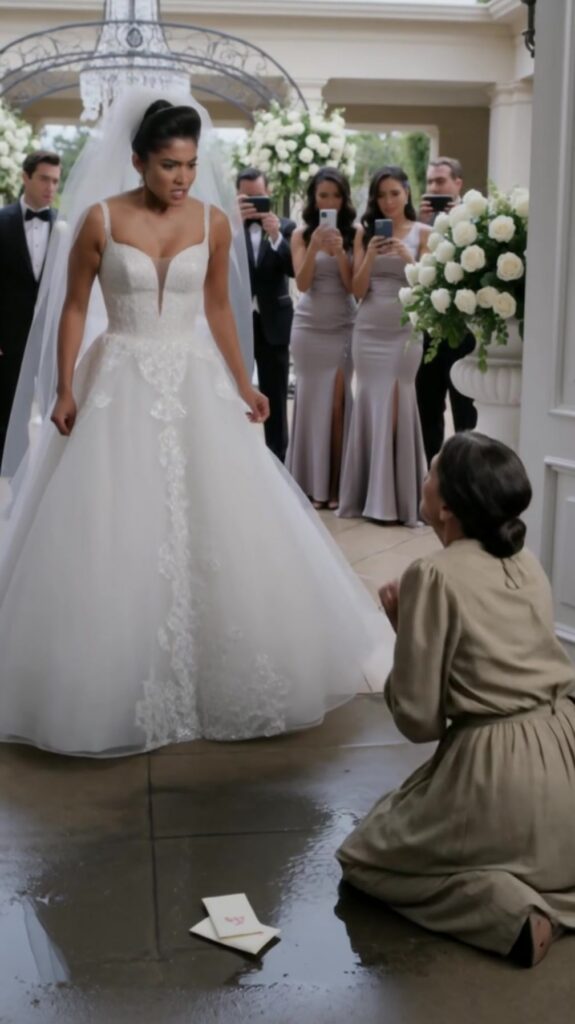
She walked three steps to where a shallow puddle reflected the arches like broken mirrors. With a flick of her wrist, she dropped the envelope into the mud. The paper darkened instantly, a bloom of brown swallowing the seal. Heads turned. A violinist faltered and stopped. Phones rose like periscopes.
“If you came to embarrass me,” Clara called, loud enough for the farthest chairs to hear, “then at least do it the way beggars do. Kneel. Pick it up.”
The word kneel passed through the audience like a chill. Someone inhaled sharply. A bridesmaid covered her mouth, then lowered her hand, unsure whether compassion belonged at a Mirren event. The older woman’s shoulders folded inward, a reflex learned from a life that had offered too many reasons to shrink. For a moment she stayed standing, trembling, as if dignity had one last fight left in it.
Julian took a step forward, but his mother—draped in pearls—caught his sleeve. “Let Clara handle it,” she murmured, smiling politely, as if cruelty was merely a mismanaged detail.
The woman finally sank to her knees. The satin of Clara’s gown remained clean and distant; the woman’s skirt drank mud. She reached into the puddle and cradled the envelope with both hands, lifting it as though it were still precious, as though humiliation could not dissolve whatever had been written inside. Water dripped from one corner onto her knuckles.
Her voice, when it came, was thin and torn. “I didn’t come for money.” She blinked against tears that seemed older than today. “Your father… he told me, if anything happened, I had to make sure you opened this. Before you married him.”
Julian went completely still. Not the stillness of a man being polite, but of a man recognizing a weapon he hadn’t expected to see drawn. Clara’s chin lifted, defiant, though a flicker of uncertainty tightened her throat. “My father has been dead two years,” she said. “Don’t use him.”
The woman’s hands shook as she offered the envelope upward, its seal distorted by water. “He gave it to me the day he signed the last transfer. He said, ‘If Julian ever gets her to the altar, she won’t listen to anyone but ink.’ He said that. Those were his words.”
That sentence landed like a stone dropped into a still pond, and the ripples touched every face in attendance. Clara’s eyes moved, unwillingly, to Julian. He attempted a smile, but it was late and wrong. “Clara, don’t,” he said quietly, as if he were speaking to a child about to touch fire.
She snatched the envelope back from the woman’s outstretched hands. The paper tore slightly where it had softened. For a breath she hesitated, staring at the seal—her father’s crest, blurred but recognizable. Then she tore it open. The guests leaned forward as if the air itself had become a rumor.
The letter inside was written on heavy stationery, the kind her father used when he meant to be believed. The ink had bled in places, but the words remained legible enough to sting. Clara’s eyes scanned the first lines, and the color drained from her face with such speed it was almost theatrical—except she wasn’t acting.
She read aloud without meaning to. “Clara. If you are holding this, it means I was right to distrust my own generosity. Julian Ashford is not who he claims to be. His name is an arrangement, his charm is a tool, and his affection is a contract.” Her voice broke on the next sentence. “I have attached copies of the settlement records and the bank authorizations he forged, and the confession he signed when I confronted him—before he begged and swore and promised to change.”
A murmur rose, then another, then a swell of shock that could not be smoothed by etiquette. Clara turned the page with shaking fingers. “He is connected to the fire at the Westport warehouse. The one that killed… me.” The letter’s ink had pooled there, as if her father had pressed his pen too hard. “Not directly, but through the man he paid to destroy evidence. I kept this quiet because I thought I could protect you with control. I was wrong. The only protection left is truth.”
Julian’s face became something unfamiliar—calculation stripped bare. “This is insane,” he said, stepping forward quickly. “She’s manipulating you. That woman—” He pointed at the kneeling stranger as if she were the threat, not the letter. “She’s here for revenge. Clara, give me that.”
Clara backed away, clutching the paper to her chest. Her gown whispered over the grass like it had suddenly learned fear. “You forged my father’s signature?” she asked, and the question sounded small, which made it more terrifying. “You stood beside me at his grave.”
Julian’s jaw tightened; he glanced at the crowd, at the phones, at the witnesses. “You don’t understand the pressure,” he began, switching to the voice that soothed investors and made apologies feel like gifts. “Your father was ill. Things were complicated. I was trying to hold everything together—”
“Don’t.” Clara’s word cut clean. She looked down the aisle at the older woman still on her knees, mud on her hands, eyes lifted with a sorrow that had nothing left to hide. “You knew,” Clara whispered to her. “All this time. And I—”
The woman swallowed. “I tried before,” she said. “He threatened me. Your father sent me away with the letter and told me to wait until you couldn’t ignore it. He said you would think I was nothing. He was right.”
Clara’s breath hitched. For the first time all morning, she seemed young—bare and unarmored beneath the wealth. She turned to the officiant, to the arches, to the rows of perfect people. “There will be no wedding,” she said, and the words fell heavier than any vow.
Julian lunged for the letter. Two groomsmen moved instinctively, but not to help him; they blocked him, confused loyalty turning on its axis. Someone called security. Julian’s mother stood, pearl necklace trembling against her throat, her smile finally collapsing. “Clara,” she said sharply, “you’re making a spectacle—”
“No,” Clara answered, voice steady now, the steadiness of a door being locked. “He did.”
She walked to the older woman and held out a hand. It was not an apology—apologies were too thin for what had been done—but it was a refusal to continue the cruelty. After a beat, the woman placed her muddy fingers in Clara’s gloved palm. Clara helped her stand, lifting her from the ground in full view of everyone who had watched her kneel.
The wet letter drooped in Clara’s other hand, edges stained, ink bruised, but it had done what her father had asked: it had stopped the wedding. Behind them, the crystal arches caught the sunlight and scattered it everywhere, as if the day were trying to pretend nothing had changed. Yet the guests sat frozen, the music remained silent, and Julian Ashford—caught between charm and consequence—had nowhere left to hide.