Rain struck the city with a fury that felt personal, a hard percussion against glass and stone, as if the streets themselves were being punished for what they had witnessed. Water raced along gutters like impatient hands, dragging cigarette ends and wilted receipts into the dark mouths of drains. At the main intersection, cars sat in obedient rows, their beams smearing into long white blades across the slick asphalt.
People moved through it as though they could outrun misery. Umbrellas bobbed like cautious animals; collars were raised; faces were hidden behind scarves and screens. Every stranger became a wall. And at the curb, half swallowed by the gray, a little girl stood in clothes that clung to her like cold skin.
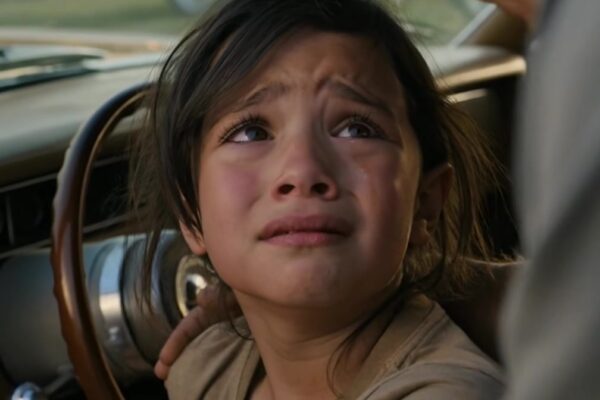
She couldn’t have been more than eight. Her hair was plastered to her forehead in thin ropes, and her hands shook so violently it seemed the tremor might snap her wrists. Yet she kept her fingers locked around a folded piece of paper, sheltering it with her palms. She angled her body as if to protect that scrap from the downpour, even while the rain lanced through her sleeves and the cold climbed higher with every breath.
The girl watched the traffic light like it was a judge. She didn’t look at the cars, and she didn’t look at the people. She looked at the corner across from her, searching for something that never came into view. Whenever a silver glint passed—metal, a puddle reflecting a sign—her chin jerked up. Hope, sharp as hunger, flashed and died again.
Then the air changed. Perfume cut through wet concrete, expensive and out of place. A woman stepped from the crowd as if she owned the rain itself. She wore a tailored coat the color of bone, heels that clicked even on wet pavement, and a face composed into practiced disapproval. Her umbrella was black and perfectly dry beneath it, as though the storm had agreed not to touch her.
She noticed the girl the way people notice trash near their shoe. With a flick of her wrist she reached down, snatched the folded paper, and held it up between two manicured fingers. “Enough,” she said, voice bright with contempt. “Don’t clutter the sidewalk with those pathetic pleas.”
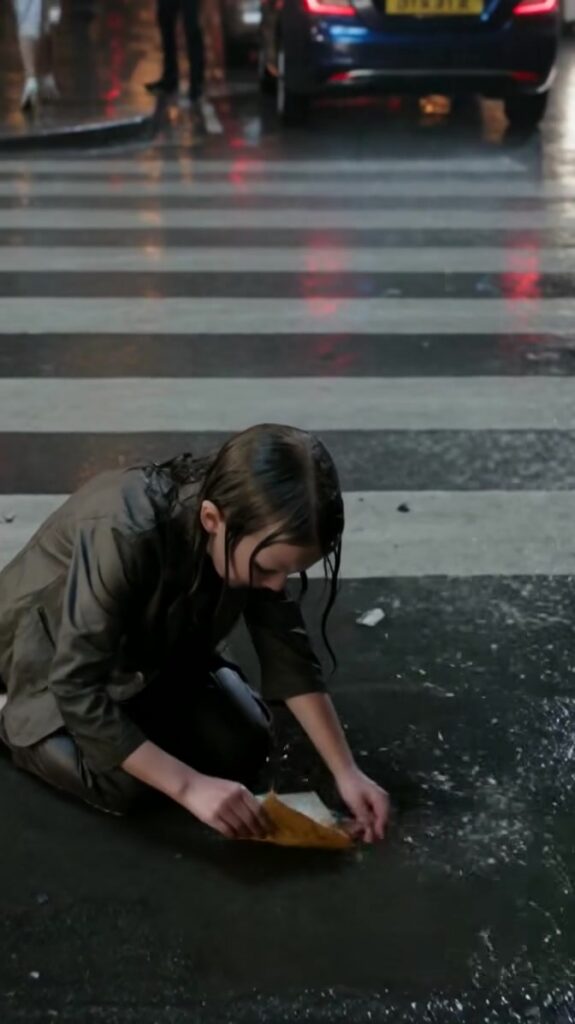
Before the girl could form a word, the woman tossed the note into the street. It landed in a shallow river, instantly darkening, the edges softening as the ink began to bleed. A few pedestrians stopped mid-step. Someone raised a phone, the lens aimed like a weapon. The little girl made a sound that wasn’t quite a scream—more like breath being ripped out of her.
She lunged into the roadway without thinking. Knees hit the cold water, hands slapped against the shining surface, and for a moment she looked like she was drowning on dry land. She fumbled for the paper, sliding it onto her palm with reverence, trying to lift it from the rain as if she could pull it back in time. Her lips moved around words no one could hear, then a whisper broke through, ragged and raw: her mother had told her that a man who carried a silver umbrella needed to see the message, that it was the only way to find him again.
The elegant woman’s expression tightened, annoyance turning briefly to uncertainty. She glanced over her shoulder, perhaps expecting the crowd to applaud her neat cruelty. Instead, the people were staring past her. Under the awning of a bakery, just out of the worst of the rain, an older man stood holding a silver umbrella that caught the streetlights in pale flashes. He hadn’t moved when the light changed. His hand, steady a second ago, now trembled on the handle.
His eyes were fixed on the paper in the child’s hands. Even soaked, a single line remained visible, the ink stubborn in defiance of the storm. The man’s mouth opened, closed, and opened again, as if his body had forgotten how to make sound. Color drained from his cheeks until his face looked carved from winter. “That… that script,” he whispered, the words barely surviving the rain’s roar. “She swore she would never write to me again unless…”
The girl lifted her head. Water ran down her lashes and made mirrors on her cheeks. She turned slowly toward him, as if afraid the motion might erase him. The man stepped off the curb and into the open rain, ignoring the immediate splash that soaked his trousers, ignoring the impatient honk from somewhere behind the line of cars. He crouched a few feet from her, keeping the silver umbrella tilted so it covered them both.
Up close, he looked exhausted in the way rich men try to hide: the careful suit, the polished shoes, and underneath, eyes that had been awake too long. He stared at the child’s face like it was an equation that might finally make sense. “Where did you get this?” he asked. His voice cracked on the last word.
“My mom,” the girl said. She held the paper out with both hands, pleading with her whole posture. “She told me if I found you, you’d know what to do. She said you used to promise things and you always kept them. She said your umbrella would be silver so I wouldn’t mistake you.”
He took the paper like it was holy. His fingers hovered above the wet fibers, careful not to tear them. The ink had bled into bruised shapes, but he could still make out enough: a name at the bottom, drawn with a familiar loop, the signature that had haunted him for years. A woman’s name he had once spoken like a prayer, then buried under legal documents and pride.
The elegant woman hovered near the curb, suddenly small in her expensive coat. “Sir,” she said, trying to recover authority. “It’s just a scam. These street children—”
He didn’t look at her. “What is your name?” he asked the girl, eyes returning to her face as if the answer might cut him open.
“Mara,” she said, voice almost inaudible. “My mom calls me her miracle, but I don’t feel like one.”
His breath hitched. The name landed in him with the weight of a door slamming shut. He swallowed hard. “You have a birthmark,” he said, reaching a hand toward her temple and stopping short, asking permission without words. “Right here. Like a tiny crescent.”
Mara blinked. “How do you—”
“Because I prayed for it,” he said, and the confession sounded like shame. “Because I begged a doctor once to tell me anything, anything at all, and he said the baby might not live, and your mother—” He paused, eyes glassy. “Your mother told me she would only ever write again if our daughter made it.”
The traffic light turned green. The cars remained still. People lowered their phones, forgetting to record, as though the story had suddenly demanded silence instead of spectacle.
Mara’s mouth trembled. “So… you’re him?”
He nodded, a movement so slight it looked like he feared the rain might carry it away. “I’m Elias,” he said. “I’m the man who should have been looking for you every day.” His gaze darted to the corner she’d been watching. “Where is your mother?”
Mara hugged her arms around herself, shivering. “At the clinic,” she whispered. “They said she has to stay. She made me promise I’d bring you the note because she can’t leave. She said—” Her throat worked around a sob. “She said she doesn’t have long enough to wait for pride anymore.”
Elias’s face folded in a way money couldn’t fix. He stood abruptly, lifting the umbrella higher so it covered her fully. Then he reached into his coat, not for cash, not for a business card, but for his phone with shaking hands. He looked at the crowd and his voice cut through the rain, fierce and final. “Someone call an ambulance if you need to,” he said, “but right now I need a car. I need to get to a clinic, and I need a witness.”
The elegant woman took a half-step back, searching for the exit she usually found in other people’s discomfort. Elias finally turned his eyes on her, and what lived there was not anger—it was a quiet verdict. “You threw away the one thing that kept her alive,” he said. “If you want to do something decent, step aside.”
A stranger in a hooded jacket pushed forward and offered keys. Another person placed their own coat around Mara’s shoulders, careful, wordless. The city, for a brief moment, stopped pretending.
Elias guided Mara toward the sidewalk, the silver umbrella above them like a fragile new roof. “I don’t know how to be your father,” he said, voice low, as if admitting it could summon lightning. “But I know how to keep a promise once I make it. Tell me what she needs. Tell me everything.”
Mara looked up at him, rain dripping from her chin, and in her eyes there was still fear—of losing him, of being told she belonged nowhere. But there was something else too, thin and bright as a thread holding under strain. “She needs you to read the note,” she said. “She needs you to come.”
He tightened his grip on the umbrella handle, and together they stepped into the waiting world, leaving behind the red light, the stalled cars, and the puddle where a story had nearly dissolved—until someone finally chose to pick it up.