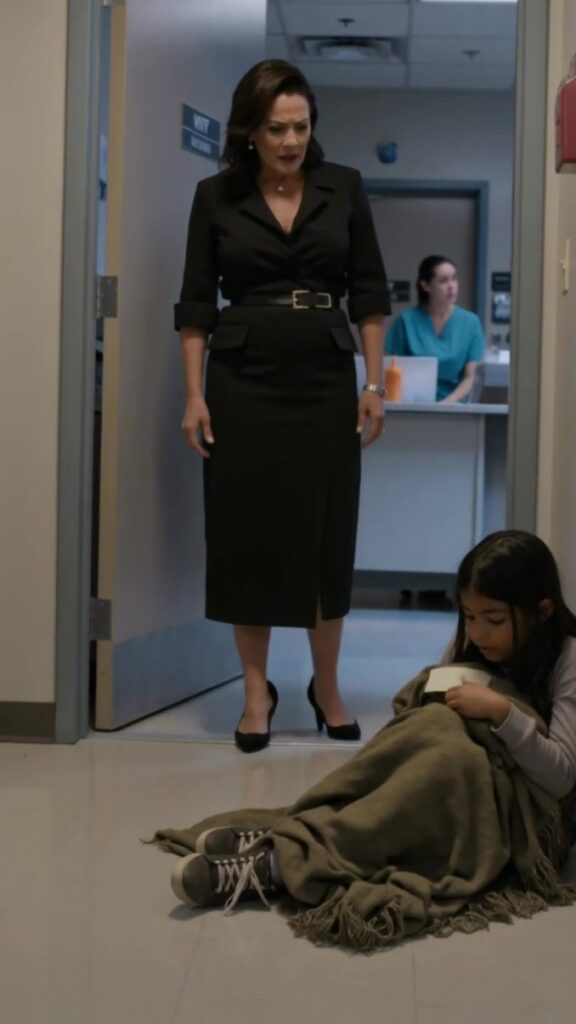
The private hospital corridor was too bright, too clean, too cold for a child like her. The lights were the kind that didn’t simply illuminate—they interrogated. They bleached every shadow from the corners and made the polished floor shine like a thin sheet of ice. Even the air smelled expensive: antiseptic layered with something floral, as if illness had been asked to behave politely.
She sat with her back against the wall across from the VIP suites, knees pulled in, an old blanket bundled around her like a small, fraying fort. The shoes on her feet were too large and had once been white; now they carried the city’s grime in their seams. A hospital bracelet, wrong-sized and long expired, hung loose around one wrist, as if she’d once belonged to a place like this and then been misfiled.
The doors along this corridor belonged to people who had never waited for anything. Their rooms were quiet in the way of expensive things: not empty, but contained—hushed machines, muted alarms, nurses who spoke in low voices as though money could hear itself echo.
The child tried to make her coughing small, swallowing it into the blanket so the sound wouldn’t travel. Each time her chest tightened, she stared at the silver numbers on the nearest door as if the metal could answer questions: Is he still here? Is he still breathing? Is it time?
Across the hall, the door with the gold-plated plaque—Suite 12—opened with a soft click, like a safe unlatched.
A woman stepped out, tall and lacquered, her dark hair pinned perfectly in place. She wore a coat with a fur collar and an expression that suggested she expected the world to move aside without friction. Her heels struck the floor with tidy authority.
She stopped when she saw the girl.
Disgust moved across her face in a practiced line, as if someone had placed something uninvited on a tablecloth. “Who let you in here?” she asked. Her voice was calm, yet sharp enough to cut paper. “This floor isn’t a waiting room.”
A nurse at the far desk hesitated, then turned back to her screen with the deliberate blindness of someone avoiding trouble. Another nurse paused mid-stride, eyes flicking between the woman’s face and the child’s small body as though calculating which could do more damage.
The girl didn’t look up. She tightened her grip on the blanket, knuckles pale under thin skin. “I’m… I’m supposed to be here,” she said, so quietly the words nearly disappeared into the fluorescent hum.
The woman’s gaze fell on the blanket, on the child’s trembling shoulders. “Supposed to be,” she repeated, a humorless laugh exhaling through her nose. “This suite is paid for by families who belong here.”
A man in a tailored suit slowed as he walked past, his phone already angled at an interesting scene. Curiosity was a common currency, even on VIP floors.
The girl swallowed. “My mother said to wait by this door,” she managed. “If the man inside… if he was still alive.”
The word alive snagged on the corridor’s sterile calm. Even the nurses seemed to draw in a fraction of breath, as if the child had used a forbidden term.
The woman’s eyes narrowed. “Your mother,” she said, rolling the phrase as if tasting something sour. “And where is she now? Another story for sympathy?”
The girl’s chin dipped further. In the fold of the blanket, something stiffened—a paper corner, tucked close to her chest like a hidden pulse.
The woman noticed. Not because she was kind, but because she was trained to find leverage. She reached down, swift as a pickpocket, and tugged the folded note free before the girl’s fingers could clamp down.
“Give it back,” the girl whispered, the first edge of fear breaking through her fatigue.
“Let’s see what you’ve been coached to say,” the woman replied, unfolding the paper with impeccable nails. The handwriting on it wasn’t neat; it was urgent, angled and pressured, as if the pen had been driven by shaking hands.
She began to read aloud, intending to turn the words into theater. “To the one who—”
“Stop.”
The voice came from behind her, rough with age and sudden shock.
An older doctor had stepped out of the elevator at the far end of the corridor. His white coat hung on him like a banner he’d grown tired of carrying. He held a clipboard against his chest, but his fingers were loosening around it, the board tilting toward the floor as if gravity had increased.
His eyes were fixed on the note.
The corridor seemed to shrink around his stare. A pulse of silence spread outward: the nurses froze; the man with the phone lowered it half an inch; the woman’s lips parted in irritation at being addressed.
“Doctor,” she said, trying to regain the dominance of the moment, “this child is loitering outside my husband’s—”
“I know that handwriting,” the doctor whispered, as though speaking louder would make it less true. His face drained of color until his skin matched the corridor’s cruel light. “I’ve seen it on consent forms. On post-it notes left on monitors. On a letter that—” His breath hitched. “On a letter from the woman who vanished.”
The woman’s fingers tightened around the note. “What are you talking about?”
The doctor stepped closer, as if pulled. His hands began to shake openly now, not the discreet tremor of fatigue but the unmistakable tremble of guilt awakening. “Years ago,” he said, the words scraping out of him, “a young mother came here in the middle of the night. Not through the main entrance. Through the service hallway. She had a baby, barely breathing, and she begged me. She said someone would come for her child if anyone knew she’d been here.”
The girl’s head lifted just slightly, drawn by the sound of her mother being spoken of like a real person and not a story.
“She wanted the baby’s record erased,” the doctor continued, voice cracking. “No name. No trace. She said it was the only way to keep her safe.” He swallowed hard. “I refused. I told her there are rules. There are laws. She looked at me like the world had already decided she didn’t count.”
He reached for the note, then stopped, as if touching it might burn. “The next morning she was gone. Security footage was missing. The intake entry… deleted. I told myself I’d imagined it. I told myself it was impossible for something like that to happen in a place this… this perfect.” He gestured weakly at the bright corridor, the gleaming floor that suddenly looked like a stage set.
The woman’s throat worked. She looked at the child properly for the first time—not as dirt in a hallway, but as a person with a history that might have teeth. “Who are you?” she demanded, though the question came out thinner now.
The girl’s voice was barely more than breath. “My name is Lark,” she said. “My mother called me that because she said I had to learn to sing quietly.”
“Lark,” the doctor repeated, and his eyes went wet. “She used that word. In the letter.” He finally took the note from the woman’s rigid hand, careful as if it were a living thing. “She wrote… she wrote that if anything happened to her, the child should be brought back to Suite 12. Not to the emergency department. Not to any office. To this door.” His gaze flicked to the gold plaque, then back to the girl. “Because the man inside would understand what she couldn’t say.”
The elegant woman staggered a half-step. Her composure, so carefully assembled, cracked at a seam. “My husband has been unconscious for three days,” she said, almost pleading. “He doesn’t understand anything. He barely—”
From behind the VIP door, a machine alarmed softly, then quieted. A slow, controlled sound, like the hospital correcting itself.
The doctor’s jaw tightened. “Then perhaps,” he said, “he doesn’t want to.”
He knelt in front of Lark, lowering himself to her level as if repaying a debt of height and authority. “Where is your mother now?” he asked gently, though fear lived under the gentleness.
Lark’s small face pinched with something older than childhood. “She told me not to wait for her,” she said. “She told me to wait for proof.”
“Proof?” the woman echoed.
Lark hesitated, then loosened her grip on the blanket. Something slid out from a hidden pocket: a tiny hospital identification card, edges worn, the plastic bent as if it had been carried against a beating heart for a long time. The name line was scratched out, but the date and the facility stamp were still visible—this hospital, this wing, this floor. And in the corner, a doctor’s signature—Dr. Aron Bell—matching the man now kneeling before her.
Dr. Bell’s hand flew to his mouth. “I signed that,” he said, voice breaking into a sound that wasn’t quite a sob and wasn’t quite a laugh. “I signed it and thought it would disappear like everything else.”
Lark’s eyes, tired and fever-bright, held his. “She said you would know,” she whispered. “She said you would be afraid. But you would remember.”
The woman stared at the card as if it were a knife suddenly laid on white linen. Around them, the corridor held its breath. The nurses, the suit with the phone, the cleaning cart paused at the end—everyone seemed trapped in the same sterile light, forced to witness what wealth couldn’t polish away.
Dr. Bell stood slowly, spine stiff with a decision forming. “Bring a wheelchair,” he ordered, voice snapping back into the authority he’d abandoned years ago. “And call security—no, don’t. Call the on-call administrator. And the police. Not hospital security. Not tonight.”
The woman’s lips trembled. “Doctor, you can’t—this is my family—”
“So is she,” Dr. Bell said, looking at Lark with a grief-stricken steadiness. “Whatever someone tried to erase, it’s sitting right there against your wall.”
Lark coughed again, quieter this time, as if she’d done her part and could now let the adults carry the weight. The corridor remained too bright, too clean, too cold—but in the center of it, something warm and dangerous had been introduced: a child with a note, a name, and the kind of truth that didn’t ask permission before it ruined lives.
Behind the gold-plated door of Suite 12, the expensive silence faltered, and the night finally began to make noise.