The automatic doors sighed open and shut like tired lungs, swallowing people into the fluorescent hum. Sunday afternoons at Harrow & Finch Market were always the same—families drifting past the sample station, couples arguing about cereal, a security guard pacing like a metronome. Nothing in that orderly rhythm suggested that the entire bakery aisle was about to fracture over something as small as a handful of coins.
She stood just beyond the endcap of bagels, close enough to the warm breath of the ovens that the air had softened her thin coat. The girl couldn’t have been more than eight. Her shoes were a size too big, the laces knotted in frantic bows, and she held her fist closed like it contained a delicate animal. Every few seconds she opened it a crack, peeking at what she’d saved: tiny coins, dull and mismatched, edges worn smooth by years of other people’s pockets.
Her eyes never left the lowest shelf where the discount loaves sat in neat plastic sleeves. Her gaze wasn’t hungry in the way adults imagined hunger—sharp and desperate. It was reverent, as if bread was a promise and she was trying not to break it by wanting too loudly.
Behind the counter, Martin Sallow slid a tray of rolls into the case. His name tag read MARTIN in block letters that had faded to gray. He’d worked this corner of the store for fifteen years, long enough to measure time by expiration dates and holiday cakes. He noticed the girl, of course. He’d noticed her the last three Sundays too, always near the bakery, always waiting as if the aisle itself had told her to stand there and not move until instructed.
Today, her lips moved as she counted under her breath. One coin clicked against another in her palm. The sound was nearly nothing, but in the bakery’s hush it carried like a pin dropped on tile.
“Seriously?” a voice said—silky, annoyed, sharpened to a point.
An elegant woman had stepped into the aisle as if she owned the air. Her hair was twisted into a glossy knot, her coat was the color of winter berries, and her cart held expensive things in deliberate arrangement. She looked at the girl the way one looked at a stain that hadn’t been scrubbed out properly.
“You can’t do that here,” the woman said, waving a hand toward the girl’s palm. “This isn’t a sidewalk.”
The girl flinched. She closed her fist tighter, and the coins clinked again—an involuntary confession.
“I’m not—” the girl began. Her voice was small, but it tried to be firm. “I’m just—waiting.”
The woman’s smile showed no teeth. “Waiting for what? Someone to pity you?”
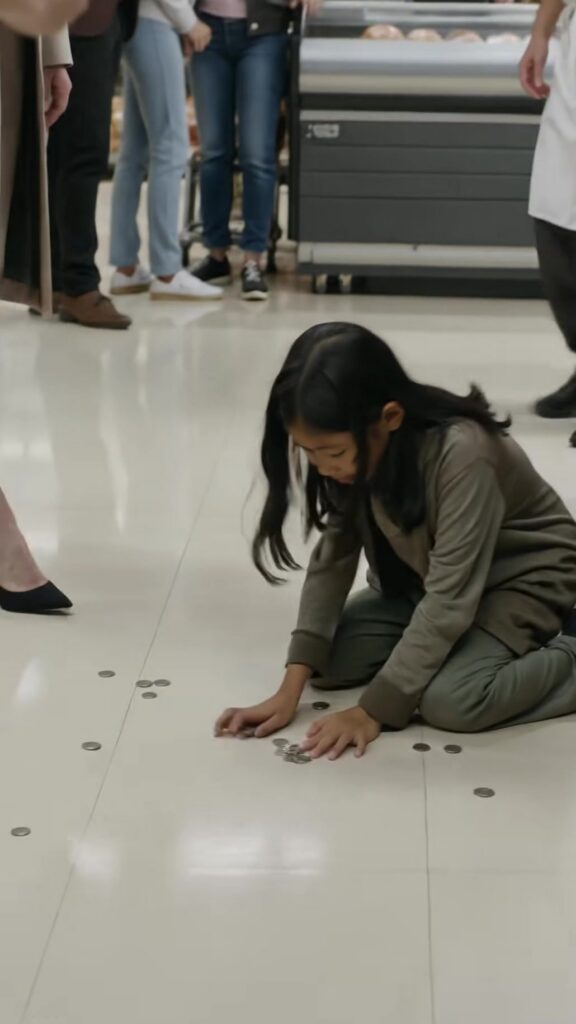
What happened next seemed to unfold in slow pieces, each one landing with a sound that didn’t belong in a supermarket. The woman reached out, not to touch the girl, but to strike the space she occupied. Her knuckles snapped against the child’s hand. The fist opened. The coins scattered like insects startled from hiding.
They spun and rolled across the tile—under the bread rack, toward the cooler, into the gap beneath the endcap. The woman, neat as a stamp, stepped forward and ground her heel down. Metal squealed faintly. Not loud, but loud enough.
“Pick up your little charity money somewhere else,” she said. “This store is for customers.”
Air shifted. A cashier at lane seven paused with an item halfway over the scanner. A man holding oranges stopped mid-step. Someone near the dairy case raised a phone, not out of courage but habit, because moments became proof when people didn’t know what else to do with them.
The girl dropped to her knees as if the floor had pulled her down. Panic contorted her face into something too old. “No—please—” She crawled, hands darting, trying to trap the coins before they disappeared under displays. Tears fell and made dark dots on the tile. “My mom said I had to wait here,” she sobbed. “Every Sunday. Until the man who bought two loaves sees me.”
The woman laughed—one short, cold note. “A fairy tale,” she said. “How convenient.”
Martin’s tray trembled in his hands. Not because of anger at the woman—though that came later, like fire catching—but because the girl’s wrist flashed as she reached under the rack. A pale line, thin as thread, cut across her skin: a scar shaped like a crescent.
His stomach dropped. The bakery lights seemed to dim. The smell of yeast turned abruptly sour in his memory.
Years ago, on a rain-whipped night when the parking lot was an ocean of reflected headlights, a young woman had run into this very store through the employee entrance. Martin had been taking out trash, his apron smeared with flour, when she appeared from the darkness with a baby bundled against her chest.
“Please,” she’d whispered, frantic. “They’re behind me. If they find her—”
Martin had followed her into the storeroom without understanding, then had seen her hands: shaking, scraped, a fresh cut on her wrist where someone had grabbed her. She’d pressed the baby into his arms for a heartbeat—just long enough for him to feel the weight of a life—and he’d seen the baby’s tiny wrist marked with the same crescent scar, as if the world had tagged her before she could even speak.
“Hide her,” the woman begged. “Just for tonight. I’ll come back when it’s safe.”
She never came back. Not the next morning. Not any morning. Police had asked questions with bored eyes. The security footage had mysteriously glitched during the hour she arrived. Martin had told himself the mother must have fled and succeeded. He had told himself the baby was somewhere warm.
Now the scar was here, on tile cold enough to sting through thin knees.
Martin set the tray down. His hands felt detached, as if they belonged to someone braver. He stepped out from behind the counter and into the open aisle. The woman’s eyes narrowed, irritated that an employee dared to enter her scene.
“Sir,” the woman began, turning on her charm like a lamp. “You should remove her before—”
“That mark,” Martin said, voice rough as uncut bread crust. “On her wrist.”
The aisle quieted further, the kind of silence that makes you hear the refrigeration units breathing. The girl looked up, cheeks streaked, one coin trapped against her palm by a trembling finger.
“I’ve seen it,” Martin went on. The words scraped out of him. “Years ago. The night a mother ran into our parking lot with a baby. She begged me to hide the child. She said someone was coming.”
The woman’s color shifted. It wasn’t guilt that washed her face, but recognition—an involuntary flicker, the way a mask slips when it hears its own name. She gripped her cart handle too tightly. Her knuckles blanched.
“What are you talking about?” she snapped, too quickly.
Martin ignored her. He crouched, slow, so he wouldn’t startle the girl. “What’s your name?” he asked.
The girl swallowed. “Lena,” she whispered. Then, as if remembering her instructions, she added, “I’m supposed to wait for the man who buys two loaves. Mom said he’d know.”
Martin’s throat tightened. He remembered the mother’s face now—not clearly, but in shards: rain in her eyelashes, fear in her teeth. He remembered a whispered name in the storeroom, a name she’d made him repeat so he wouldn’t forget.
“Lena,” he echoed, and the syllables struck him like a bell. He looked at the girl’s eyes—dark, steady beneath the tears, familiar in a way that made his chest ache. Then he looked up at the elegant woman, and he understood why she’d been so eager to crush metal under her heel. Some people didn’t stamp out coins because they hated poverty. Some people did it because they feared what small things could reveal.
“You,” Martin said to her, rising. His voice grew louder, reaching past the bread racks into the store. “You were there that night.”
“Don’t be ridiculous,” the woman hissed, but her gaze darted to the phone recording near the dairy aisle. She began to maneuver her cart backward, posture still perfect, panic tucked under expensive fabric.
Martin stepped into her path. “Manager,” he called, without turning. “Call the police. Now.”
A murmur rippled. The cashier’s hand hovered over the intercom button. The security guard, who had been strolling at the front like nothing mattered, suddenly moved with purpose.
On the floor, Lena gathered the last coin, pressing it hard into her palm as if it could anchor her. She stared at Martin as though he’d just spoken the password to a door she’d been leaning against for years.
“My mom said,” she said, voice shaking, “the bread man would help me if anything happened.”
Martin’s eyes burned. He knelt again, not as an employee now but as a witness making a vow late and loudly. “I should have looked for you,” he said. “I should have made more noise. But I’m here now. And I’m not letting anyone step on what you brought.”
The elegant woman’s heel, still resting on the flattened coin, lifted as she tried to flee. The metal sprang free with a tiny, bright sound, rolling into the light between them—small, stubborn, impossible to ignore.
And that was how the aisle broke: not from the force of cruelty, but from the sudden, irreversible weight of a truth that refused to stay underfoot.