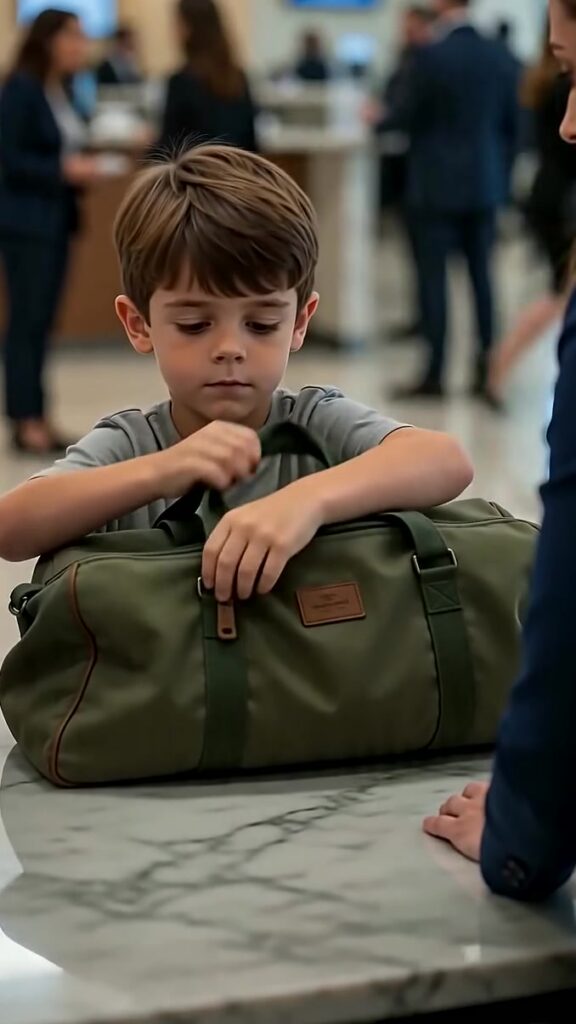
The bell above the glass doors gave a tired, obedient ring as the child stepped inside, as if the building itself hesitated to acknowledge him. Rain clung to his hair in dark beads; the cuffs of his sweatshirt were soaked through. He was small enough that the brass handle of the door had required two hands and a shoulder shove. Yet he moved with the careful gravity of someone carrying a secret that weighed more than his bones. Behind him, scraping softly over the polished tile, came a battered green duffel bag. It looked like it had once belonged to a soldier. It looked like it had been dragged through years.
Mara Hensley watched from station three, where her computer hummed and the air smelled faintly of printer toner and lemon cleanser. She had been telling herself, all morning, that today would be ordinary: deposits, withdrawals, the same chorus of signatures. The boy’s face made her soften automatically—freckles, wide eyes, a thin cut on his upper lip—until she noticed the way his gaze kept flicking to the reflections in the glass doors, like he expected someone to appear there at any moment. She rose and leaned across her counter, lowering her voice to the gentle tone people used when addressing stray animals. “Hi there. Are you here with a parent or guardian?”
The child shook his head without looking up. “No, ma’am.” His voice was steadier than it should have been. “I need to open a savings account.” In the lobby, two customers exchanged a warm smile. An older woman near the brochure rack whispered something to her companion and chuckled. It was the kind of scene that invited sentimentality, the bank as a place where children learned to be responsible. Mara could almost hear the story someone would tell later—until the boy’s hands moved to the duffel bag’s strap and he strained, jaw clenched, to lift it onto the marble ledge.
The bag hit the counter with a dull thud that silenced the lobby like a slammed book. Mara’s practiced smile faltered. The child’s fingers—raw at the knuckles—found the zipper and pulled. The teeth parted reluctantly, as if resisting. Inside, the green canvas yawned open to reveal neat bricks of currency, bound with paper sleeves, packed so tightly that the fabric bulged. Hundred-dollar faces stared up in a hundred identical expressions. A faint, metallic smell rose with the air trapped inside—ink and old paper and something else, something like a basement.
Mara’s throat tightened. Training took over: remain calm, do not alarm the customer, notify security discreetly. But her hands betrayed her, hovering over the counter as if the money might burn. “Sweetheart,” she managed, though her voice had lost its warmth, “where did you get this?” The boy swallowed and glanced again toward the doors. His shoulders lifted, then fell, as if he’d been carrying the answer for miles. “My mom told me if something happened to her, I had to bring it here,” he whispered. “And I can’t let my uncle find me.”
There were uncles and there were Uncle stories; this was the latter. Mara felt the hairs along her arms rise. She leaned closer, lowering her voice to a murmur only he could hear. “Is someone chasing you?” The boy’s eyes glistened but did not spill. “He’ll come,” he said simply, as if naming weather. Then, as Mara’s gaze dropped again into the duffel, she saw the object tucked between two bundles: a tarnished silver tag, the kind the bank used decades ago before digital records made everything clean and forgettable. It had a small hole for a chain and an engraving worn by fingers. Mara recognized the name before her mind would accept it.
ARTHUR HENSLEY.
For a moment the bank’s sounds—the counting machine, the low murmurs, the distant cough—fell away. Her father’s name sat in her sight like a ghost that had taken physical form. Arthur Hensley had died twelve years ago in an accident the papers called a robbery gone wrong. Mara remembered the casket, the folded flag, the way her mother had stared at the wall for months afterward as if the wall might explain it. The tag could not exist. Yet it did, dulled but unmistakable. Mara’s fingers closed around the silver, and the cool metal shocked her skin. The boy watched her with a strange urgency, as if he were measuring her reaction for clues about who she really was.
Mara forced herself to breathe. She reached down and pressed the silent alarm with her knee, the hidden switch beneath the counter that called security without a spectacle. Her other hand slid a deposit slip toward her, but she didn’t fill it out. Instead she looked at the boy—really looked—and tried to see what lay beneath the grime and fear. “What’s your name?” she asked. “Eli,” he said. “Eli Rourke.” The last name landed like a stone in her memory. Rourke. A man had come to the funeral once, a stranger in a dark coat who’d stood far back and left before anyone spoke to him. Mara had been twenty then. Her father’s partner, someone had whispered. Someone dangerous.
“Eli,” Mara said, “tell me about your mother.” The boy’s chin trembled. “She said your bank would know what to do. She said the tag would make them listen.” He dug into his pocket with frantic fingers and produced a damp envelope. “She told me not to open it until I was safe.” The flap had already been torn, though, as if the boy hadn’t been able to stop himself. Inside was a single photograph and a note written in hurried strokes. Mara took them with a hand that no longer felt like hers. The photograph showed her father younger than she’d ever seen him, standing beside a woman with long hair and defiant eyes—Eli’s eyes. And in her father’s arms, a baby wrapped in a blanket. On the back, in faded pen: FOR WHEN THE LIES BREAK.
The note was addressed to Mara by name. Her pulse hammered as she read. It was not long. It was devastating. It claimed Arthur Hensley hadn’t died in a random robbery; he’d been laundering evidence—money pulled from a criminal network, marked bills meant to trap a man named Dorian Rourke. The “accident” had been the network reclaiming what Arthur stole. The money in the duffel was not stolen treasure, the note said; it was a ledger made of cash, serial numbers recorded in Arthur’s private journal, proof that could detonate the lives of powerful men. The last line was scrawled so hard it nearly tore the paper: IF DORIAN FINDS ELI, HE’LL BURY THE TRUTH WITH HIM.
A shadow crossed the glass doors. Mara looked up and saw a man outside under the awning, shaking rain from his coat. He was tall, clean-cut, carrying himself like someone who believed the world moved aside when he approached. His eyes swept the lobby with predatory patience. Eli’s small hand clamped around the counter edge, knuckles whitening. “That’s him,” he breathed. Panic surged through Mara, hot and precise. She stood too quickly, forcing a smile at the nearest customer as if nothing had changed. “Eli,” she said softly, “listen to me. You’re going to come with me right now.”
She opened the side gate of her station and guided him behind the counter, the duffel bag scraping and bumping over the threshold like a reluctant animal. The bank’s security guard glanced up, confused, but Mara’s eyes locked on his and she made a subtle, urgent motion toward the back hallway. The guard’s expression sharpened. Mara led Eli past the employee lockers and into the records room, where old paper files still lived in dusty rows, and shut the door. The child’s breathing came fast. “He’s going to take it,” Eli said, hugging the duffel like a life raft. “He’s going to take me.”
“No,” Mara said, surprising herself with the steel in her voice. She had spent twelve years believing her father’s death was senseless. Now sense—awful, brutal sense—flooded the space. She knelt so she was eye level with Eli. “You did exactly what your mom asked,” she said. “And now you do what I ask.” She pulled her phone from her pocket with shaking fingers and dialed a number she hadn’t called since the funeral: the retired detective who’d once pressed a card into her hand and said, If you ever learn something, anything, you call me. It rang once, twice. Outside the door, muffled through drywall, came the sound of footsteps and a voice, smooth as oiled wood, asking the tellers if they’d seen a little boy.
The detective answered, older, wary. Mara spoke quickly, the words tasting like rust. “It’s Mara Hensley,” she said. “My father’s name is on a deposit tag in my hand, and the money he died for is in my records room. And the man who killed him is in my lobby.” There was a pause—then the detective’s voice snapped into clarity. “Stay where you are,” he said. “Lock it. Don’t confront him.” Mara ended the call and stared at the duffel, at Eli’s frightened face, at the silver tag that felt heavier than any stack of bills. Somewhere in the bank, Dorian Rourke’s voice continued its polite inquiry. Mara slid the deposit tag onto a chain around her neck, the metal cold against her skin, and wrapped her hand around Eli’s. “We’re going to ruin someone’s life,” she whispered—not in triumph, but in solemn promise. “And we’re going to save yours doing it.”