Twilight had already turned the street blue, the kind of blue that made everything look like a secret kept too long. Overhead, warm string lights hung in graceful dips between buildings, turning the sidewalk into a corridor of gold. The storefront glass threw back shimmering copies of passersby—faces, coats, steaming cups, glossy shopping bags—each reflection sliding away before it could be held.
On that street, no one belonged to anyone for more than a heartbeat. People moved in soft blurs, brushing shoulders, apologizing without meaning it, looking through one another as though the evening itself were thick enough to erase strangers.
Then a little boy stepped out of the crowd like a wrong note in a familiar song.
He was small and underdressed, wearing a hoodie that had lost its shape and trousers too thin for the cooling air. Dirt streaked his cheek and the back of one hand as if he’d fallen and decided there was no time to stand still and feel the sting. His fingers trembled, not from cold alone but from effort—the kind it takes to cross a room full of adults when you are afraid of being pushed back into the corner you came from.
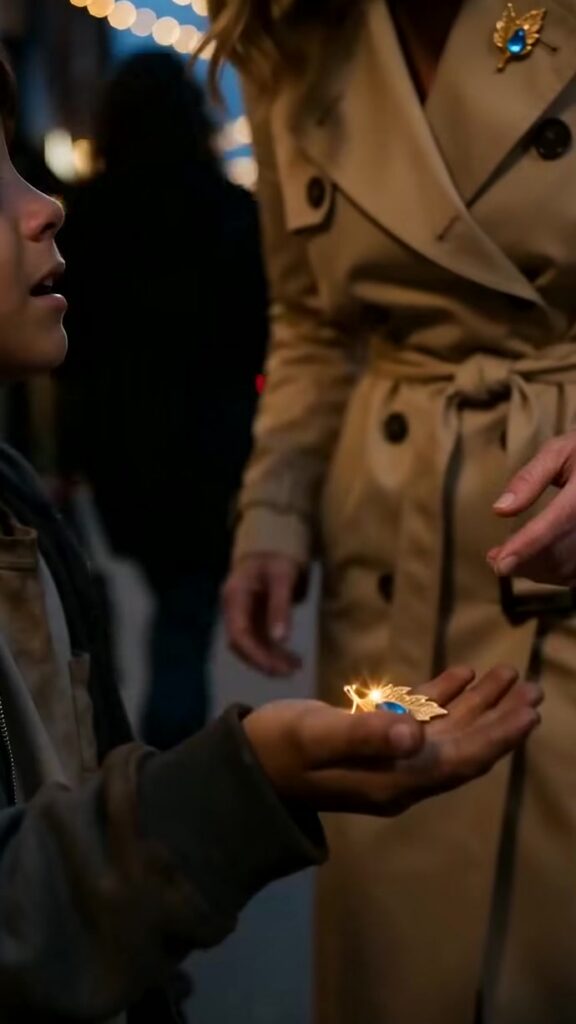
He watched a woman walking beneath the lights. She moved with the practiced speed of someone who had a destination and knew she deserved to reach it. A beige trench coat hugged her shoulders; her hair was pinned neatly at her nape. A gold chain strap swung from her arm, catching light in bright flashes like a signal.
But it wasn’t the bag that held the boy’s attention. It was her collar. The small thing fastened there: a gold leaf, delicate veins etched in metal, and at its tip a single blue teardrop stone that seemed to hold twilight inside it.
The boy stopped breathing for a moment, as if air would disturb the fragile proof his eyes were gathering. Then he moved.
He ran forward and caught the chain strap of her bag with one hand—more a desperate tap than a theft. The motion jolted her as if she’d been struck. She spun around instantly, eyes sharp, posture flaring into defense.
“Don’t touch me.” Her voice cut through the evening noise, crisp and clean, the kind of voice people listened to in boardrooms and restaurants where the menu didn’t list prices.
The boy recoiled. His hand fell away at once, fingers curling to show he had nothing. He didn’t back away, though. His mouth opened and closed twice before sound came.
“Excuse me,” he managed, the words barely above the street’s hum.
The woman yanked the bag close, already turning her shoulder to leave. She wore annoyance like an accessory; it suited her. “Find someone else,” she said without looking, as if he were a sales flyer fluttering at her heels.
But the boy looked up at her with the terrible focus of a person who understands there may not be another chance. “You… you have the same pin.”
That sentence stopped her—not the way a stranger’s remark usually stops you, with irritation, but the way a name spoken in a dream stops you, with dread. Her gaze flicked to his face, then to where he stared.
“What are you talking about?” Her question sounded annoyed, yet her eyes had already begun to change, searching him for something she didn’t want to find.
The boy swallowed hard. Slowly, carefully, as though he feared the street might snatch it away, he opened his fist.
In his palm lay a pin: gold, leaf-shaped, tipped with the same blue teardrop jewel. Under the string lights, the stone caught fire, a sharp blue that didn’t belong to the warmth around it.
The woman’s hand flew to her own collar. She pressed her fingers to the pin she wore, as if to make sure it was still there, as if to confirm her own body existed.
For a moment her face held nothing—no anger, no disdain—only a hollowing shock. Then fear slid into the empty place, quiet and quick.
“That’s impossible,” she said, but the words thinned before they reached the air.
The boy’s eyes filled. He blinked once, hard, trying to keep his voice from cracking. “My mom had this. She kept it in a tin with paper flowers. She told me not to lose it. She said… if I ever saw the woman with the other one…”
The woman went very still. The city didn’t stop for them—shoes kept passing, laughter rose and fell, a bicycle bell chimed—but the space beneath the lights seemed to tighten as if an unseen hand had gathered it.
“Who is your mother?” she asked. Her voice had softened, but not into kindness. It softened into something more dangerous: recognition.
The boy hesitated, not because he didn’t know the name, but because he’d carried it like a stone in his mouth for so long. “Her name was Maris.”
The woman’s lips parted. Color drained from her face. She looked beyond him for a second, as though she might see a figure stepping out of the twilight—someone she had buried without a grave.
“Maris,” she repeated, and the syllables sounded unfamiliar on her tongue, too intimate to say aloud on a public street. “No. She can’t—”
“She’s gone,” the boy said quickly, because pretending otherwise had cost him too much already. “She got sick last winter. The shelter nurse said it was pneumonia. She said it would get better. It didn’t.”
The woman’s throat moved as if she’d swallowed glass. Her fingers stayed on the pin at her collar, pinching it as if it might anchor her to the earth. “Where is she buried?”
The boy’s shoulders curled in. “I don’t know. They said… they said there was a place. I couldn’t go. I didn’t have anyone to take me.”
A wave of noise swept past—someone calling a friend’s name, a car door slamming—and the woman flinched like it was aimed at her. She studied the boy again, and now her eyes were not sharp with judgment but frantic with calculation: his jawline, the set of his brows, the shape of his ears. The small scars on his knuckles. Something in him tugged open a locked drawer in her memory.
“How did you get that pin?” she demanded, too suddenly, too fiercely. “Did you steal it from her?”
The boy shook his head so fast it hurt. “No. She gave it to me the day before she went to the hospital. She said it was proof. She said you’d know.” He lifted his hand higher, and his trembling made the jewel wink like a signal flare. “She said you were her sister.”
The woman’s breath hitched. Her gaze dropped to the matching pin on her coat, as if it had become an accusation. “I don’t have a sister,” she whispered, and yet her voice betrayed her—because the statement sounded like something she had practiced saying to survive.
“She said you stopped answering,” the boy said, softer now. “She said you changed your last name. She said you were afraid.”
That last word landed between them with weight. The woman’s eyes shone, but not with tears—yet. With the strain of holding them back.
“What is your name?” she asked.
“Eli,” he said. Then, as if he feared she might dismiss him again, he added, “Eli Maris’s son.”
The woman’s knees seemed to loosen. She reached out as though to touch his shoulder, then stopped short, her hand hovering in the air between them like an apology that didn’t know where to go.
“I’m Adrienne,” she said at last, the name falling from her mouth with the heaviness of confession. “Adrienne Vale.” She laughed once, sharply, without humor. “Vale. Like a curtain. Like something meant to cover what’s behind it.”
The boy stared at her as if names were spells and he was waiting to see if the street would change.
Adrienne’s eyes darted to the crowd, then back. “I haven’t heard Maris’s name in fifteen years,” she said. “I told myself she’d forget me. I told myself she was safer without me.” Her voice shook. “I told myself a lot of things.”
“She didn’t forget,” Eli said, and his words were a small blade, clean and final.
Adrienne closed her eyes. When she opened them again, something in her face had cracked, letting through a grief that made her look younger and older at once. She sank down on one knee so they were level under the lights.
“Show me,” she whispered. “Show me everything you have from her.”
Eli’s fingers curled around the pin, guarding it. “If I do,” he said, voice quivering, “you won’t walk away?”
Adrienne’s expression tightened, and for a moment it looked like she might break apart on the pavement. Then she reached up and, with careful hands, unclasped the pin from her collar. She held it out, not as proof but as surrender.
“I won’t,” she said. “Not again.”
Under the string lights, two identical leaves gleamed in two trembling hands—one small and dirty, one pale and manicured—both shaking for the same reason. People continued to hurry past, unaware of the quiet collision happening in the blue of the street: a child holding the last thing his mother left him, and a woman discovering that the past had grown teeth and returned to bite through the lies she’d built her life upon.
Eli took a shaky breath and stepped closer. The air between them felt thinner, electric. Adrienne looked at him as if she were trying to memorize him in case she woke up and found herself alone again.
“Come with me,” she said, and it wasn’t a command. It was a plea weighted with a promise. “We’re going to talk. We’re going to find out what happened. And if you’re telling me the truth—if you’re Maris’s boy—then you’re not going back to the cold.”
Eli didn’t smile. He didn’t even nod at first. He only lifted the pin once more, holding it between them like a fragile bridge. “She said you’d be scared,” he whispered. “But she said you’d be good underneath it.”
Adrienne’s eyes finally spilled over. She reached for him, slow and careful, and this time she didn’t stop. Her hand settled on his shoulder, light as a feather and heavy as a vow.
Twilight deepened, and the street stayed blue, but under the string lights something else began—something that did not shimmer and vanish when you looked too long.