The ballroom was glowing gold, as if someone had melted down sunlight and poured it into every corner. It clung to the crystal chandeliers and slipped across the lacquered floor in long, bright ribbons. The last notes of the evening’s performance had faded, but the applause still seemed to hover in the air—soft as dust, unwilling to settle.
Guests in black and white stood in clusters around the dance space, holding flutes of champagne with careful fingers, wearing the practiced expressions of people who had dressed for celebration and weren’t sure what to do with the after. A string quartet at the far end adjusted their music stands, turning pages that didn’t need turning. Someone laughed too loudly and then swallowed it back, as if the room itself had asked for quiet.
At the edge of the floor sat a wheelchair, dark and plain against the glow. It looked like an object left behind when the real story moved on. But the story hadn’t moved on. It was right there beside it—small, still, and glittering in blue.
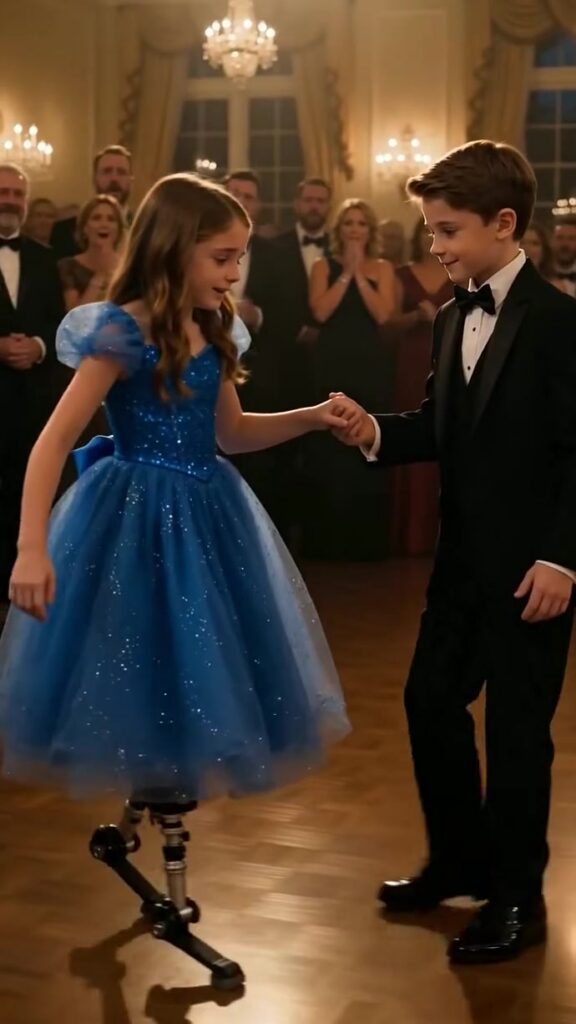
Lina’s dress had layers like waves, each one catching the chandelier light and throwing it back in shards of sapphire. A tiny plastic tiara perched on her curls. She looked like a princess someone had taken too literally: beautiful, ceremonial, and pinned to a single spot by rules she hadn’t agreed to. Her hands trembled in her lap, not from cold but from the effort of holding herself together under so many watching eyes.
The bright folds of her skirt hid the joints and seams of her prosthetic legs. The adults pretended not to stare. The children didn’t pretend at all; they studied her with the blunt curiosity that never means harm and still can.
Her father stood behind her, a tall man in a dark suit that fit as if it had been tailored around grief. Victor’s tie was perfectly knotted; his face was not. He watched the dance floor the way sailors watch a storm: trying to measure it, trying to bargain with it, trying to convince themselves they can steer through.
He had memorized the language of limitation over the last five years—terms that sounded scientific and final. He had learned to smile at hopeful specialists and to nod at cautious ones. He had learned how to clap when Lina completed another small exercise, and how to swallow his disappointment when she collapsed afterward, pale with frustration.
Tonight was supposed to be safe. Tonight was supposed to be about watching other children do what their bodies did without negotiating. The event had ended. They could leave with dignity intact. That was Victor’s plan.
Then a boy in a black tuxedo stepped out from the crowd.
He was not tall. He was not particularly striking. But he moved with the certainty of someone who had decided on a single truth and didn’t care whether the room agreed. His shoes whispered on the wood as he crossed the boundary where people usually stopped and stared from a distance.
He looked at Lina for one long second—long enough that Victor’s chest tightened, ready to intercept whatever pity might follow. But the boy’s face held no softness of condescension. There was no theatrical smile, no careful sadness. His expression was simply intent, like a musician listening for a note.
He stopped in front of Lina and held out his hand.
The ballroom went quiet in a way that felt physical, as if someone had lowered a glass dome over them all.
“Come on,” the boy said, his voice steady, almost gentle. “Dance with me.”
Lina stared at his hand. Then she glanced at the wide, empty center of the floor, where the light pooled like honey. She looked back at him, her lips parted in a question she couldn’t shape.
Victor’s mind flashed through scenes like broken film: Lina as a toddler reaching for the coffee table and falling; Lina at therapy, jaw clenched, refusing to cry; Lina at home, practicing in the hallway until her shoulders shook with fatigue. He had tried to make peace with all the things she might never do. Peace, he had discovered, was not calm. It was surrender dressed up as wisdom.
“Lina,” he started, meaning to protect her, meaning to stop the moment before it could cut.
But Lina lifted her small hand and placed it in the boy’s palm.
Victor froze. Around them, a ripple moved through the room—inhales, hands rising to mouths, the subtle shift of bodies leaning forward as if pulled by a tide.
The boy tightened his grip just enough to be real, not enough to hurt. He stepped back a half pace, inviting her forward.
Lina pushed herself up from the chair. The wheelchair rolled slightly behind her with a quiet squeak, as if it, too, were startled. Lina’s face tightened. Her shoulders trembled. She swallowed once, hard, and lifted her chin like someone climbing a mountain that had once only existed in stories.
Her first step was a negotiation between fear and physics. The prosthetics held, the joints responding with a sound so small it might have been imagined. She wobbled and caught herself with the boy’s hand. His other hand hovered near her elbow, not grabbing, just present—an offered safety net.
Another step. Then another. Her cheeks flushed, and tears gathered without falling. She was not looking at the crowd. She was looking at the floor as if it might betray her. The boy kept his gaze on her face, as if her expression mattered more than her balance.
The quartet, sensing the shift in the room’s heartbeat, began to play again. A waltz, slow and forgiving. The first notes were tentative, then they grew confident, climbing into the chandeliers and coming back down softened by gold.
The boy guided Lina into the light. Her blue dress caught the warmth and exploded into glittering shards of color, as if the ballroom had been waiting for her specifically to appear. He raised their joined hands and turned her gently. The skirt opened around her like a flower learning it is allowed to bloom.
Lina’s laugh burst out—bright, startled, edged with tears. It wasn’t the polite giggle she offered strangers. It was the sound of a door opening in a house she’d thought was locked forever.
“I’m… I’m dancing,” she whispered, as if speaking it might anchor it into truth.
The applause came then, not the formal clapping of performances but a wave of sound full of awe and relief. People cried openly. People who had never met Lina pressed their hands to their hearts as if they had been waiting their whole lives to see someone stand in defiance of a sentence.
Victor’s body betrayed him. He brought a shaking hand to his mouth, but it couldn’t stop the sob that broke free. He had imagined this moment in secret, like a forbidden prayer. Now it was happening, and it was more painful than he’d expected—not because it hurt, but because it revealed how much he had already buried.
In the center of the floor, the boy slowed. He shifted his grip, then—very carefully—released one of Lina’s hands. Just for a heartbeat.
The room’s applause died as if someone had cut a string. Silence crashed back down.
Lina stood.
She swayed, her arms lifting instinctively for balance. Her eyes widened with terror, then narrowed with focus. The ballroom held its breath, hundreds of people suspended on the knife-edge of whether she would fall.
She did not fall.
Lina looked down at her feet as if they belonged to someone else. Then she looked up, and the boy offered her his hand again without rushing. She didn’t take it immediately. Her gaze drifted to the wheelchair at the edge of the floor, the dark outline against the light.
Her lips parted. Her whole face changed, shock shifting into something almost fierce.
She turned to the boy, tears finally spilling, and whispered with a trembling certainty that sounded like a demand: “You knew I could do it… but how?”
The boy’s eyes flicked, not to the wheelchair, but to Victor. For a brief, electrifying second, Victor saw something in the child’s expression that didn’t belong to a child at all—an understanding too old, too intimate with grief.
Then the boy looked back at Lina, and his voice dropped low enough that only she could hear.
“Because I’ve watched you try when you thought no one was looking,” he said. “And because the floor isn’t the thing you should be afraid of. It’s the moment you stop believing the next step is possible.”
Lina blinked. The gold light flickered across her wet cheeks. She tightened her fingers around his again—not as a rescue, but as a choice.
Victor exhaled, as if he had been underwater for years. The ballroom still glowed, still held its breath, but something in the air had shifted. It wasn’t just celebration anymore. It was the fierce, terrifying beginning of a new story—one where the edge of the floor was no longer a place to wait.
And in the center, under the chandeliers, Lina took another step.