No one at the rooftop restaurant knew the boy’s name when he stepped into the light. They didn’t even think to ask. On a rooftop where reservations were currency and the city glittered like a promise, a child was simply an interruption—an error in the velvet logic of the evening.
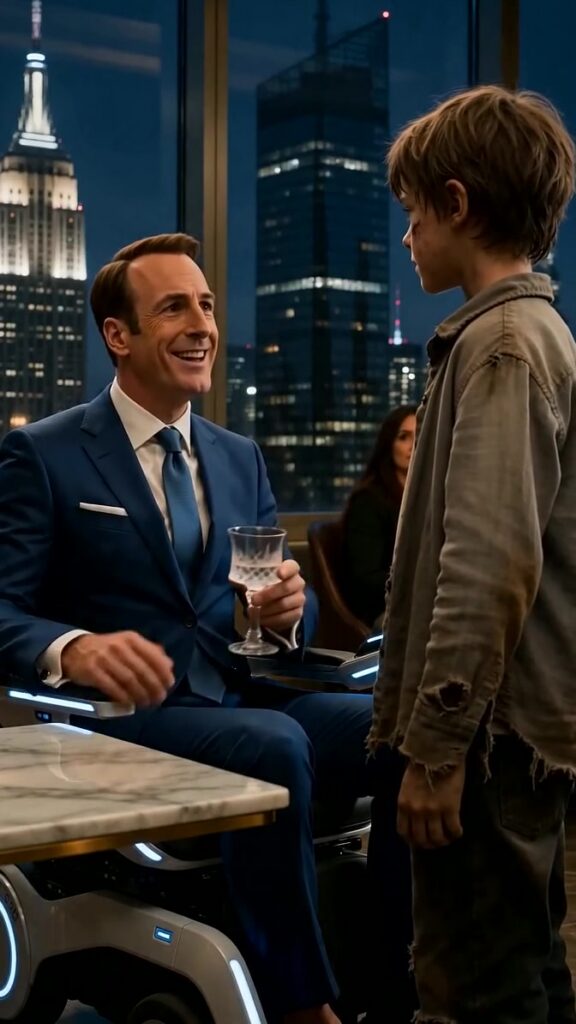
The restaurant was built to make people feel untouchable. Glass walls held the wind at bay. A chandelier the size of a small car scattered gold across marble tabletops. The skyline beyond looked painted, distant, harmless. At the center of the room, Julian Voss sat in his custom wheelchair like a man on a throne, his suit cut to flatter a body the world had learned to address carefully.
The boy stopped at Julian’s table as though he’d been invited. He was all angles and thinness, clothes torn in practical places, shoes worn through at the toes. His hair stood up in stubborn tufts, as if combs were an invention meant for other children. He didn’t stare at the wheelchair with that hesitant pity Julian had trained himself to endure. He looked straight at Julian’s face, with an expression that made the air around them feel newly sharp.
“Sir,” the boy said, and the word sounded too heavy for a child’s mouth.
Nearby diners leaned in, sensing entertainment. A woman with sequins on her sleeves smiled like she’d been promised a punchline. Julian turned his wine glass slowly by the stem, pretending he was amused by the audacity rather than unsettled by the boy’s calm.
“What do you want?” Julian asked.
The boy stepped closer until the chandelier light found his cheeks and made the grime along his jaw look like shadow. “I can make you walk,” he said.
The sequined woman let out a small laugh. A man at the bar snorted. Julian’s mouth twitched—not quite a smile, not quite anything. He had heard every miracle story: faith healers, experimental surgeons, herbalists, men who claimed to read nerves like scripture. They all wanted money, attention, a photograph with the famous crippled heir. They all left eventually, when he did not become their headline.
“How quickly?” Julian asked, because the part of him that had once prayed in hospital rooms still lived somewhere under the sarcasm.
“Count to three,” the boy answered.
Julian set the glass down. “If you do it,” he said, leaning forward as if negotiating a business acquisition, “I’ll transfer one million by morning.”
Now the room went quiet in the peculiar way rich spaces do when something threatens to become real. Waiters paused with plates hovering. Conversations thinned to silence. The boy didn’t react to the number. He crouched by the wheelchair, close enough that Julian could see his hands shaking, not with fear but with strain—as if the boy were holding up something invisible.
He placed his palm over Julian’s bare foot on the footrest. The contact was warm, ordinary. Nothing mystical. Yet a faint vibration seemed to move through the table legs, through Julian’s bones, like the echo of a subway train passing beneath the city.
“With me,” the boy said, eyes lifted to Julian’s. “One.”
A jolt went through Julian’s leg like lightning finding a path it had forgotten. His fingers slammed the table edge. Wine jumped in the glass. Someone gasped, loud enough to break the room’s spell and then instantly regretted it.
Julian stared down at his foot. His toes had moved. Not the phantom flicker that sometimes teased him, not a remembered sensation, but motion—unmistakable, undeniable.
“Two,” the boy whispered, and Julian’s second toe curled as if testing the world. Pain arrived late, sharp and clean, like a blade of ice: the pain of nerves waking, of a body realizing what it had lost. Julian’s throat tightened around a sound he did not want to make.
“Stop,” he breathed, but the word wasn’t a command. It was fear in disguise.
“Three.”
The foot flexed. The ankle tried, wobbling like a newborn animal. Julian’s vision blurred at the edges. The room was very still. Even the sequined woman had gone pale, her smile erased as if she’d been slapped.
Julian looked up. “What are you?” he demanded, because no other question fit.
The boy’s expression crumpled for a moment, grief pushing through his composure. “My mother begged you once,” he said. “You didn’t see her. You saw a problem that could be thrown away.”
He reached into his pocket and opened his fist. A small oval pendant lay in his palm, its silver worn smooth, the clasp slightly bent. Julian’s lungs stopped working. He had bought that pendant years ago, in a place he had convinced himself was a dream—an apartment above a pharmacy, the air smelling of antiseptic and rain.
Elena had worn it against her throat. Elena had laughed softly when he fastened it, as if she couldn’t believe anyone would give her something pretty without demanding blood in exchange. He had promised he would return before sunrise, swearing it like a vow. By morning, she was gone, and his family’s version of the story had been ironclad: she’d taken his gift, taken his foolishness, and disappeared.
The boy’s eyes were Elena’s eyes—dark, direct, unafraid of the world’s verdict. His mouth, when it tightened, was Julian’s. “She said if your leg ever woke up,” the boy murmured, “you’d finally look at me.”
The restaurant’s silence thickened into something suffocating. Julian’s hands gripped the wheelchair arms until his knuckles whitened. “Who are you?” he managed.
The boy swallowed and said, with the steadiness of someone repeating a rehearsed truth, “I’m the part of your life that got buried.” Then, quieter: “She told me not to hate you until I saw you for myself.”
Julian tried to speak again, but the words tangled. The pendant trembled in the boy’s palm. Tears stood at the edges of his eyes without falling, as though even crying was a luxury he couldn’t afford. “She’s downstairs,” he said. “Saint Claire’s clinic. Three floors down. She can’t breathe right anymore. She said rich people like to dine above pain as long as they don’t have to smell it.”
Julian’s stomach turned cold. He looked toward the glass wall as if the city might offer an explanation. “Why now?” he whispered.
“Because she’s running out of time,” the boy said. “And because there’s something else you don’t know.” He took a breath that shook. “She told me to ask you why your brother paid to hide your son.”
Julian froze so completely it felt like the chandelier light had turned to stone. Only one person knew that Elena had vanished with help—help purchased with Voss money, arranged with the efficiency of a corporate merger. Julian’s older brother, Marcus, had always been the family’s cleaner of messes.
The private dining doors opened behind the glass, and Marcus Voss stepped into view in a charcoal suit, his posture sharp with entitlement. The second his gaze landed on the boy kneeling by the wheelchair, his face drained of color. The mask of the evening—polite laughter, curated elegance, the illusion that nothing unexpected could pierce their world—cracked cleanly in half.
Marcus moved toward them with a smile that didn’t reach his eyes. “Julian,” he said, voice pitched for calm, for control, “what is this?”
The boy stood, still small, still thin, but somehow taller now that the truth had been spoken aloud. He lifted the pendant higher, so the light struck its worn surface and made it gleam like a tiny blade. “My name doesn’t matter,” he said to Marcus, then turned to Julian. “But yours does. And hers does. Are you going to keep sitting here pretending you can’t feel anything?”
Julian looked down at his foot, at the faint tremor running through it—a reminder that something dead can wake, that something stolen can return. He looked up at his brother, at the fear flickering behind Marcus’s practiced composure. Then he looked at the boy—his son, his sentence, his chance—and he felt the terrible weight of the years come crashing back with the force of a fall.
Julian pushed his palms hard against the wheelchair arms. Pain lanced up his leg, bright and honest. The room held its breath as he forced his foot to the floor.
“Take me to her,” he said, and his voice, for the first time in twelve years, sounded like a man who had decided to stop being managed.
Marcus’s hand shot out. “Julian, don’t—”
“Don’t what?” Julian cut in, eyes locked on his brother. “Don’t remember? Don’t ask questions? Don’t walk into the part of this city you paid to keep me above?”
The boy stepped toward the doors without waiting. Julian rose—shaking, uneven, furious—and the restaurant watched as the untouchable heir stumbled into motion, following a child nobody had named, down from the light toward the truth waiting in the floors below.