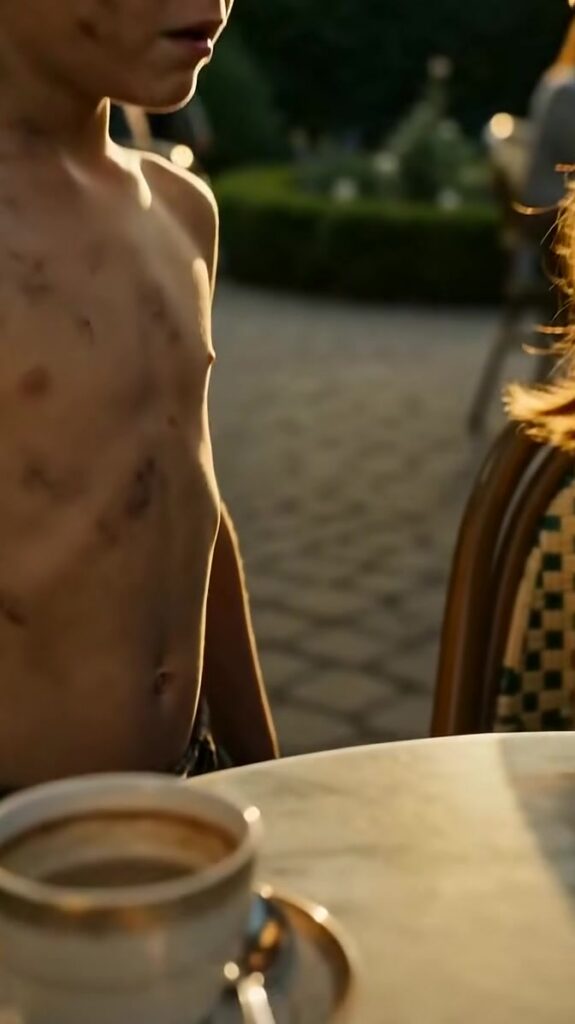
The café glowed with the kind of golden light that made everything look expensive and untouched. It gilded the rims of water glasses and turned the marble tabletops into calm, pale mirrors. Even the air seemed filtered—perfume softened by citrus trees, espresso rounded into something almost ceremonial. Outside, the afternoon pooled in the garden path like honey, and the patrons spoke as if noise itself were impolite.
Clara Voss sat where she always sat on Thursdays, back straight, hands folded, a black dress that could pass for mourning or power depending on who was looking. She had learned to wear grief in fabrics that didn’t wrinkle. The waiter brought her tea—Darjeeling, no sugar—without asking. She watched the elegant people leaning into their lives, their laughter held low, their fears concealed like seams.
Then something moved at the edge of that perfect scene, in the place the golden light didn’t quite reach. A child stepped out from behind a planter, small enough that no one had noticed him until he was already there, between the chairs and the money and the careful voices. He was barefoot. Dust clung to his shins. His ribs showed through skin browned by sun and neglect. He looked too young to be alone and too determined to be lost.
Clara’s first impulse was irritation—an old reflex from a family that believed disorder was a moral failing. Her second impulse, sharper, was caution. He walked toward her as if she were the only fixed point in the room. His eyes were bright with a wetness that didn’t ask for pity; it demanded attention. Before the people around them could decide whether to be charitable or offended, the boy lifted a trembling hand and combed his fingers into Clara’s hair near her temple.
Clara jerked back so hard her chair scraped the stone. The sound cut through the café like a snapped string. Conversations stopped. Cutlery paused in midair. A woman with an expensive watch inhaled as if witnessing a crime. Clara’s voice came out colder than she intended. “Don’t touch me.”
The boy recoiled, but not like someone scolded. More like someone who had just reached toward a flame and realized the warmth was not his. He stared at her hair, at the curve where it fell against her cheek. “It’s the same,” he whispered, as if speaking too loudly might break whatever was holding him together. “She had it like this.”
Clara’s annoyance faltered. A certain sentence—half memory, half threat—ticked through her mind: We all look alike when we’re frightened. She hated how quickly her heart had changed its rhythm. “Who is ‘she’?” Clara asked, and heard, against her will, the tremor under the words.
The boy swallowed. His throat worked as if every syllable cost him something he couldn’t afford. “My mother,” he said. “She told me… she said I’d find you here.” The phrase landed with the weight of a name she hadn’t spoken in years. Clara’s fingers tightened around her teacup until she felt the porcelain’s delicate resistance.
“That’s impossible,” Clara said automatically, the way she had said it to the police nine years ago, and to journalists after, and to her own father when he wanted an ending that didn’t hurt. Impossible was easier than not knowing. Impossible was what you paid for with lawyers and silence.
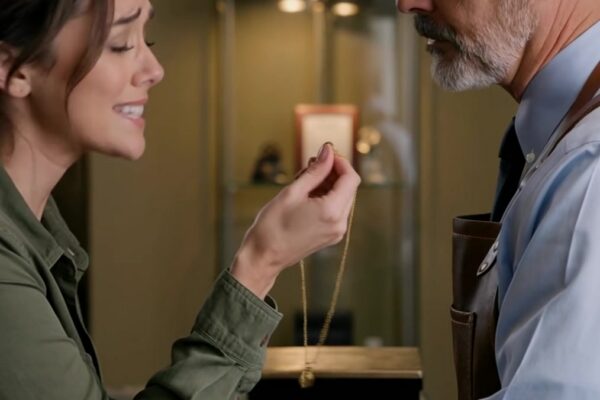
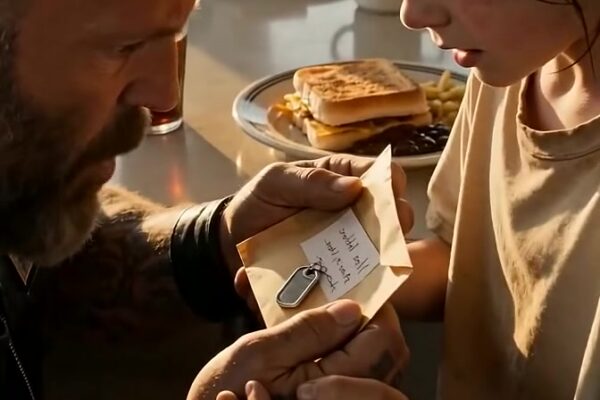
The boy reached into the pocket of his torn shorts and pulled out something that did not belong in those dirty fingers. A hair clip. Gold filigree shaped like a small wing, studded with stones so tiny they flashed like trapped stars. The café’s light caught it and turned it into a message. Clara’s breath snagged. She recognized the clip the way one recognizes a scar on someone else—intimately, violently. It had been Lena’s. Her sister’s favorite. A foolishly beautiful piece their mother had given her on her twenty-first birthday, right before Lena walked out with a woman the family pretended was a friend.
Clara stood too fast. Her knees hit the table. Tea rippled, nearly spilling. Around them, the patrons leaned in, starving for drama that wasn’t theirs. Clara couldn’t find her voice at first; when she did, it was raw. “Where did you get that?”
The boy’s eyes filled and overflowed. “She kept it wrapped in cloth,” he said. “Like it was a secret she could hold onto.” He thrust the clip toward Clara as if returning something stolen. “She said you’d know. She said you’d know it was hers.”
Clara’s pulse hammered in her throat. Lena. Lena with the laugh that broke rules. Lena with the habit of tucking hair behind her ear when she was lying. Lena, who had vanished after a charity gala, after a supposed weekend retreat organized by a woman named Maris Haldane—a consultant with smooth hands and no history anyone could trace. The official story had been an accident. The unofficial story had been everything Clara refused to say aloud at night.
“Your mother,” Clara managed. “Is she alive?” The word alive felt like a sin against the years Clara had spent mourning without proof.
The boy’s shoulders shook once. “Yes,” he whispered. “But not for long if she stays where she is.” He turned his head, slow, as if afraid that moving too quickly would summon something dangerous. His gaze pointed beyond the café’s terrace, down the garden path where the sunlight broke into stripes between trees.
Clara followed his look—and felt the world tilt.
There, half hidden near the hedges, stood a woman in a slate-gray suit. She was still, almost elegant, hands clasped in front of her like a visitor at a museum display. Her hair was pinned severely. Her eyes were on the boy, then on Clara, with the calm of someone who believed she had already won. Maris Haldane. Older now, but unmistakable. The woman who had smiled at Clara’s parents and promised she would “keep Lena safe.”
Clara’s lungs refused to work for a beat. Her mind flashed with details she’d tried to drown: Maris’s business card with its raised lettering, the way Lena’s wrist had been held a fraction too tightly as she was guided to the car, the hush that fell over the family afterward like a lid. Clara tasted metal. Her hands curled into fists at her sides to keep them from shaking.
Maris’s chin lifted as if in greeting, then she began to pivot away—an unhurried retreat, confident in the crowd’s reluctance to interfere. Clara took a step forward, but her feet felt anchored by every year she had failed to find her sister.
The boy’s voice cut through her paralysis, small and fierce. “If she leaves,” he whispered, “my mom will die with no one knowing she existed.” He swiped his face with his forearm, smearing tears into dust. “She can’t move much. She told me to bring you the wing, and to say—” His voice cracked. He forced it out anyway. “She said, ‘Tell Clara I’m sorry I believed her.’”
Clara’s stomach dropped. Sorry. Believed her. The pronouns were arrows that finally found a target.
In the café, someone murmured, “Is everything all right?” as if this were a spill to be cleaned up. Clara didn’t answer. She stepped around the table, eyes never leaving Maris. She heard her own heels on stone, loud as gunshots in a room built to muffle truth.
Maris quickened her pace. Not much—just enough to test whether Clara would follow. The golden light no longer felt warm. It felt like a spotlight. Clara’s voice came out steady, to her own surprise. “Maris.”
The woman in gray paused near the trees and turned, her expression composed, her eyes assessing. “Clara,” she said, as though they were acquaintances meeting for tea. “It’s been a long time.”
Clara closed the distance until only a few steps separated them. Behind her, the boy hovered like a fragile witness, clutching the jeweled clip as if it were proof that could bite. Clara’s heart raged against her ribs, but her mind, for the first time in years, felt painfully clear.
“Where is my sister?” Clara asked. The words were not a plea. They were an accusation sharpened by nine years of unanswered nights.
Maris’s gaze flicked to the boy, then back. For a moment, something like irritation marred her polish. “You don’t understand what your sister agreed to,” she said softly. “You never did.”
Clara took the hair clip from the boy’s hand. It was heavier than it looked. It warmed against her palm as if it remembered Lena’s skin. Clara lifted it between them, a small wing catching the sun. “I understand this,” she said. “And I understand that he came alone because you thought no one would believe him.” She leaned in, lowering her voice so only Maris could hear. “But I will. And I will make the world watch.”
Maris’s mouth tightened. Her confidence slipped, just a fraction. Enough.
Clara reached into her purse and pulled out her phone, thumb already pressing the emergency number. As it rang, Clara looked back at the boy. “What’s your name?”
He blinked, startled by the gentleness in her voice. “Eli,” he whispered.
Clara nodded once, as if sealing a vow. “Eli,” she said, “you did the bravest thing in this room.” Her eyes returned to Maris, who had begun to glance around for exits. “Now we go to your mother.”
The café’s golden light continued to glow, making everything look expensive and untouched. But beneath that sheen, a story that had been buried alive finally began to claw its way into the open air.