Late sunlight fell through the maple leaves like scattered coins, turning the cul-de-sac into something a postcard would envy. Lawns lay trimmed to surgical perfection. Sprinklers ticked. Wind chimes argued softly with birdsong. If you drove through too fast, you’d assume nothing bad could happen here—nothing sharp, nothing hungry, nothing that could make a child choose between pride and survival.
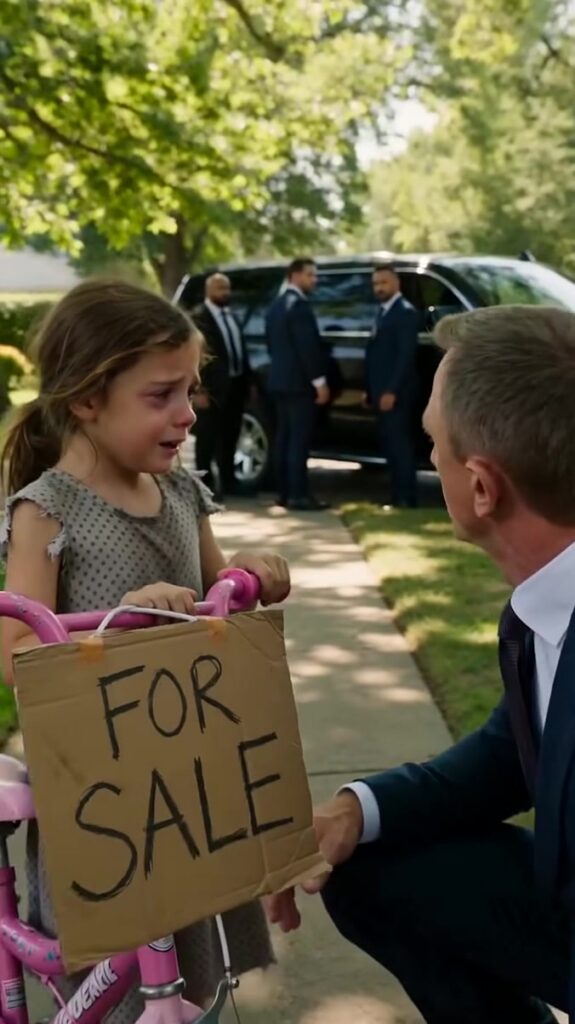
Yet on the sidewalk in front of a pale-blue house, a little girl stood with a pink bicycle that was too small for tragedy and too loved for a yard sale. A piece of cardboard hung from the handlebars on twine, the letters thick and unsteady: FOR SALE. The sign swung with every tremor of her hands, tapping the bell again and again as if the bicycle were trying to call attention to itself.
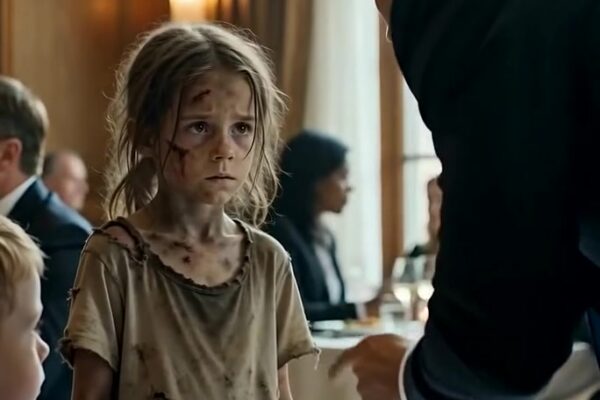
Her dress had been white once. It carried old stains like stories she didn’t want to tell. Tears shone on her cheeks and kept sliding down as if her face had forgotten how to stop. She was doing the brave thing adults praised in speeches—standing up, asking for help—except there were no speeches here, only the hiss of a passing car and the faint smell of fresh-cut grass that had no right to smell so clean.
Across the street, a black SUV waited at the curb like a poised animal. Three men in dark suits stood near it, speaking in the low, clipped tones of people who had learned to keep emotions out of public view. Their eyes moved in patterns: driveway, windows, street corners. They did not look at the little girl. They looked at everything around her, as though she were background decoration.
Then the wealthy man in a navy suit approached from the direction of the park. He walked with the kind of confidence that came from never having to ask permission. His tie was neat, his shoes polished, his expression tired in a way that suggested meetings and flights and decisions made in glass offices. One of the suited men angled his body as if to intercept anyone who got too close.
The little girl pushed the bicycle directly into the man’s path.
Not rudely—there was no defiance in her, only urgency. The bicycle’s front wheel bumped his shin with a soft thud. She flinched, as if apologizing for even that small contact.
The man stopped immediately.
That pause changed the street. It was the difference between a person and a passing shadow. Most adults had already looked past her, or looked at the bicycle first, or offered the empty smile that warmed nothing. But he looked at her face as though it mattered what it said.
He lowered himself onto one knee, bringing his eyes level with hers. The sunlight caught the edge of his watch, bright as a flash of water.
“Why are you selling it?” he asked.
She wiped at her tears with the heel of her hand, smearing them instead of drying them. Her other hand never left the handlebars, as if letting go would cause the whole plan to collapse.
“My mom hasn’t eaten,” she managed, the words dragged out of her like hooks. “Not since yesterday. She says she’s not hungry but—” Her breath broke. “But I can hear her stomach at night.”
Something in the man’s face shifted. It wasn’t pity. It was something sharper, an alarm bell behind his eyes. He looked down at the bicycle again, taking in the scuffs, the faded sticker on the frame, the frayed ribbon tied near the seat. This wasn’t junk dragged from a garage. This was a child’s small kingdom, surrendered for a chance at groceries.
“How much?” he asked softly.
She blinked, startled by the question, as if she had expected only dismissal. “Twenty,” she whispered. Then, as though she could make the number more believable by adding details, “It has new tires. I kept it inside.”
Behind them, one of the suited men cleared his throat, a warning disguised as a reflex. The wealthy man didn’t look back. He studied the girl’s face a moment longer. The street felt suddenly too quiet. Even the birds seemed to hold their breath.
The man rose in one quick motion, urgency replacing his careful composure. He turned toward the SUV. “Get the car ready,” he said.
The three men snapped into movement. A door opened. Another suit stepped toward the curb, scanning the street with sharpened focus.
The girl froze beside the bicycle, confusion and hope tangling together. She hadn’t expected this. She had expected maybe a crumpled bill and a polite refusal to take the bike. Instead, the world was moving fast around her, like she’d tugged on a thread and loosened something heavy.
The man turned back and reached down. His hand closed around the cardboard sign.
His voice lowered, final and certain. “No one’s buying your bike.”
Her throat tightened. For a heartbeat, the sentence sounded like rejection—another adult drawing a line between his life and hers. She tried to pull the bike back, instinctively guarding the last thing she owned that still felt like a promise.
He began to tear the twine away from the handlebar.
And the sound that burst from her was raw, too big for her small body. “Don’t take it!” she screamed, stepping forward like she could physically block his hand. “Don’t—you can’t—my dad gave me that bike before he disappeared!”
The word disappeared hung in the warm suburban air like smoke.
The man stopped tearing. His fingers stilled on the cardboard. The suited men paused, attention snapping to the girl as if she had just spoken a code phrase. One of them took a step closer, not threatening but alert, like a door had opened to a room they didn’t know existed.
The wealthy man crouched again, slower this time, as if trying not to spook something wounded. “Tell me about your dad,” he said, and his gentleness had an edge now, the kind that meant he was building a plan.
The girl’s eyes brimmed again. She nodded hard, swallowing. “He said it was ours,” she whispered, pressing her cheek to the bicycle’s handlebar as if it could steady her. “He said… he said if anything ever happened, I could ride to the big oak near the creek and wait. He’d come back.”
“Has he come back?”
She shook her head. The motion made her hair fall loose from its clip. “Mom says he left. But she cries when she thinks I’m asleep. And today she said we can’t call anyone because… because people get mad when you ask for help.”
The wealthy man’s jaw tightened. He glanced toward the pale-blue house: curtains drawn even in daylight, mailbox overflowing, a world trying to look normal from the outside. Then he looked at the girl again, and the alarm in him became something resolute.
He let go of the sign without taking it. Instead, he reached into his jacket and pulled out his phone. His thumb hovered, then moved with certainty.
“What’s your name?” he asked.
“Lila,” she said, voice small.
“Lila,” he repeated, as if anchoring her to the moment. “I’m Daniel Mercer.” He didn’t offer a hand like he was greeting an adult; he offered his attention like it was protection. “You were right to stand here. You were brave. Now I need you to tell me one more thing.”
He tilted the phone so the suited men couldn’t see the screen. His gaze stayed on hers, steady and unblinking. “When your dad disappeared,” he said quietly, “did he leave you anything else besides the bike? A note? A number? A name?”
Lila stared at him, the bicycle bell trembling under her fingers. The peaceful street glowed gold around them, pretending it wasn’t listening.
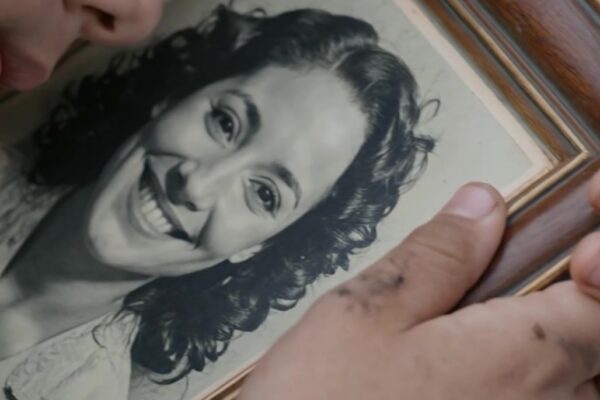
Then she nodded, very slowly. “He left me a picture,” she whispered. “And he told me never to show it unless… unless I met someone who would kneel down to talk to me.”
For the first time, Daniel Mercer’s composure faltered. His eyes flicked to the suited men, then back to Lila, and the air around them tightened as if the street itself understood: this wasn’t about a hungry mother anymore.
“Lila,” he said, voice low and careful, “where is the picture?”
She glanced toward the pale-blue house. Her lips trembled. “Under my bed.”
Daniel Mercer rose, not fast this time but with the gravity of someone stepping into a storm. He turned to the SUV, and his voice cut through the late afternoon like a blade.
“No one moves,” he ordered. “And nobody speaks to her mother until I do.”
The suited men obeyed instantly.
Lila clutched the bicycle as if it might vanish, her sign still swinging gently in the warm wind. The street remained beautiful, quiet, almost holy in its calm. But beneath that calm, desperation had finally been seen—and once seen, it was no longer safe to ignore.