The ballroom glittered like a world built to keep certain people out. Crystal chandeliers hung like captured constellations, scattering cold stars across a floor so black it could have been poured from midnight itself. At the edges of the room, men in tailored jackets and women in bright, expensive laughter drifted between white columns as though gravity treated them differently than everyone else.
On the dais, a quartet pulled thin, elegant sound from strings and bows, the music moving through the air like perfume. Waiters glided, careful as priests, balancing trays of champagne that caught the light and threw it back brighter. Every surface here was designed to reflect: the silver, the glass, the jewels at throats and wrists. Even the smiles seemed polished.
Celeste Harrow stood near the center as if the room were built around her. She wore a dress the color of crushed pearls and a necklace of diamonds that sat like a frozen wave at her collarbone. Beneath it, hidden under the hard sparkle, a smaller chain lay against her skin—old, thin, and not meant for this world. She kept it there like a private superstition, a thing she never mentioned and never removed.
The charity gala was, on paper, for children. Celeste had smiled for the cameras, posed beside banners that promised hope, and repeated lines about “every child deserving a future.” She said them the way she said everything else: with poise, with practiced breath. The guests applauded because applause was the most painless donation of all.
Then something struck the floor with a clean, violent sound. A tall flute of champagne shattered, and the music stumbled for a beat as faces turned. A waiter jerked backward, his tray knocked sideways by Celeste’s sudden gesture. She hadn’t meant to hit him, and she didn’t look at him long enough to apologize.
Her attention had snapped to the ballroom doors.
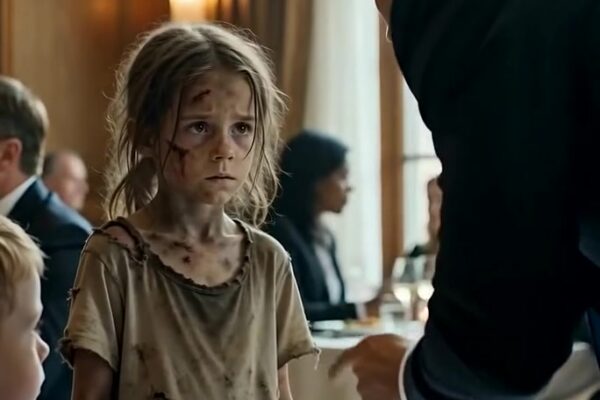
In the gap between velvet curtains, a child stood barefoot on the shining floor as if she’d stepped from a different universe. Her clothes were layers of frayed fabric too large for her body, sleeves hanging past thin wrists. Strands of hair clung to her forehead, damp with rain or sweat. She held one fist tightly closed, so tight the knuckles looked white in the chandelier light.
A ripple ran through the guests. Some leaned closer with the same curiosity they might offer a street performer; others drew back as if poverty carried a scent. Someone laughed, a quick, cruel sound, and someone else answered with a whisper. Celeste’s mouth tightened. She moved toward the doors with a force that made her bracelets click like warning bells.
“This is not a shelter,” she said, her voice pitched for the room to hear. “Who allowed her in?”
The child flinched. For a moment Celeste expected her to bolt, to be herded out by security so the evening could resume its soft, acceptable rhythm. But the girl didn’t run. She lifted her face, and her eyes—dark, too old—met Celeste’s without pleading.
“My mother told me to bring you this,” the child said. The words came out small, but they landed in the quiet like a thrown stone.
Celeste’s posture shifted, not softened exactly, but interrupted. “Your mother?” she repeated, as though the idea of someone like that having a mother was unexpected. “And what is ‘this’?”
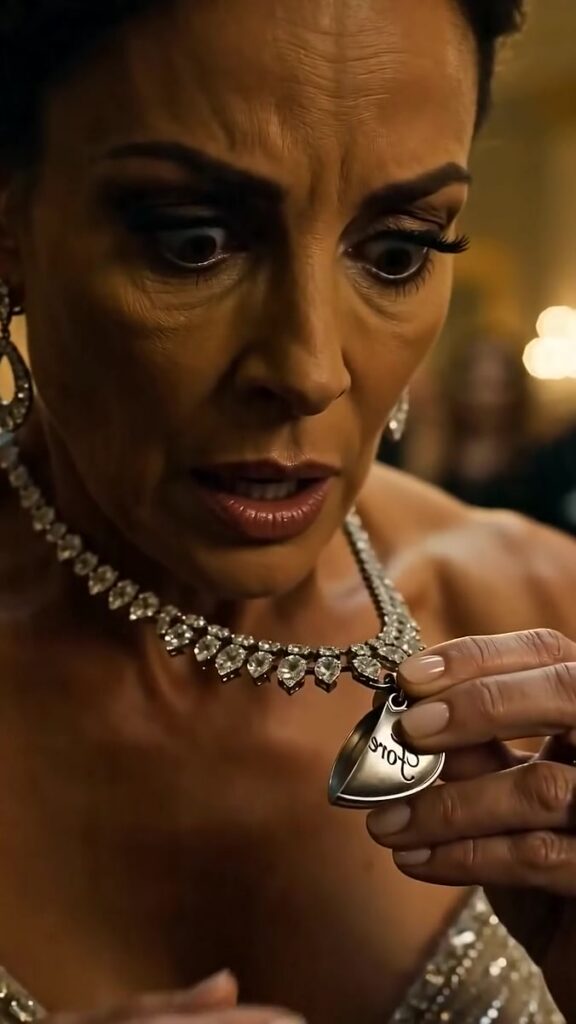
The girl opened her fist slowly. In her palm lay half of a heart-shaped locket made of silver dulled by time. The edge where it had been torn from its pair looked jagged, like a wound that never healed properly. A single word was engraved on it, the letters worn but legible: Forever.
Celeste’s breath stopped. Her hand rose, instinctive, to the hollow at her throat where the diamonds sat. Her fingers slid beneath the glittering necklace, searching with a panic she could not have explained to anyone in the room. Under the stones, the small chain was there. Under the chain, the other half of the heart.
She had not touched it in years.
A man nearby murmured something—an attempt at humor, perhaps—but the sound died before it reached the end of his tongue. Celeste’s face drained as if someone had opened a valve. The lights above seemed harsher now, bleaching color from everything they touched.
“No,” she said, and it wasn’t denial so much as a prayer that the room would rearrange itself into a more comfortable truth. She stared at the half-locket in the child’s palm. “Where did you get that?”
The girl’s lips trembled, but she held steady. “My mom wore the other half,” she said. “She wore it until she died.”
The sentence left no room for bargaining. It was not an accusation; it was a fact. Celeste’s fingers trembled against her own hidden chain, and for the first time in a long time her carefully managed expression cracked. Around them, the ballroom became a still photograph. Even the quartet had stopped, bows hovering in midair.
Celeste lowered her voice, as if volume could keep the world from hearing. “What was your mother’s name?”
The girl swallowed. “Maris.”
The name hit Celeste like a memory stepping out of darkness. Maris, with hair the color of wet ash and hands that smelled faintly of oranges from the kitchen where she worked. Maris, laughing once, in a tiny rented room above a laundromat, pressing two halves of a cheap silver heart together and saying, almost shyly, that they should keep something between them that couldn’t be bought back once sold.
Sold. The word rose up, sharp as glass.
Celeste’s gaze dropped to the child’s bare feet on the polished floor. She saw the red marks where the cold had bitten, the bruises at the ankles, the way the toes curled slightly as if the ground itself hurt. She saw, too, how the girl stood inside her own hunger with a kind of practiced dignity.
“Why would she send you here?” Celeste asked, though she already felt the answer creeping toward her like a tide.
The girl looked down at the half-heart in her hand, then up again. Her eyes were wet but unwavering. “She said you’d know,” she whispered. “She said the woman who kept the first half was the mother who gave me away.”
The last word was quieter than the rest, but it rearranged the air in the ballroom. Gave me away. The phrase didn’t fit among the chandeliers and the diamonds; it sounded like something that belonged under a bridge, or in a hospital hallway, or in the mouth of a judge.
Celeste’s fingers opened. The diamond necklace slid slightly as her hand shook, and the hidden chain slipped free from beneath it. The small silver half-heart caught the light for the first time in years. In the sudden hush, the soft click of metal against metal sounded louder than applause.
For a long moment, Celeste could not speak. She saw herself younger—desperate, cornered, with a newborn’s crying splitting her sleep into shards. She saw the signature on a paper she refused to read fully, the careful words about “a better life.” She saw the way her own mother’s face had looked when she said, coldly, that certain mistakes could not be allowed to stain the family name.
And she saw Maris again, holding a tiny bundle and whispering, “I’ll keep you alive in the only way I can.”
Celeste’s throat tightened until it hurt. “What… what is your name?”
“Lena,” the child said.
Celeste tried to swallow and found she couldn’t. Around them, guests stood as if caught between fascination and fear, waiting to see whether the intruder would be punished or transformed into something palatable. Security lingered at the edges, uncertain now, because money had hesitated and the room didn’t know what it was allowed to do.
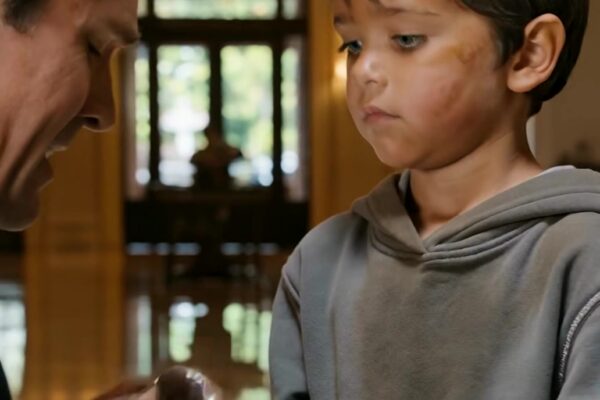
Celeste stepped closer to Lena, close enough to see the faint bruise on her cheek, close enough to smell rain and city dust. Lena lifted the half-heart slightly, offering it without flinching, as if it was both weapon and peace treaty.
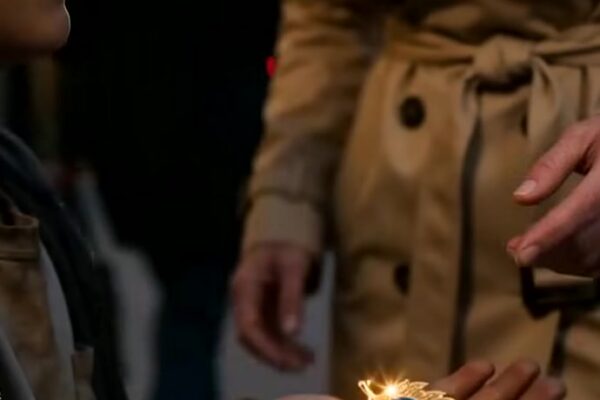
Celeste’s hand hovered, then closed around the tarnished silver. It was colder than she expected. She held it beside the half hanging from her own chain, the jagged edges aligning with a cruel precision. Two broken things finding their match.
“I didn’t know,” Celeste said, and the lie of it made her wince. What she meant was: I told myself I didn’t know. I paid for not knowing. I dressed not knowing in silk and called it survival.
Lena watched her, breath coming too fast, as if she’d run here from the end of the world. “My mom said you’d have a house that looks like day,” she whispered. “She said you’d have light that never goes out. She said you’d have enough.”
Celeste looked up at the chandeliers, at their brutal, beautiful brightness. Enough. The word tasted strange. What was enough when it had been built on absence?
She turned, finally, toward the room full of witnesses. “The gala is over,” she said, her voice ringing through the silence. “And anyone who thinks this child is a stain can leave with their donations in their pockets. I won’t take your money if you can’t stomach the reason I claimed to need it.”
A few mouths opened. Someone made a protesting sound. But Celeste didn’t wait for approval. She faced Lena again, lowering herself until they were eye to eye. The floor was cold even through the fabric of her dress; she welcomed the discomfort.
“Come with me,” she said. It was not a command and not a performance. It was a decision. “Not because it will fix what I did. It won’t. But because you should never have been outside those doors to begin with.”
Lena blinked hard. “You’re really her,” she breathed, as if she’d expected a monster and found instead a shaking woman in pearls.
Celeste touched the child’s hand—careful, as though touch itself might break something irreparable. “I’m the one who left,” she said. “And I’m the one who has to live long enough to make leaving mean something else.”
Behind them, the chandeliers continued to burn, indifferent and magnificent. But as Celeste stood, taking Lena’s small hand in hers, the ballroom’s glitter shifted. It was no longer a fortress of light. It was a stage where a door had opened, and someone who had been kept out was walking through, carrying a broken heart that finally had its other half.