The dining room of the Aster House had been engineered to make misery feel impossible. Light fell from a chandelier that looked like frozen rain, and the walls wore mirrors so guests could admire the angles of their own elegance. Candles trembled in crystal sleeves, their flames steady enough to pretend the world outside the windows did not exist.
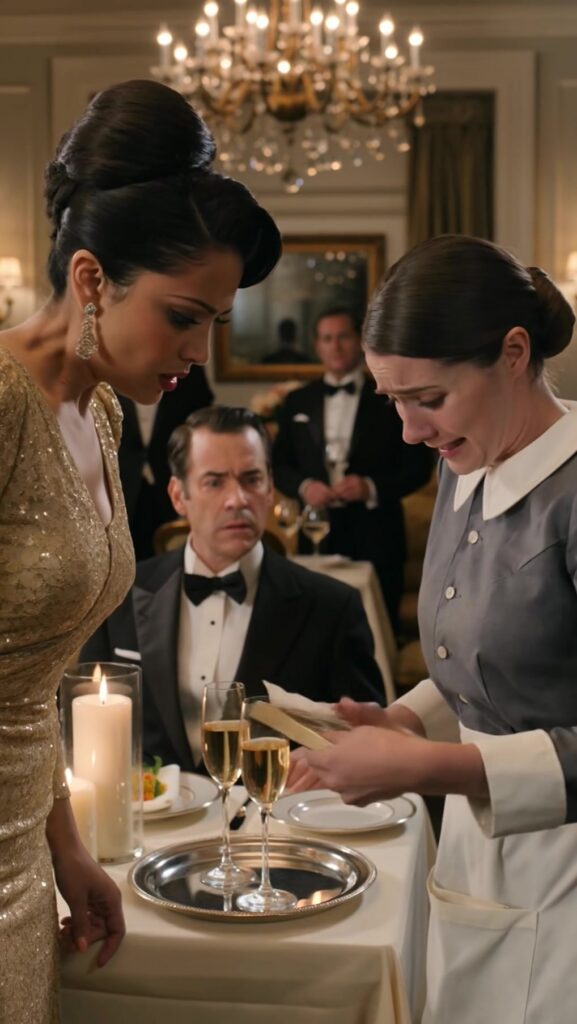
Evelyn Mott moved between tables in a gray uniform that never quite fit her shoulders, her hair pinned tight, her mouth trained into a practiced curve. She carried a silver tray with two champagne flutes, and the bubbles climbed in each glass like they were trying to escape. Her hands were the problem. They would not stop shaking.
At the center table, where the best light landed, sat Leonard Hale—developer, philanthropist, the name stitched into buildings and scholarships and charitable galas. His tuxedo fit him like a verdict. Beside him, standing rather than sitting, was his fiancée, Maris Vane, dressed in gold that clung to her like melted coin. Maris had been smiling all evening for the cameras. Now her smile had disappeared, and the absence was sharp.
Evelyn stepped forward. The tray dipped a fraction. One flute chimed against the other, a small betrayal in a room that ran on flawless silence.
Maris’s head turned with the speed of someone used to obedience. “Are you unwell?” she asked, but the softness was counterfeit. Her gaze flicked to the tray, then to Evelyn’s face, as if searching for something to punish.
The nearby tables quieted without being asked. Expensive people knew how to stop talking when a scene promised entertainment. Silverware paused midair. A laugh died halfway through a throat. The chandelier kept raining light.
“I’m sorry,” Evelyn began automatically, because apologies were her currency. She could have bowed herself out, collected herself in the service hallway, returned with steadier hands and an emptier expression. She could have done what was expected of a girl who poured other people’s celebrations.
But the photograph in her apron pressed against her ribs like a second heart.
Evelyn lowered the tray onto the edge of the table, careful as if setting down something alive. The two flutes steadied, the bubbles rising with their quiet insistence. She reached into her apron and drew out a small frame wrapped in faded cloth. The fabric had been washed so many times the pattern was almost gone, except for one detail: a stitched crescent moon in the corner, slightly crooked, as though made by someone’s hopeful, imperfect hand.
Leonard’s eyes shifted to it, not yet recognizing. His gaze had the detached politeness of a man who had been handed many things by many strangers. Maris leaned forward, impatience tightening her shoulders.
“What do you think you’re doing?” Maris said, and the question cracked like a whip.
Evelyn lifted the frame with both hands. “I didn’t come for a tip,” she said. Her voice trembled, but it did not break. “I came to bring him something that belongs to him.”
Leonard’s expression sharpened. “This is inappropriate,” he murmured, the words aimed not just at Evelyn but at the air itself, as if to restore order by naming disorder.
“Please,” Evelyn said. “Look.”
Maris made a sound under her breath—a laugh that couldn’t find humor. “Leonard, tell her to—”
Leonard took the frame.
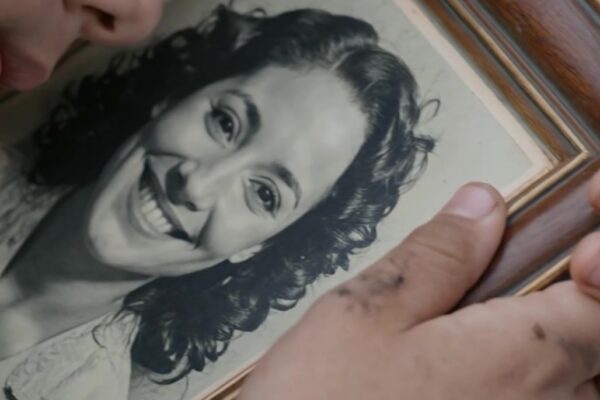
His fingers closed around the wood, and the room, with all its glittering assurances, seemed to lean in. He unwrapped the cloth. The photograph inside was old, the edges yellowed. A baby lay swaddled in a blanket, cheeks puffed, eyes shut in a sleep too deep for cameras. The moon stitched into the fabric sat in the corner like a signature.
Leonard stared as if he’d been struck. The blood drained from his face in a slow, undeniable wave. He did not blink. His mouth opened once, then closed again. When he finally spoke, it was barely a breath.
“That blanket,” he said.
Maris’s hand slid to the table’s edge as though the wood could keep her upright. She followed Leonard’s gaze, then recoiled slightly, not from the baby but from what she saw happening to Leonard. “Where did you get that?” she demanded, the sharpness now edged with fear.
Evelyn swallowed. The room smelled of wax and roasted meat and money, but under it all she smelled the hospital disinfectant from a story she’d been told a hundred times. “My mother kept it,” she said. “She said she made it for someone else, and then she was paid to forget.”
Leonard’s knuckles whitened around the frame. “Paid,” he repeated, as if the word belonged to another language. He looked up at Evelyn, and for the first time his eyes were not the steady eyes from magazine covers. They were the eyes of a man who had never truly left a particular night.
“My daughter,” he said, not a question. “They told me she didn’t make it.”
Evelyn’s throat tightened until the words felt like glass. “They told you that because they were told to,” she said. “My mother was a nurse’s aide at St. Brigid’s twenty-two years ago. She held a baby who was supposed to be gone. She heard a doctor say there was ‘a solution,’ and she watched your wife sign something with hands that didn’t shake at all.”
Maris’s face tightened, the gold of her dress suddenly less like glamour and more like armor. “This is insane,” she snapped. “This is extortion.”
Evelyn looked at her then—not with apology, but with a steady, aching clarity. “I don’t want his money,” she said. “I already have his absence.”
The words fell into the dining room like a stone into water. Somewhere behind them, a glass clinked. A chair scraped, quickly stilled. No one dared interrupt.
Leonard’s eyes did not leave Evelyn. “What is your name?” he asked.
“Evelyn,” she said. “My mother named me after a woman she said was brave enough to do a terrible thing for what she thought was love.” Her fingers tightened around the cloth that had wrapped the frame. “She kept the blanket as a punishment. She said it burned her every time she touched it.”
Leonard’s breathing turned shallow. “Why now?”
Evelyn’s lips trembled, and for a moment she looked younger than her years, like the baby in the photograph had grown up too fast. “Because my mother is dying,” she said. “And because she finally told me the truth when she realized she would take it into the ground if she didn’t. She told me you deserved to know what was taken from you. She told me you deserved to meet what was taken from you.”
Maris’s voice rose, desperate and bright. “Leonard, don’t listen to this—”
Evelyn’s gaze stayed on Leonard, but her next words were aimed like an arrow through Maris’s glittering certainty. “My mother said your first wife didn’t bury your child,” she whispered. “She paid to bury a box with nothing inside.”
Maris went very still, as if the air had turned to ice. Her fingers dug into the tablecloth, wrinkling linen that had been ironed for hours. She looked at Leonard, searching his face for agreement, for dismissal, for rescue.
Leonard didn’t look at Maris at all. He stared at the photograph until his eyes shone with something that wasn’t candlelight. “Where is she?” he asked, and the question was not about his late wife.
Evelyn drew a shaky breath. “I don’t know,” she admitted. “My mother said there was a car waiting. She said the baby was handed over in a back corridor, quiet as theft. She never saw where they went. She only knew a name that wasn’t meant to be written down.” Evelyn’s hand moved to her pocket, where a folded scrap of paper waited like a match. “But she gave me this.”
Leonard’s throat worked. “Give it to me.”
Evelyn hesitated, feeling every eye in the room pressing against her skin, feeling the weight of a life that might have been someone else’s and might still be. Then she placed the paper beside the photograph.
Leonard unfolded it with care that looked like devotion. His eyes moved across the ink. Whatever he read there made his jaw clench, made his shoulders lift as if bracing against an oncoming blow.
Maris reached for his arm. “Leonard—”
He pulled away from her touch as if it burned.
Silence spread outward, filling the polished corners of the Aster House until even the chandelier seemed to hold its breath. Somewhere, a server paused mid-step, frozen between duty and curiosity. Somewhere else, a guest lifted a phone, then lowered it, sensing that whatever was happening did not belong to social media. It belonged to something older and darker.
Leonard looked up at Evelyn, and his voice came out rough. “If this is true,” he said, “then my whole life is built on a lie.”
Evelyn nodded once. Tears had gathered along her lashes, but she did not wipe them away. “I know,” she whispered. “I’ve been living inside that lie, too. I just didn’t know it had your name on it.”
For a long moment, Leonard did not move. Then, slowly, he pushed back his chair. The legs scraped the floor, loud as thunder in a room trained for softness. He held the photograph as if it might vanish. He looked at Maris, finally, and in that glance was a verdict no court could soften.
“Dinner is over,” he said, not to the room, but to the story he’d been telling himself for twenty-two years.
Evelyn stood there in her plain uniform, feeling the chandelier’s light and the weight of every watching stranger. She had come to deliver a photograph. Instead, she had delivered a fracture line through a man’s life.
As Leonard stepped away from the table, the gold of Maris’s dress caught the candlelight and flashed like a warning. Evelyn clutched the old cloth with the stitched moon, and in the hush that followed she understood something with sudden, terrible clarity: the photograph wasn’t proof of a past crime. It was an invitation to a future reckoning.
And somewhere beyond the Aster House’s flawless doors, the missing daughter—whoever she was, whatever name she had been given—was still breathing beneath a sky that did not know it had been stolen.