The cemetery sat behind the club’s yard like a second fence—older, quieter, harder to ignore. Rain had come and gone in the early hours, leaving the grass slick and the sky a flat, pewter lid over everything. The bikers had gathered for a run, engines cooling in a row, their machines hulking and dark as cattle pressed up against the chain-link.
It should have been loud. It should have been laughter and metal and someone arguing about the route. Instead, the only sound that carried cleanly across the yard was a child sobbing, ragged and relentless, the way a storm refuses to stop at the edge of town.
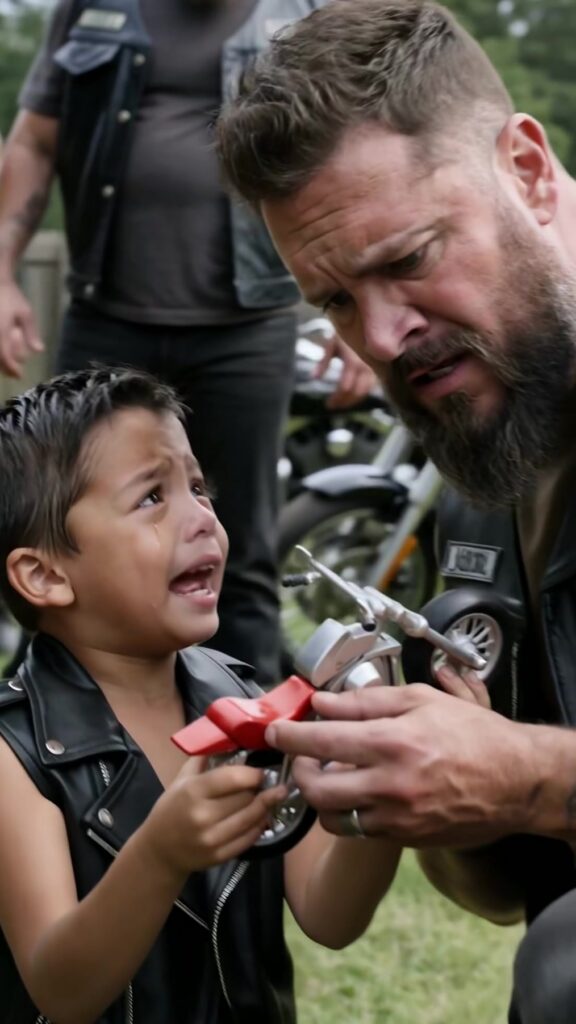
A little boy ran through the open gate, too small for the distance between his feet and the ground to look safe. His boots sank slightly with each step. His leather vest—miniature, but real—hung on him like armor borrowed from a giant. In both hands he clutched a tiny motorcycle, not cradled like a toy but held out in front of him as if it were a warrant.
The men turned in a slow wave of confusion. These were men who made people cross streets. Men who could end a conversation by standing up. Yet none of them moved at first, as if the boy’s presence broke the rules of the place.
Halfway across the yard, he tripped on nothing visible. He went down hard, palms and knees disappearing into wet grass. A couple of bikers stepped forward instinctively, boots heavy, hands already reaching.
But the boy shoved himself up before anyone could touch him. His face was red, his mouth open on a cry that seemed too large for his ribs. Still on his knees, he lifted the little motorcycle toward the biggest man among them.
Rook stood near the center, broad as a doorframe, beard shot with early gray. Most people learned quickly not to look him in the eye unless they were ready for what they might see there—years of roads that never forgave, decisions that never took themselves back.
The boy held the toy up to him like an offering made under duress.
Rook stared at it, and something in his expression shifted, not softening so much as breaking. He dropped to one knee, the motion surprisingly careful, and took the small bike from the child’s shaking hands.
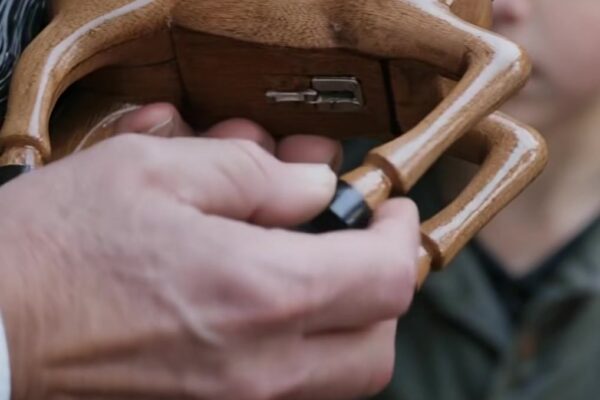
It was hand-carved from wood, sanded smooth in the places small fingers would grip. The paint was imperfect in a human way—thin at the edges, layered too thick along the tank. A black stripe ran down the center. On the left handlebar, there was a nick, the wood bruised and sealed over.
Rook’s thumb hovered above that nick, then traced it once. His throat tightened as if a hook had found its way behind his tongue.
He remembered warm beer in a cracked garage, the smell of gasoline and sawdust, and the way his friend Ash laughed through a cigarette when the knife slipped and marred the handlebar.
“Damn it,” Ash had said, and Rook had shrugged, wiping the blade on his jeans. “Leave it,” Rook had replied. “Nothing made by hand comes out untouched.”
He hadn’t thought about that night in years. He had forced it down into the same locked place where he kept names and dates and the feeling of earth hitting a box.
“Where did you get this?” Rook asked, voice low. The yard seemed to lean in to listen. Even the engines, cooling, stopped ticking for a moment.
The boy tried to swallow his crying into something usable. “My dad made it.” His words cracked on the last syllable.
Rook’s eyes lifted to the child’s face. “What’s your dad’s name?”
The boy stared back as if he had practiced this moment, as if he’d been holding the sentence in his teeth for miles. “My mom said… you were there when they put him in the ground.” He hiccuped, breath hitching. “But when she went back, the grave was empty.”
The statement didn’t ring in the air. It detonated.
All around them, men froze. One of them—Spider, who never shut up—went silent with his mouth half-open. Another biker’s hand tightened around a coffee cup until the lid creaked.
Rook held the toy motorcycle in both hands now, like he might drop it if he didn’t. His eyes went distant, fixed on a memory he’d tried to bury deeper than any coffin.
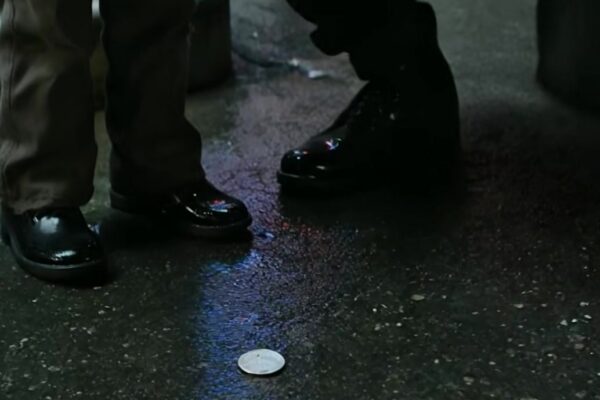
Ten years ago they had stood in this same wet kind of weather, their vests darkened by rain, their boots sinking beside a fresh mound. A simple service. No flags. No music. A casket lowered because a casket had to be lowered. The men had watched until the last inch of wood disappeared and the first shovel of dirt fell with that unmistakable dull thud.
Three men knew the casket had been heavy, yes—but not with a body. It had been filled with something else, something arranged to pass for weight because the truth couldn’t breathe in daylight.
Rook had sworn he would carry that secret to his own grave. But now a child was kneeling in the wet grass, asking for a ghost to explain itself.
The boy reached into his tiny vest with trembling fingers. He pulled out a chain, thin and too old for him, and at the end of it a piece of metal—rusted, notched, the edge broken as if bitten off. It dangled there, catching the gray light.
Rook’s face drained of color. His mouth opened, then closed again. Slowly, as though afraid of what his hands might admit, he hooked his fingers beneath his shirt collar. He drew out a chain of his own, thicker, worn smooth by years against skin. A dog tag hung from it—half of one.
He held his half up beside the boy’s. The two pieces, jagged edges and all, fitted together like a wound that had never been stitched.
No one spoke. In the silence, the cemetery’s old trees creaked, and far away a motorcycle backfired on a road that had nothing to do with them.
Rook’s voice, when it came, sounded like it had been scraped out of him. “Where’s your mother?”
The boy’s lower lip quivered. “In the car.” He pointed weakly toward the gate. “She couldn’t come in. She said you wouldn’t believe me unless I brought… that.” He nodded at the toy motorcycle, then at the tag. “She said you’d know.”
Rook rose, towering again, but the size didn’t make him safer. It only made him look like a man standing at the edge of a cliff. He handed the toy back to the boy gently, as if returning a piece of someone’s heart.
“Stay here,” he told the child, though his eyes softened for a fraction of a second. “Right here. Don’t move.”
He turned, and the men parted automatically. But their faces were different now—grim, wary, suddenly young with fear. They had all felt the earth hit the casket that day. They had all believed, in their own ways, that burying the lie was the end of it.
Rook strode to the gate. Beyond it, a battered sedan idled at the curb, windshield fogging from a nervous breath inside. As he approached, the driver’s door opened a crack, then swung wider as if whoever sat there couldn’t bear the waiting anymore.
A woman stepped out. Her hair was pulled back too tightly, as if she’d been holding herself together by force. Her eyes found Rook, and in them he saw the same thing he’d seen in the boy’s hands: proof, not of a death, but of an unfinished story.
She didn’t speak at first. She only reached into her pocket and pulled out a folded paper, rain-damp at the edges. When she held it out, Rook saw a date stamped in red, and a name he hadn’t allowed himself to say in a decade.
“They told me he was gone,” she whispered. “They made me stand at a grave and watch them fill it. But my son keeps waking up saying he hears a motorcycle at night, circling the block, like someone can’t find the driveway.”
Rook’s jaw clenched. He looked back through the gate at the boy kneeling in the grass, clutching the toy like a lifeline. The child’s small shoulders shook, but his eyes stayed locked on Rook as if he had already decided which man this stranger had to become.
Rook turned to the woman again. “Your boy doesn’t belong in my yard,” he said, each word heavy. “But the truth does.”
He glanced at the cemetery beyond the fence, at the quiet row of headstones and the one plot that had held an empty box. Then his gaze sharpened, the old predator waking behind his eyes—not hunger, not violence for its own sake, but purpose.
“Tell me everything,” Rook said. “From the beginning. From before the grave.”
And in the damp gray light, with engines waiting behind him and a child’s sobs threading through the air, Rook understood that whatever had been buried ten years ago had not stayed underground. It had simply waited long enough to return with a small hand holding the key.