The first engine appeared as a low growl beyond the mesquite line, a sound that didn’t belong to this road. Then the dust rose, not in the lazy spirals of farm trucks, but in a clean, deliberate plume as three black SUVs rolled into the yard. Their paint swallowed the sunlight. Their tires pressed new tracks into an old place that had never been on any map worth printing.
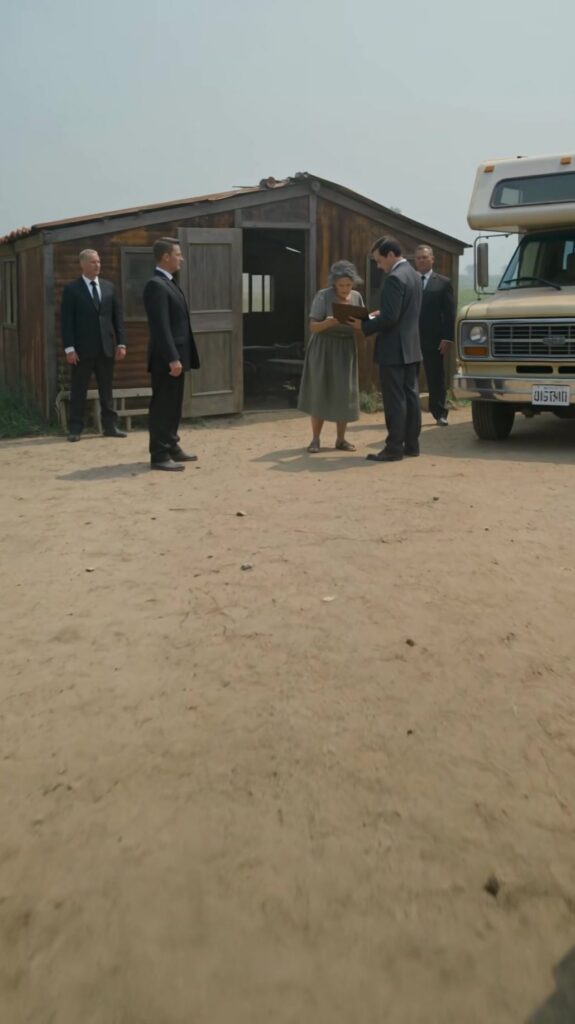
Mercy Lyle stood barefoot on the warped porch boards, the hem of her faded dress worrying at her shins in the wind. Her sandals were somewhere inside—she’d stopped searching for things years ago, when searching began to feel like praying. Behind her, the shack leaned the way tired men did, holding itself up by stubbornness alone. Off to the side, an RV with a coppery skin sat half-sunk in weeds, its windows filmed with dust like cataracts.
The SUVs stopped in a straight line as if the land itself had been measured. Doors opened. Men stepped out in dark suits and pale shirts, too clean for the heat. They moved with the practiced caution of people who had been taught what to do when everything could be a threat, even silence. One of them carried a folder held to his chest with both hands. Another scanned the tree line. A third kept his gaze on Mercy as though she might bolt, though her knees had forgotten how.
“Mrs. Lyle?” the man with the folder called, voice gentle and clipped at once.
She didn’t answer immediately. Names were dangerous in places like this; names were hooks. She watched the folder. Some part of her already knew what it contained, the way an old scar knows the weather before the sky changes.
“Who’s asking?” she said.
The man approached, stopping at the foot of the porch steps. He looked no older than forty, but his eyes had the flattened patience of someone who had seen too much paperwork for grief. “My name is Daniel Crowe. I’m here on behalf of Arthur Lyle.”
The name struck the air like a thrown stone. Mercy’s fingers tightened around the porch rail. For a heartbeat, she saw a boy in a too-small shirt, elbows sharp as fence posts, standing in this very yard and promising he’d be back before she could miss him. She heard the distant, wrong laughter of men at the gas station, the kind that made her pull him close. She smelled old pennies and bleach and fear—memories that had no right to return, yet did.
“Arthur’s dead,” Mercy whispered, because it was the only safe version of the story. “That’s what they told me.”
Daniel didn’t correct her. He lifted the folder slightly, showing the edge of two photographs tucked inside. “He left instructions,” he said. “Very specific ones. He never stopped thinking of you.”
Mercy came down the steps slowly, each footfall a negotiation. The men didn’t move to help her. Their stillness was its own kind of respect—or restraint. Daniel opened the folder with the care of someone handling a relic. The first photo showed a man in a suit, older than Mercy’s memories allowed, jaw firm, eyes familiar. Arthur’s eyes: the same gray that had watched storms roll in and believed he could talk them away. He looked wealthy in a way Mercy had only seen on billboards. The second photo was of a little girl on a swing, hair tied with a bright ribbon, a grin wide enough to break your heart.
Mercy’s throat made a sound that wasn’t quite a sob. Her hand rose to her mouth as if to keep the years from pouring out. “He had a baby,” she said, words tumbling like marbles. “Arthur had a child.”
Daniel slid a sealed envelope from the folder and a document stamped in gold. He didn’t hand them over yet. He looked at Mercy as though choosing a truth the way a person chooses a bandage—knowing it will hurt regardless.
“Her name is Wren,” he said. “She’s seven. And she’s missing.”
The yard seemed to tilt. Mercy gripped the rail again, her knuckles pale. Missing was a word she knew too well. It was the word people used when they didn’t want to say taken, or traded, or buried in a place that never got searched. It was the word that kept sheriffs from looking too long. It was the word that let the world stay clean.
“Why bring this to me?” Mercy asked. “I’ve got nothing. I can’t even keep the roof from leaking.”
Daniel finally offered the envelope. Mercy’s hands trembled as she took it, her fingertips roughened by decades of work that never paid off. The seal was unbroken. Her name was written in a precise hand she didn’t recognize, though the slant of the letters made her think of Arthur trying to teach himself penmanship on the back of grocery lists.
She tore it open and unfolded the letter. Inside was a single page and, tucked behind it, a small key wrapped in clear tape.
Mercy, the letter began. If you’re reading this, I waited too long to come home.
Her eyes burned as she read, the words blurring, then sharpening again. Arthur wrote of leaving at sixteen, of sleeping in his car, of learning to wear confidence like armor. He wrote of building a company, of buying his way into rooms that once would have thrown him out. He wrote of Wren, the way her laughter made him feel like he’d been forgiven for surviving. Then the tone changed, tightening like a rope.
I thought money could keep her safe, he wrote. But some debts aren’t measured in dollars. Some men don’t forget where you came from, and they don’t forgive what you escaped.
Mercy lowered the page. The men around them stood still as statues, but she could sense their impatience, the clock ticking behind their eyes. “What did he do?” she asked Daniel. “What kind of trouble follows a man all the way out here?”
Daniel’s gaze flicked to the cracked earth, the weeds, the tired RV. “Arthur tried to expose someone,” he said. “A network. They move children. They launder money through charities and construction contracts. He had evidence. He kept it in a safe place he believed no one would look.”
Mercy’s fingers closed around the key. It felt cold despite the heat. “And you think that safe place is—”
Daniel nodded once. “Here.”
A laugh escaped Mercy, sharp and bitter. “Ain’t no one come looking for anything here in thirty years.”
“They came once,” Daniel said quietly, and Mercy’s stomach tightened. “Arthur believed that, too. That the past had moved on. It didn’t. We think they took Wren to force him to hand over what he had. He wouldn’t. He…” Daniel’s voice faltered for the first time. “He’s gone. But before he died, he arranged for us to find you. He said you’d know how to hide something in plain sight.”
Mercy’s mind raced backward through the years like a film rewinding: the night Arthur left, the day strangers drove past slow, the way her mailbox had been smashed twice, the way her RV door had a new lock she hadn’t put there. The past hadn’t been asleep. It had been watching.
She looked at the RV—the “tired witness,” as she’d always called it when talking to herself. She remembered Arthur climbing into it as a boy, pretending it was a spaceship, swearing he’d leave orbit someday. She remembered the hidden compartment beneath the bench seat, something he’d built from scrap wood, proud of his secret.
Mercy’s feet carried her across the yard without her permission. The suited men followed, boots careful in the dirt. She climbed into the RV, the air inside stale and metallic. Dust floated in slanted light. Her hand found the bench seat, found the edge of the panel that didn’t quite match. She slid the key into a tiny, almost invisible lock and turned.
The panel popped loose with a soft thud. Inside was a small metal box and, atop it, a child’s bracelet—plastic beads spelled WREN in uneven letters.
Mercy’s breath hitched. Daniel’s shoulders stiffened as he reached for the box, then stopped himself, as if the act required permission from someone higher than law.
Mercy touched the bracelet with a tenderness that felt like trespassing. “She was here,” Mercy whispered.
“Recently,” Daniel said. His voice was steady again, but his eyes weren’t. “This changes everything.”
Mercy closed her fist around the bracelet until the beads pressed into her skin. For decades, she had lived as a woman the world could overlook. She had learned to be quiet, to be small, to accept that missing meant never found. But in that moment, with Arthur’s key in her palm and a child’s name biting into her hand, something in her rose up, ancient and furious.
Outside, one of the men spoke into an earpiece, words clipped and urgent. Daniel looked at Mercy. “We’re going to need your help,” he said. “Not because you’re all we have—but because Arthur was right. You know this place. You know these people. And they won’t expect you to fight.”
Mercy stepped down from the RV, the bracelet still in her fist. She stared at the line of black vehicles and the men who had brought her a dead name and a living hope. The yard was the same as it had been an hour ago—cracked earth, crooked shack, the smell of heat. But the air had changed. The past had finally come home, and it had come with teeth.
“Tell me where to start,” Mercy said, and her voice did not shake.
Daniel opened the metal box. Inside were drives, papers, a map marked with circles like bruises across counties Mercy had never visited. He looked up at her with a new kind of respect, not for her age, but for the storm he could sense gathering behind her eyes.
“We start,” he said, “by bringing Wren back.”