Rain came down in sheets so thick the highway lights looked like they were drowning. It battered the gas station’s tin awning, turning the roof into a drum and the forecourt into a mirror of black water and trembling neon. A row of motorcycles squatted under the glow—chrome slick, tires steaming—like animals waiting for a whistle.
Inside, the air was dense with gasoline, scorched coffee, and old fryer grease. The clerk had a television turned low behind the counter, but the static hiss seemed louder than the news. A fluorescent tube above the candy rack blinked as if it couldn’t decide whether this place deserved light.
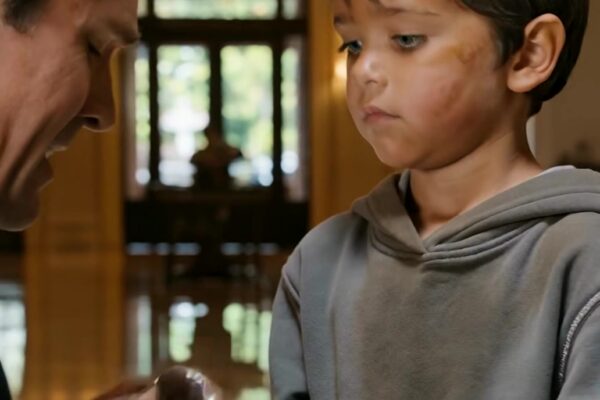
The door chimed weakly, then swung in on wind. A boy stepped through, no older than five, soaked to the bone. His shirt hung in strings at the hem, and his sneakers made a wet sucking sound with each step. He didn’t look around like a kid exploring. He moved like someone who had already learned to be careful about taking up space.
On the counter sat a wrapped sandwich, the paper damp where the air had clung to it. The boy’s hands hovered, trembling with the kind of hunger that shakes your joints. He swallowed, reached, and his fingers brushed the edge.
The owner’s palm slapped down fast. He yanked the sandwich away like it was poison. “Not for you,” he said. His voice was tired, practiced. “Get out, kid.”
The boy flinched as if struck. “Please,” he whispered, and the word came with a sob he couldn’t stop. “I’m so hungry.” Tears tracked clean lines down grime on his cheeks.
Near the coffee machines, a cluster of bikers stood in patched leather, steam rising off their shoulders. They had the look of men who belonged to the road more than to any town. One of them muttered something about kids these days and turned his back. Another stared at the spinning display of powdered donuts as if it held the answer to anything.
Only their leader watched without blinking.
He was tall, with gray threaded through his beard and scars that looked like they had stories but no patience for being asked. His gloves were fingerless, his hands big enough to close around a throat or a promise. People called him Rook—because he moved in straight lines and didn’t apologize for it—and he carried himself like a man who had walked away from things that should have chased him.
The boy’s shoulders caved inward. He turned toward the door, defeated, rain shoving at the glass behind him. He took one step, then another, and as he did, something slid from under his torn shirt—caught on the chain at his neck, slipped free, and swung forward.
A small silver locket, worn smooth by fingers. It dropped and would have struck the tile, but Rook was already moving. His hand shot out and caught it mid-fall with a reflex too clean for a man pretending to be slow.
The room quieted. Even the coffeemaker seemed to pause its gurgle.
Rook looked at the locket in his palm. Its surface was scratched, the clasp bent, as if it had been opened too many times in fear. He should have handed it back unopened. A man with his history should have known better than to pry at old doors.
But the locket’s design was familiar—two tiny etched feathers crossing at the hinge. His thumb found them, and the memory of another thumb touching the same mark rose up like heat.
He flipped it open.
Inside was a photograph, faded at the edges, the colors softened by time and sweat. A woman smiled at the camera like she didn’t know anything could ever break. Dark hair pinned back with a cheap clip. A faint dimple in her left cheek. The kind of face you saw once and then carried like a splinter for the rest of your life.
Rook’s breath caught, sharp enough to hurt. The world narrowed to that image. The neon outside seemed to dim, the rain to slow, the station to tilt on its foundation.
“No,” he said, but it wasn’t denial. It was a prayer for the past to stay buried.
The boy turned back, eyes huge. “That’s Mama,” he said quickly, as if the words could protect it. “She told me to keep it safe. She said… she said never let nobody take it.”
Rook’s knuckles whitened around the chain. “Where did you get this?” he asked. His voice had changed, scraping raw. “Where’s your mother?”
The owner cleared his throat nervously, sensing trouble. “Hey,” he said, trying for authority. “This ain’t your business. Kid’s probably—”
Rook didn’t look away from the boy. “How did you end up here?”
The boy sniffed hard. “Mama… she told me to run when the shouting started.” His eyes flicked to the door, to the curtains of rain. “She put the locket on me and said if I got lost, I had to find… find the man on the picture’s other side.”
Rook’s chest tightened. He turned the locket. The second photo was older, more worn. A younger Rook stared back, hair black then, eyes less empty. His arm was around the woman. The two of them were laughing, caught mid-moment like time had never learned cruelty.
One of the bikers shifted uncomfortably. “Boss?” he muttered. “You okay?”
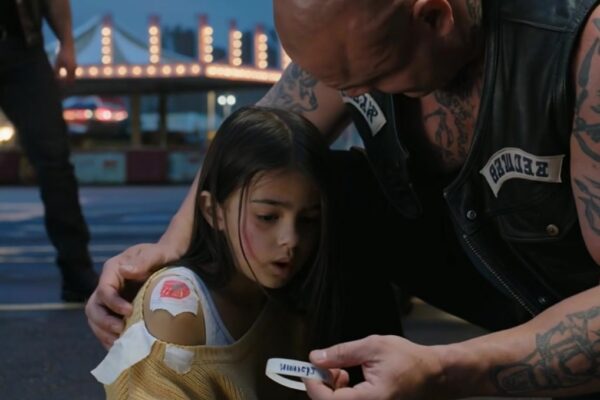
Rook ignored him. He crouched so his face was level with the boy’s. The kid’s lips were blue with cold. His ribs showed under the wet fabric. There were bruises on his forearm shaped like fingerprints, too big to belong to another child.
Rook’s hand trembled now, not from age, but from the collision of years. He closed the locket gently, as if the metal could bruise the photograph. “What did your mama say my name was?” he asked, and the question came out softer than he meant it to, like a man afraid of the answer.
The boy blinked through tears. “She said… she said ‘Rook.’”
The name landed like a thrown brick. Rook’s mouth opened, but no sound came. For a moment he was twenty years younger, sitting on a motel bed while a woman packed a duffel bag with shaking hands. He remembered the way she had looked at him—equal parts love and warning.
Don’t come looking, she had said. If you do, you’ll burn everything.
He had believed he was protecting her by staying away. He had made a thousand excuses and called them honor. He had convinced himself she’d started a life where his shadow couldn’t reach.
And now her child stood in front of him, drenched and starving, wearing proof that she hadn’t forgotten him at all.
Rook stood up slowly, the locket’s chain wrapped around his fingers like a tether. He turned to the owner. “Wrap the sandwich,” he said, calm as a gun being cocked. “And hot chocolate. Now.”
“He can’t pay,” the owner protested, half-rising behind the counter.
Rook set a folded bill down—too much, deliberate. “Keep the change. And if you ever put your hand on a kid like that again, you’ll be picking it up in pieces.” He said it quietly, and somehow that made it worse.
The owner’s face went pale. He reached for the sandwich with stiff fingers.
Rook turned back to the boy. “What’s your name?”
“Eli,” the boy whispered. “Mama called me Eli.”
Rook nodded once, as if locking the name into place. He took off his leather jacket and draped it around the child’s shoulders. It swallowed him whole, smelling of rain and smoke and roads that didn’t end. “Eat,” Rook said when the sandwich was handed over. “Slow. You’ll get sick if you rush.”
Eli clutched the food with both hands like it might vanish and took a careful bite, chewing with painful effort. Rook watched him with a violence in his eyes that had nothing to do with the boy.
“Who was shouting?” Rook asked, every syllable measured. “At home.”
Eli swallowed. “A man,” he said. “He didn’t like Mama talking about you. He said you was dead. Mama said no. Mama said you were the kind of dead that still walks.”
Rook felt his jaw tighten. Somewhere in the back of his mind, an old enemy’s laughter stirred—a man who collected secrets the way some people collected trophies.
Outside, thunder rolled like an engine turning over.
One of Rook’s men stepped closer. “Boss,” he said under his breath, “if this is about her… about Lena… you said—”
“I know what I said,” Rook cut in. The name had escaped before he could stop it. Lena. It sounded like blood on his tongue.
He looked down at Eli, at the bruises, at the way the child flinched whenever the door gusted. Rook slipped the locket back around Eli’s neck, letting it settle against the boy’s small chest like a promise returning home.
“Listen to me,” Rook said, his voice low and steady. “You did good. You kept it safe. Now you’re not alone anymore.”
Eli’s eyes searched his face, desperate for certainty. “Mama said you might not come,” he whispered. “She said if you didn’t… I should still wear the locket so you could find me in heaven.”
Rook went very still. The station seemed to shrink until it was barely big enough to hold that sentence.
He turned toward the window where the rain made everything outside indistinct. Somewhere out there, between this cheap light and the dark miles beyond, Lena was either hiding or gone. Either answer meant the same thing: the past had found him, and it wasn’t asking politely.
Rook reached into his pocket and pulled out his phone. His thumb hovered over a number he hadn’t dialed in years, a contact saved under a name that was only a warning. He looked at his men. “Fuel the bikes,” he ordered. “All of them.”
“Boss, it’s a storm,” someone protested.
Rook’s gaze didn’t waver. “Then we ride through it.”
He looked back down at Eli, small beneath the leather jacket, chewing slowly, fighting not to cry. Rook slid a hand to the back of the boy’s neck—gentle, protective—and for the first time in two decades, he allowed himself to feel the full weight of what he’d abandoned.
“We’re going to find your mama,” he said. “And whoever made you run is going to learn what it means to wake the dead.”