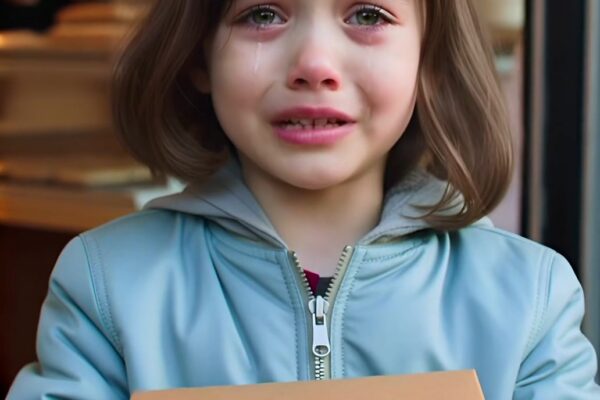
The girl hadn’t eaten properly in three days. Hunger had stopped being a sharp pain and become something quieter, a patient animal curled inside her ribs. It made everything sound too loud—the clink of cutlery from the terrace, the fizz of poured champagne, the careless laughter that floated out of the restaurant like warm perfume. She sat with her knees drawn to her chest and tried to make herself smaller than the evening.
In her hands she held a crust of bread wrapped in a torn napkin, flattened by the pressure of her fingers. It was dry and faintly sweet, like something baked to comfort someone who still believed in comfort. Her mother had pressed it into her palm the morning the coughing became wet and red, when their room above the laundromat smelled of ironed cloth and fear. “Not all at once,” her mother had said, voice threadbare but stubborn. “Keep it for the moment you think no one is left.”
She had saved it like a relic, because saving it meant her mother’s voice still had power over the world. When the city workers had carried the body out and the landlord had changed the lock before the day was over, she’d put the bread inside her jacket, close to her skin, and told herself she would not let the last gift be taken too. She had eaten nothing else, not properly. A sip of water from a fountain. The corner of an apple someone dropped. Small things that didn’t count.
Across the street, the restaurant’s windows glowed with amber light. Brass fixtures flashed; napkins bloomed like white flowers. A pianist, sleek in a vest, was finishing a song on the grand piano near the center. People applauded without looking at him. They were applauding themselves—being here, being warm, being sure.
The hostess had asked the girl to move once. Not unkindly, more like someone wiping a smudge from glass. Later a server had stepped around her as if she were a puddle. A couple in matching coats paused, eyes sliding away, and the woman tugged the man’s sleeve as though the girl’s emptiness might be contagious.
Then a voice from a table near the window drifted out, sharp as a snapped violin string. “If you’re going to sit there, at least earn it,” the man called, leaning back in his chair. He had cufflinks that caught the light like tiny coins. “Play us something, little stray. Or is holding your hand out all you know?” A ripple of amusement followed him, the kind that makes people feel briefly invincible.
The girl kept her gaze on the bread. She had learned that meeting eyes could invite cruelty, and cruelty was a luxury she could not afford. But the words stung anyway. Not because they were true, but because they were spoken like a verdict.
“That’s enough.”
The command came from inside the restaurant, and it carried like a gavel. A man in a black suit had stood. He wasn’t loud; he didn’t need to be. Even from the sidewalk she could see how the room adjusted around him, chairs shifting, smiles shrinking, the air turning attentive. He walked to the window, and for a moment his reflection overlapped her face, making her look like a ghost wearing someone else’s life.
He stepped outside. The cold followed him, obedient. He looked down at her the way one might look at a photograph found in a drawer—something familiar but impossible. His eyes didn’t soften with pity. They narrowed with focus, as if he were trying to read the fine print of a past he’d tried to erase.
“Can you play?” he asked, and though his voice was controlled, something in it was unsteady, like a hand held too still. “The piano.”
The question should have been ridiculous. A starving girl on a sidewalk, wrapped in an oversized jacket, asked to do something that belonged to shining rooms. But the girl felt the old shape of the keys in her memory—ivory under small fingers, the way scales could be a ladder out of a day. She swallowed, throat dry. “Yes,” she said. “I can.”
The man’s jaw tightened. “Then come inside.”
People watched her cross the threshold as if she were bringing in the weather. The hostess blinked as though the rules had changed without notice. Someone muttered that it was a stunt. The cufflinked man smirked, already preparing the story he would tell later—how a beggar made a mess of a Steinway.
The pianist in the vest stood aside reluctantly. His bench was still warm. The girl climbed onto it, feet dangling. For a moment she stared at the black lid reflecting the chandelier, at the shine so deep it looked like water. Her hands hovered above the keys. They trembled—not from nerves, but from weakness. The room held its breath, waiting for her to fail.
She placed her fingers down, and the first note landed clean as a bell. Then another, and another, building into a melody that didn’t belong to streets or hunger. It was the kind of music that sounded like remembering a home that had never existed, and yet everyone in the room felt certain it was theirs. It was precise and fierce, but threaded with sorrow so pure it made the throat ache. The girl’s wrists lifted and fell with the calm authority of someone who had once been taught not only how to play, but why.
Forks paused midair. Glasses stopped halfway to lips. The restaurant’s laughter died as if snuffed by a hand. Even the cufflinked man’s smirk drained away, replaced by confusion and a flash of shame he tried to disguise by looking angry.
At the doorway, the man in the black suit had gone still. Color left his face in stages, like lights dimming in a hall. His eyes were locked on the girl’s hands, on a small crescent-shaped scar at the base of her thumb. Recognition struck him with the force of a slammed door.
When the final chord settled, it didn’t end so much as it hovered, refusing to disappear. No one applauded at first. They were afraid to break whatever had just entered the room.
The man approached the piano as if it might bite. He leaned down, voice suddenly stripped of its polish. “That scar,” he whispered, and his breath smelled faintly of expensive mint. “You got it when you fell off the practice stool. You were six.”
The girl looked up. Her eyes were too large in her thin face, but the gaze inside them was steady. Tears clung to her lashes without falling, like they were waiting for permission. “You remember,” she said, and the words landed heavier than any accusation. “So you didn’t forget everything.”
The room leaned in. The hostess stopped moving. The pianist in the vest held his hands together as if in prayer, watching something more dramatic than any performance.
“What is your name?” the man asked, though his voice said he already knew.
The girl’s fingers curled against the edge of the bench. The bread, forgotten in her pocket, pressed against her ribs like a small, hard heart. “You’re the one who gave me my first lesson,” she said softly. “The one who promised my mother you’d never leave. Then you left in the night and the rent stopped and the letters stopped and the doctors stopped answering.”
He flinched as if she’d struck him. “I—” His throat worked. “I thought you went away. I was told—” He looked around at the polished room, the gold lights, the people who suddenly found the tablecloths fascinating. “I was told it was handled.”
She shook her head. The movement was small but final. “Nothing was handled.” Her voice trembled only at the end, where the child in her still lived. “My mother waited. She kept the curtains open because she said you’d come up the stairs and she didn’t want to miss the sound.”
Silence spread, thick as velvet. The cufflinked man stared at his plate, no longer amused. Someone at the bar wiped at their eyes and pretended it was the smoke from the kitchen.
The man in black swallowed hard, and for the first time his certainty cracked. “Where is she?” he asked, though grief had already answered.
The girl didn’t point to a grave. She didn’t need to. She reached into her jacket and drew out the crust of bread, the napkin frayed, the edges crumbling. She held it up like evidence, like a vow. “This is what she left me,” she said. “She said to save it for when I felt completely alone.”
The man’s eyes shut briefly, as if he could hide from the sight. When he opened them again, they were wet. “You’re not alone,” he said, but it sounded less like reassurance and more like a desperate attempt to rewrite time.
The girl slid off the bench. She was suddenly aware of every gaze, every whisper that would follow her. But she looked only at him. “You don’t get to say that because you heard me play,” she told him quietly. “You don’t get to buy your way back in with applause.”
He reached out, stopped, then lowered his hand as though he’d learned he had no right to touch. “Tell me what you need,” he said, voice raw. “Food. A place. A—” He struggled for words that might be strong enough to build a bridge.
For a moment the girl’s expression softened—not into forgiveness, but into something more dangerous: hope. She glanced down at the bread, then back up. “I need the truth,” she said. “Why did you leave us?”
The gold lights above them flickered, or perhaps it was only the illusion of a world shifting on its axis. The man’s mouth opened, and the room waited for the answer that would decide whether the music had been a miracle or a trap.
Outside, through the window, the city kept moving, indifferent as ever. Inside, a starving girl stood in a room of plenty holding the last gift of the dead, and a man in a black suit realized that recognition was not redemption—it was the beginning of judgment.