The boutique on Valeron Street was a cathedral built out of light. Chandeliers poured brilliance onto velvet trays; mirrors made the diamonds look like constellations that had fallen and agreed to behave. Outside, the city’s winter slush turned car tires into gray fans, but inside, even the air smelled expensive—citrus, polished wood, and the faint, metallic chill of gold.
When the boy pushed through the glass door, the bell sounded like a mistake.
He was small for his age, wrapped in an oversized coat with a broken zipper. A knit cap sat too high on his head, exposing a thin strip of hair that looked like it had been cut with kitchen scissors. His shoes were wet at the seams. He paused just inside as if expecting someone to throw him back out, then walked with careful steps across the marble, leaving damp crescents behind him.
At the center counter, a woman in a camel coat—elegant, immaculate—turned as though she’d smelled smoke. Her wrist glinted with a watch that could have paid a year’s rent in the boy’s neighborhood. She tightened her lips and shifted her purse to her front.
“Sir,” she said to the man behind the counter, “you should be careful.” Her eyes flicked to the boy’s hands. “These places attract… opportunists.”
The jeweler, Mr. Kellan, had the tired posture of a man who’d spent decades balancing beauty against suspicion. He offered the woman a placating smile. “We’re always careful.”
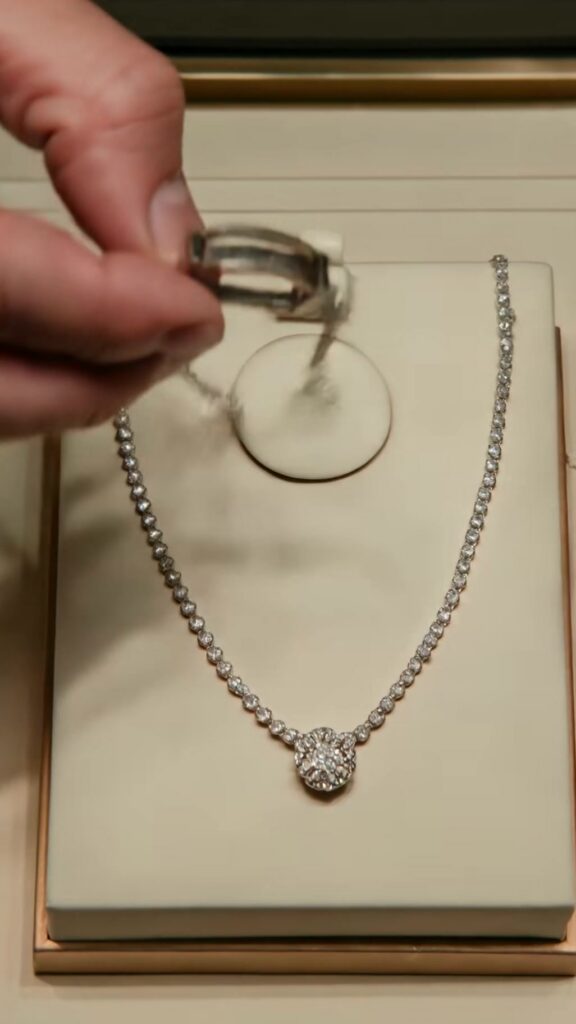
The boy did not look at either of them. He moved straight to the corner display where a single necklace sat apart from the rest, as if it didn’t want company. It was delicate—white gold, a teardrop pendant holding a pale stone that caught the light softly, more moon than diamond. The boy stared so hard his eyelashes trembled.
He lifted his hand toward the glass. A security guard at the door straightened, already halfway into his own story about stopping a theft. The wealthy woman took a step back as if poverty were contagious.
“Don’t,” she snapped. “Don’t touch that.”
The boy froze. His fingers hovered inches from the case, then retreated like a burned thing. His mouth opened, closed. The silence in the boutique grew sharp, the kind that waits for an accident.
He swallowed and, without looking up, pointed at the necklace through the glass. His voice came out thin but stubborn, as if it had been rehearsed in colder places than this. “My mother told me that one isn’t for sale,” he said. “She said it belongs to the woman who lost me.”
The sentence landed like a dropped tray—no crash, but every ear turned. Mr. Kellan’s hands stopped moving. The guard didn’t take another step. Even the boutique’s soft music seemed to thin out, retreating to the corners.
The woman in the camel coat blinked once, then laughed too quickly. “That’s ridiculous. It’s a necklace.” Yet her gaze stayed fixed on the pendant as if it had started breathing.
Mr. Kellan leaned forward, studying the boy—not his coat, not his shoes, but his face. There was something in the boy’s cheekbones, a certain tilt at the corner of the mouth that suggested a photograph folded and carried too long. “Where did you hear that?” he asked quietly.
The boy’s chin lifted a fraction. “From my mother. The one who raised me.” He rubbed his sleeve against his nose, leaving a damp streak. “She said if I ever got the courage, I should come here. Not to ask for money. Not to beg. Just to show it.”
“Show it?” Mr. Kellan repeated, and reached under the counter for a small key.
The wealthy woman drew in a breath. “You can’t possibly be considering—”
“Ma’am,” Mr. Kellan said, not unkindly, “this piece has sat here for years. No one buys it. No one even tries.” He slid the key into the lock. “It isn’t because it isn’t beautiful.”
The case clicked open. The sound was indecently loud.
Mr. Kellan lifted the necklace with gloved fingers. The boy didn’t move, but his eyes tracked it with the concentration of someone afraid the world would change if he blinked. The jeweler turned the clasp over, angling it beneath the spotlight. Something small and precise appeared, cut into the metal in tiny, careful letters.
For our little Elena.
The woman in the camel coat made a sound that was not a word. She raised a hand to her mouth, as if to keep her breath from escaping. Her eyes filled so quickly it was alarming, as if tears had been waiting behind them for years and had finally been given permission.
“No,” she whispered. Then, louder, hoarse. “No… That was—” She reached out, not touching the necklace, only the air near it. “That was my baby’s name.”
The guard shifted his weight, suddenly unsure what role he was supposed to play. Another customer at the far end of the room lowered a bracelet they’d been admiring and stared openly.
Mr. Kellan’s voice softened. “Marianne,” he said, and it wasn’t the voice of a salesman now but of a witness. “You told me you’d stop coming if I ever put it in the window again. You said you couldn’t stand strangers looking at it.”
Marianne—because that had to be her—nodded without taking her eyes from the engraving. “The hospital…” Her throat worked, trying to form the sentence. “The fire. The alarms didn’t go off. The smoke…”
The boy’s shoulders rose and fell in one uneven breath. “I don’t remember fire,” he said. “I remember a siren sometimes, in dreams. And a smell—like plastic, melting.” His fingers tightened into his sleeve until the fabric bunched. “My mother said she found me wrapped in a blanket behind a laundromat two days later. She said I was coughing, and my hair… my hair was singed.”
Marianne’s knees bent slightly, as if grief had hooked behind them and pulled. Mr. Kellan moved around the counter without thinking and offered her a chair. She didn’t sit. She kept staring at the boy’s face, searching it like a map with a missing legend.
“What’s your name?” she asked, the words trembling between demand and prayer.
The boy hesitated. “Leo,” he said. “That’s what she calls me. But she told me—” His voice cracked, and he pressed his lips together until it steadied. “She told me the first name I had was Elena. She said she heard it once, whispered, when I was half asleep and feverish. She said she wrote it down because it sounded like someone had loved me before.”
Marianne’s breath came in sharp pieces. She took a step forward. She didn’t reach for him—not yet. Instead, she lifted her own hand and touched two fingers to the inside of her wrist, as if checking for a pulse that had been absent for a decade. “I had a bracelet,” she murmured, speaking to Mr. Kellan as much as to herself. “A hospital tag. A tiny one. It said Elena Voss.” Her gaze snapped back to the boy. “Do you have—”
The boy dug into his coat pocket with shaking hands and pulled out a folded strip of plastic, yellowed and cracked from being opened and closed too many times. He held it out like a dangerous offering.
Mr. Kellan took it carefully and smoothed it on the counter beneath the light. The printed text was faded, but legible enough. A surname. A date. A number that meant something to someone who had memorized it in panic.
Marianne made a sound like her heart had been struck. She reached for the strip, then stopped herself, palms hovering, reverent. “That’s…” She looked at the boy again, and the last of the boutique’s distance—its rules, its velvet ropes, its shining belief that tragedy happened elsewhere—collapsed. “That’s mine,” she said. “That’s my child.”
The boy stood very still, as if sudden movement might break the fragile bridge forming between them. His eyes were bright, but he did not cry. “My mother said I should tell you one more thing,” he said. “She said you’d know it wasn’t a lie.” He swallowed. “She said to tell you: you sang to me even when the nurses told you to rest. You always started with the wrong verse, and you laughed every time.”
Marianne’s hand flew to her mouth again, but this time it was to catch a sob. “I did,” she whispered. “I did start with the wrong verse.” She looked to Mr. Kellan, helpless. “I used to be so tired.”
Mr. Kellan held the necklace out—not to sell, not to display, but like returning a relic to its altar. “This stayed here because you asked me to keep it safe,” he said. “You said if she was alive, the world would bring her back to it. I didn’t know whether to believe that.” His eyes shone. “I kept it anyway.”
Marianne’s fingers finally closed around the chain. The pendant lay against her palm, and the stone caught a new kind of light—warmer, wet with tears. She looked at the boy, at Leo-Elena, and the fear on his face—fear of being rejected, fear of having dared to hope—made something fierce rise in her.
“Come here,” she said, voice breaking on the command.
He took a half step, then stopped, waiting for permission in the way children do when their lives have taught them that love can be withdrawn without warning. Marianne crossed the remaining distance and sank to her knees on the marble floor, not caring what it did to her coat. She didn’t grab him. She only held the necklace up between them, the engraving turned outward like proof.
“I don’t care what you’re called now,” she said. “I don’t care how many years we lost.” Her eyes locked on his. “If you want me, I’m here.”
The boy’s face crumpled at last, relief and grief mixing until neither could be separated. He leaned forward into her arms with the cautious surrender of someone stepping onto a bridge that might hold. The boutique remained silent—not the cold silence of judgment, but the stunned hush of witnesses watching a life return to its rightful name.
And on Valeron Street, in a room made for glittering objects, the most valuable thing in the building was the sound of a child finally being found.