The little girl had already decided she would rather be called a thief than watch the baby cry one more night. Hunger had a sound—thin, furious, and relentless—and when it rose from the baby’s lungs in the dark, it filled their whole room until Mara couldn’t hear her own thoughts. The neighbors thumped the wall. The landlord shouted through the door. The city outside kept moving, indifferent as rain. But the baby’s cry made time feel personal, like an accusation.
So she walked to Kellan’s Market at the edge of the bus depot with the baby strapped tight against her chest in a fraying scarf. She knew which aisle the milk was on. She knew where the cameras couldn’t see, because she had mapped the place with her eyes the way other kids memorized playgrounds. She didn’t want to become what people already assumed she was. She wanted the baby to sleep.
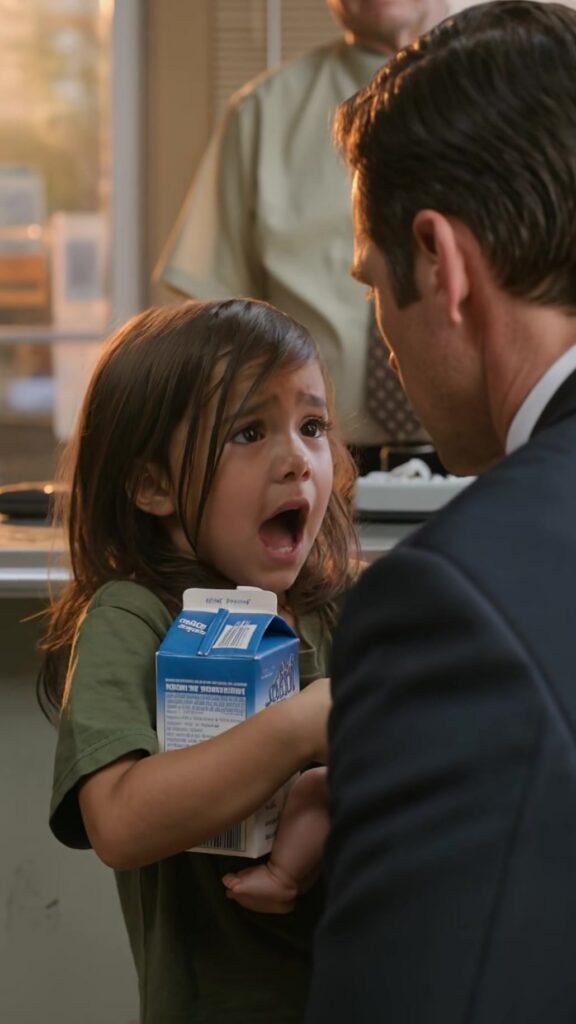
At the counter, Mara held the carton with both hands as if its cold weight could keep her steady. The fluorescent lights made her olive shirt look gray and made the bruises under her eyes look like they belonged to someone older. Mr. Kellan stood behind the register in his stained apron, his face carved by years of late nights and too many cigarettes. He watched her without reaching for the phone, without calling her names, without the righteous anger she’d prepared herself to swallow.
“I’ll pay,” she said before anyone could speak, because if she spoke first, maybe the world would behave. “Not now. But I will. When I’m… when I’m bigger.” Her voice tried to be brave and cracked anyway. The baby—Finn, she’d named him Finn because it sounded like something that could swim—rooted against her collarbone and whimpered.
The store door chimed, and in came a man who didn’t belong among scratch-off tickets and dented cans. His suit was dark and clean, the kind that didn’t wrinkle even when its owner moved like he had places to go. He paused as if the air itself had spoken to him. His gaze lifted from the floor to the baby’s blanket—faded blue with a stitched constellation along the edge—and then to Mara’s face. Something in his expression tightened, not with disgust, but with recognition that looked like pain.
Mara stepped back. Instinct made her body a shield. She’d learned early that good manners didn’t stop bad hands. “I’m not—” she started, meaning she wasn’t stealing, she wasn’t lying, she wasn’t asking for pity. But the man was already lowering himself to her height, careful, as if sudden movement might break something.
“How old are you?” he asked. His voice was soft, the kind of soft that could be a trap. He didn’t smile. He didn’t reach for the baby. He kept his hands in view, empty, and still Mara’s heart hammered like it wanted out.
“Old enough,” she said, which was true in the way emergencies made things true. “Old enough to know he needs this.” She lifted the milk carton a little, her final argument with the world. “Please. He hasn’t had anything since yesterday.”
The man’s eyes dropped again to the blanket. He drew a slow breath, then reached into the inner pocket of his jacket. Mara’s muscles coiled; Mr. Kellan’s shoulders rose behind the register. But the man didn’t pull out money or a weapon. He pulled out a photograph, folded and worn, kept close like a wound. He opened it just enough for Mara to see the image inside.
The floor seemed to tilt. In the picture was a woman Mara knew better than the lines of her own palm: her mother, Lina, caught mid-laugh, hair shining in sunlight that didn’t exist in their apartment. In her arms, a baby wrapped in the same blue blanket, the stitched constellation unmistakable. The baby in the photo had the same small crescent mark on the chin—Mara had traced it with her fingertip a thousand times on Finn’s skin like it was a promise.
“Where did you get that?” Mara whispered. Her throat closed around the words. Her mother had burned everything that looked like the past. She’d said it was safer not to be remembered.
The man didn’t look triumphant. He looked terrified of what he had to say. “My name is Elias Mercer,” he said. “Lina isn’t just… someone who passed through your life. She married into my family once. She disappeared three years ago with a child we’ve been searching for since.” He hesitated, then added, “I think the baby you’re holding is that child.”
Mara’s arms tightened around Finn until he squeaked. She rocked him automatically, as if motion could undo meaning. “He’s my brother,” she said fiercely. “She said he was my brother.” The words came out sharp, but the certainty underneath them wavered like a candle in a draft. Lina had never told Mara much—only that they had to move, that names were dangerous, that some doors should never be answered. And the night Lina didn’t come home, Mara had waited by the window until dawn smeared the sky gray, then waited again and again until waiting became their life.
Elias’s eyes flicked to Mara’s face as if measuring every bruise and every missing meal. “I’m not here to take him by force,” he said. “If I wanted that, I wouldn’t be speaking to you in a convenience store.” His jaw worked, and for the first time, his composure slipped. “I’m here because someone finally told me where Lina was last seen. And because if I’m here, it means others can be here too.”
Mr. Kellan cleared his throat, a small human sound that reminded Mara the world hadn’t vanished. He reached under the counter, not for a gun but for his wallet. “Kid,” he muttered, not unkindly, “take the milk. On the house.”
Mara didn’t move. Milk suddenly felt like the smallest thing in the room. The baby’s warmth pressed against her, real and heavy. If Elias was lying, he could still be dangerous. If he was telling the truth, then everything Mara had done—every night she’d paced the floor whispering lullabies and promises—had been for a child whose life belonged to someone else’s story.
“What do you mean, others?” she asked, because fear made her practical. “Who?”
Elias looked toward the front window where the afternoon sun made the street seem harmless. “My father,” he said quietly. “And people who work for him. Lina didn’t leave because she wanted a new life. She left because she was trying to keep the baby from being used as leverage, as inheritance, as a symbol. If they find him, they won’t care that you kept him alive. They’ll call you a criminal and erase you.” He swallowed. “I can keep you both from being erased.”
Mara’s mind flashed with the landlord’s threats, the neighbor’s fists on the wall, the men outside the building who watched too long. She had blamed poverty for everything, because poverty was a simple monster. This was a different kind of monster, dressed in expensive fabric and family names.
“You’re offering more than milk,” Mara said, the words tasting bitter. “You’re offering a cage.”
Elias flinched as if she’d struck him. “I’m offering a door,” he said. “One with locks on it, yes. But also a bed for him. Food. Doctors. A way to find Lina—if she’s alive.” His voice lowered. “And a way to keep you from taking the fall for choices you were too young to make.”
The baby fussed again, and Mara tipped the carton against her forearm, awkwardly unscrewed the cap with her thumb. Mr. Kellan slid a paper cup across the counter without a word. Mara poured a little milk, hands shaking, and guided it to Finn’s lips. He latched clumsily and quieted, his eyes fluttering shut as if peace were a thing that could be purchased after all.
Mara stared at his face while he drank. She thought of Lina’s hands braiding her hair, Lina’s whisper in the night: If anyone asks, you don’t know me. She thought of the empty apartment and the way the silence had felt like abandonment until it began to feel like a warning.
When Finn finished, a tiny dribble of milk ran down his chin. Mara wiped it with her sleeve and lifted her gaze to Elias. “If you lie to me,” she said, voice raw, “I’ll scream so loud the whole street will hear.”
Elias nodded once. “Good,” he said. “Keep that scream. You’ll need it.”
Mara set the carton on the counter like a signature. She didn’t hand the baby over. She didn’t step closer to Elias, either. She adjusted the scarf so Finn’s head rested beneath her chin and said to Mr. Kellan, “Thank you,” in a voice that carried more grief than gratitude.
Then she looked at Elias again. “You don’t take him,” she said. “Not from me. If he belongs to your family, then your family can learn what I already know: he belongs to the person who keeps him alive.”
Elias’s eyes shone, and for a moment Mara saw a man who had also been cornered by a name he didn’t choose. He opened the store door, and the sunlight spilled in like an invitation and a threat. “Stay close,” he said. “Whatever happens next, don’t let go.”
Mara stepped into the brightness with a baby against her heart and a stolen carton’s coldness still in her palms. Behind her, the bell chimed again, ordinary as ever, as if the world hadn’t just rewritten her life. She walked anyway, because she had already decided what she would be called if it meant Finn would sleep through the night.