The paper hit the marble softly.
It didn’t flutter like paper was supposed to. It didn’t skate across the floor or curl into a corner. It simply fell—flat, obedient, as if it had always belonged on the hotel’s polished marble, as if the building had been waiting for it.
But in the hotel hall, it sounded louder than the accusation.
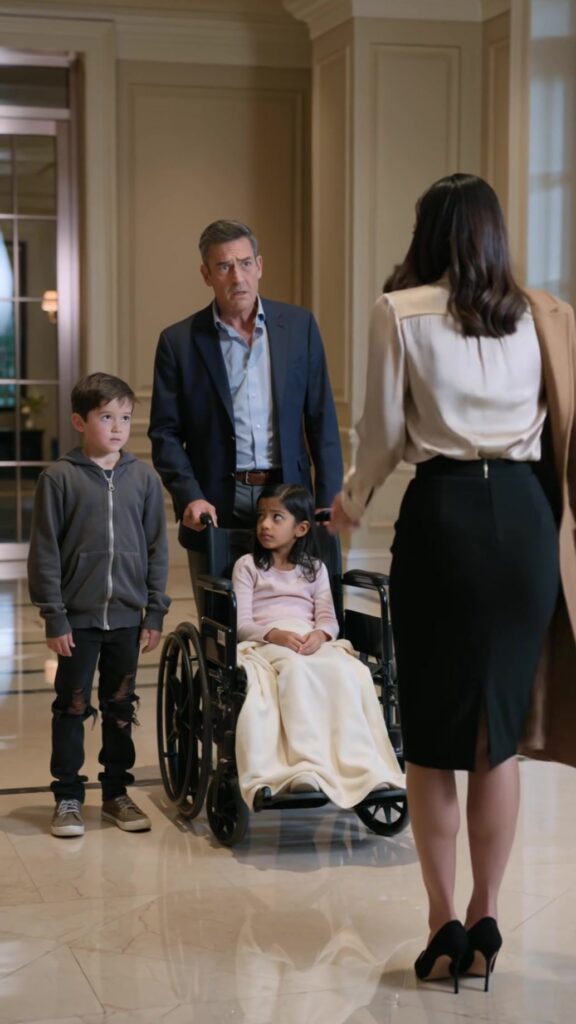
The chandelier above the lobby cast perfect light on everything worth hiding: the smudged brass of the concierge desk, the gold-stitched crest on the carpet runner, the father’s knuckles whitening on the back of his daughter’s wheelchair. Behind the tall windows, evening rain turned the city into a watercolor of brakes and streetlamps.
The homeless boy on the left—thin, damp-haired, with a borrowed coat that swallowed his shoulders—had already said the sentence that split the room open. He’d forced it out like a splinter from under his tongue.
“She could get better,” he said, voice cracking, “but your future wife has been stopping it.”
Now no one could return to the moment before it.
Daniel Rowe turned slowly, as if speed would make the truth more real. He looked at Elise Carroway—Elise with her neat hair and immaculate hands, Elise who knew how to occupy a room without asking permission, Elise who had stood by his side through his wife’s funeral and his company’s lawsuits and the relentless discomfort of pitying stares. Elise on his right, slender in a pale coat that had cost more than some people’s rent.
His mouth shaped words that sounded like they came from someone else’s life.
“Tell me that’s not true.”
Elise did not answer.
She recoiled.
Not offended. Not furious. Cornered.
It wasn’t the kind of flinch people did when they were wrongly accused. It was the small, involuntary retreat of someone whose practiced face had been caught between masks.
Mara, in her wheelchair, looked from her father to Elise with slow, frightened attention. She was fourteen and thin in the way sickness makes children look older, as if the body is trying to grow out of itself. Her fingers worried at the blanket on her lap, folding it again and again into a tight strip. She didn’t understand the words fully—stopping it, better—but she understood the change in air. One adult had suddenly become dangerous to the others.
Daniel moved slightly toward Elise, still keeping one hand near the chair, as if his body had not yet decided whether to confront betrayal or protect weakness. It was a movement of two instincts fighting for the same muscle.
The boy stayed frozen. His chest rose and fell too fast, like he had been running for miles just to reach this moment. His eyes didn’t dart around like a liar’s. He stared forward as if he’d carried the sentence for too long to survive swallowing it again.
“Who are you?” Daniel asked him, not because he didn’t know, but because he needed something he could hold in his hand.
The boy swallowed. “Tommy,” he said. “You gave me coffee outside the clinic last month. You told me I could come to the lobby if it rained.” His gaze flicked, just once, to Mara. “Your daughter… she asked me what the sky looked like from the river.”
Mara’s eyes widened at her father, recognition slipping in like a shy guest. She had spoken to him, then. She had been alive enough to wonder about a river.
Daniel’s throat tightened. He remembered. The clinic’s side entrance, the way Mara had been too tired to lift her head but had insisted on sitting by the window. He remembered Elise stepping out to make a call, pacing with quick, irritated steps. He remembered thinking, absurdly, that weddings were made of small interruptions like that.
“What did you see?” he asked Tommy, voice rough.
The boy’s hands balled inside his sleeves. “I saw her—Elise—come out with a bag from the pharmacy. I was under the awning because the guard told me to move. She didn’t see me. She went back in, and later I heard the nurse arguing with someone on the phone.” He dragged in a breath, as if it hurt. “And then… I saw her again two days ago. In the staff lot. She gave a guy an envelope.”
“Enough,” Elise said finally. Her voice was controlled, almost delicate, and that was worse than shouting. “You’re letting a stray child tell you stories.”
“He has no reason—” Daniel began, then stopped. He did not know that. People always had reasons. Hunger had reasons. Fear had reasons. But then he looked at Mara. At the way her eyelids trembled with effort, at the thin tube taped to her arm, at how she had been deteriorating for months despite specialists and private rooms and imported medication.
And he remembered Elise’s explanations—always polished, always reasonable. The disease was unpredictable. The body resisted. The doctors were cautious. Mara mustn’t hope too much.
“Elise,” he said, quieter now, “answer me.”
She stepped back. Her heel caught on the edge of the carpet runner, and the graceful slide of her retreat broke into a small stumble. Something shifted inside her coat with the movement.
A folded slip of paper slid free.
It landed on the glossy marble between them with a soft, flat sound that seemed to ring against the lobby’s high ceiling.
The father saw it.
So did she.
And for one long second, nobody bent to pick it up.
Daniel stared at the paper as if it were a snake, as if it could leap and strike. Elise’s gaze fixed on it too, not with surprise, but with the exhausted resignation of someone whose careful stacking had finally collapsed.
Tommy took one step forward, then stopped as if an invisible line had been drawn on the floor.
The concierge pretended to rearrange brochures. A bellhop paused mid-stride, eyes darting away in the practiced manner of hotel staff trained to ignore other people’s implosions.
Mara whispered, barely audible. “Dad?”
Daniel’s hand, still hovering near the wheelchair, tightened on the grip. Then he reached down with the other hand and picked up the slip.
It was a prescription. Not for Mara. Daniel read the name at the top and felt the lobby tilt: Elise Carroway.
The medication listed was not pain relief or anxiety tablets. It was a drug he recognized from late-night research and desperate conversations with specialists—an immunosuppressant sometimes used to blunt certain treatments, sometimes used in cases where doctors wanted to prevent the body from responding.
“This is…” His voice failed. He tried again. “This is what they said could help her,” he whispered, looking at Mara, then back at Elise. “This is what Dr. Patel wanted to start.”
Elise’s lips parted. For a moment she looked like she might deny it. Then she didn’t. The denial would require a new story, and she had run out of paper to write it on.
“It was never supposed to be like this,” she said, and the words were so ordinary they were grotesque.
Daniel’s horror shifted, not into certainty, but into recognition. It was a particular kind of recognition—like hearing a melody you’d been humming without knowing the song’s name.
He remembered Elise’s insistence that Mara’s care remain “streamlined.” Elise’s kindness that always came with a suggestion. Elise volunteering to organize medications, to speak to pharmacists, to “take that burden” from him. Elise offering to handle everything so he could grieve properly. So he could work. So he could be hers.
“Why?” Daniel asked, and it was not a shout. It was the small question that lives under bigger ones.
Elise’s eyes shone, not with tears yet, but with the pressure behind them. “Because you were disappearing,” she said, and at last the polished voice cracked. “Because you looked at her like you’d burn the world down to keep her alive, and you never looked at me like that. Because every time she improved, you would run back to the hope and leave me standing in the hallway again.”
Tommy made a sound—half disgust, half fear.
Elise kept speaking, as if stopping would make her fall. “I didn’t want her dead,” she said quickly, and that was the most chilling part: the careful distinction. “I just—needed time. Needed her stable. Needed you stable. The doctors were rushing. These treatments… they make people worse before they make them better. What if she—”
“Don’t,” Daniel said, and the word cut through her like glass. His jaw clenched, tendons straining. “Don’t pretend you were protecting her.”
Mara stared at Elise with an expression that was not anger yet, not fully, but a dawning, trembling understanding. “You… made me tired?” she asked softly, as if asking someone to repeat a math problem.
Elise’s face finally changed. Pain flared there, real and raw, because a child’s simple sentence offers no place to hide. “Mara, I—”
Daniel’s hand moved to the back of the chair, anchoring himself. The instinct to protect hardened into something else: an instinct to remove a threat. He looked up and saw Elise angle her body toward the exit.
She was going to leave.
Of course she was. In every story Elise had ever told, she got to control the ending. She could vanish into a car service and an attorney’s office and a new narrative where she was the misunderstood fiancée, the victim of a grieving man and a street kid’s lies.
But the paper in Daniel’s hand was not a story. It was ink and numbers and a pharmacist’s stamp. It was weight.
“Call security,” Daniel said to no one in particular, and the concierge’s hands stilled on the brochures. “And call Dr. Patel.” He looked down at Mara, gentler for a heartbeat. “We’re going back. Tonight.”
Elise’s breath hitched. “Daniel, if you do this—”
“If I do this?” He laughed once, soundless. “If I do this, my daughter might live. That’s the only sentence in this room that matters.”
Tommy shifted, as if bracing for violence. Daniel saw it, and something inside him recognized another truth: the boy was not brave because he felt safe. He was brave because he had nothing else to lose.
“You,” Daniel said, meeting Tommy’s eyes. “Stay. Please.”
Tommy blinked, startled by the softness. Then he nodded once, a sharp movement, as if agreeing could keep him from shaking apart.
Elise took another step toward the doors. Her hand reached for her phone, thumb hovering. Her old instincts, calling for rescue.
Security arrived as if summoned by the hotel’s architecture. Two men in dark suits, polite faces, firm stances. Elise’s mouth opened, ready to shape a version of events. Then she saw Daniel lift the prescription slip slightly, like a flag.
Her shoulders sank. The performance died in her throat.
Outside, the rain thickened, tapping the windows like impatient fingers. In the lobby, the air changed again—not back to what it had been, but into something sharper, cleaner. A room after a storm, when the debris is finally visible.
Daniel leaned down to Mara. He pressed his forehead briefly to hers, careful of tubes and fragile skin. “I’m here,” he whispered. “I’m sorry I wasn’t looking.”
Mara’s eyes filled, and she nodded, as if she had been waiting for him to say that more than she had been waiting for any medicine.
Elise stood between the guards, face pale, eyes fixed somewhere beyond the marble floor, beyond the paper that had betrayed her. When they guided her away, she didn’t fight. She moved like someone walking out of a photograph that had finally developed properly.
Daniel watched her go, then turned the wheelchair toward the doors leading to the street. The marble floor reflected them—father, daughter, and the boy who had thrown a sentence into the world and lived long enough to see it land.
The paper hit the marble softly, but it had landed like a verdict. And there was no returning to the moment before it.