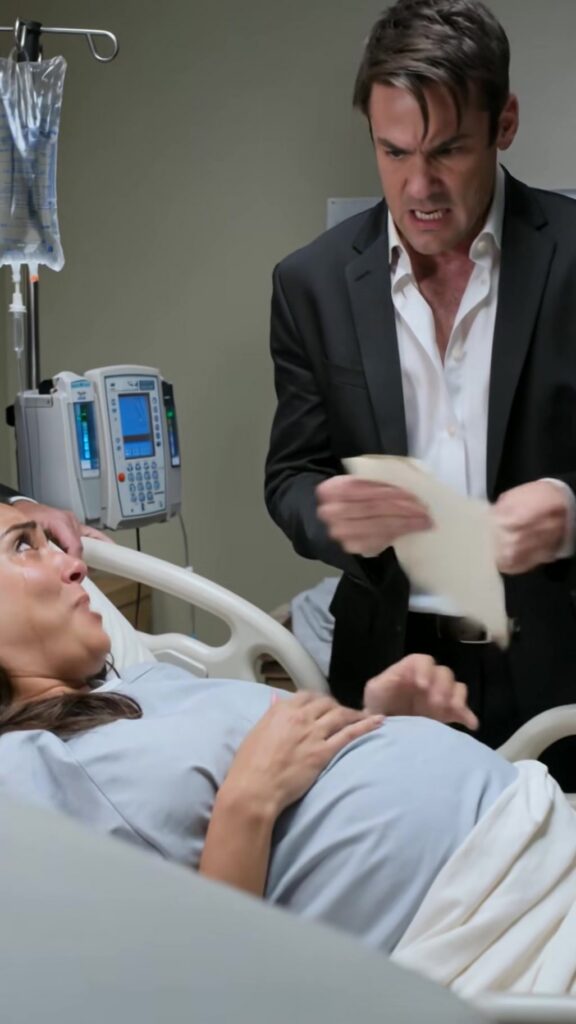
The hospital room felt ice-cold, the kind of cold that didn’t come from air conditioning but from people who had decided what you were before you could speak. The fluorescent lights buzzed like angry insects above the bed, and the thin blanket over Mara Quinn’s legs might as well have been paper. She lay on her back with her knees slightly drawn, one hand splayed protectively over the curve that was barely there yet, the other clenched at the sheet as if she could anchor herself to it and keep from drifting away.
Her face was bloodless. Her eyes were swollen, red at the rims, and every time she breathed the stitches of her composure threatened to split. The monitor beside her traced a steady heartbeat she could not feel as her own, and the scent of antiseptic clung to everything—clean, clinical, unmerciful.
“Say it,” Julian Vale demanded.
He stood at the foot of the bed in a tailored coat that looked absurd in a hospital, as if he’d arrived dressed for judgment. He wasn’t wearing gloves, but his hand was curled as though he wanted to. He pointed at her with a trembling finger, not from weakness but from fury held too tightly.
“Tell them you trapped me,” he said, the words snapping like a whip. “Tell them you got pregnant with another man’s child and dragged my name into it.”
Mara flinched at the volume. The sound of his voice filled the room and pushed the air out of her lungs. When she tried to answer, all that came out was a broken breath. Tears slid down from the corners of her eyes—hot against skin that felt numb.
Near the window, framed by the gray city beyond, stood Conrad Vale. Julian’s father didn’t need to raise his voice. He didn’t need to point. His disdain was quiet and complete, as if it had been etched into him by years of boardrooms and courtroom victories. His hair was silvered perfectly, his posture straight as a blade.
“We opened our home to you,” Conrad said, his tone not cruel so much as final. “We brought you into our name. And you repay us by humiliating my son.”
Mara’s throat burned. She remembered the dinner table where Conrad had toasted her with an expensive wine and called her “family” as cameras flashed. She remembered how her mother had watched from the side, proud and terrified. She remembered Julian’s smile that night—wide, shining, rehearsed.
Now that smile was gone, replaced by a hard, sharp line.
Julian reached into his coat and threw a sealed hospital envelope onto Mara’s lap. It landed with a soft slap, the only gentle thing he had done in days.
“The truth is in there,” he said. “You want to clear yourself? Open it.” His eyes narrowed. “No—don’t. You told everyone you didn’t need me. Fine. You open it.”
Mara stared at the envelope until the letters blurred. She had asked the nurse to seal it. She had asked for one mercy: that she not have to watch them twist the pages with their fingertips, hungry for evidence. But even sealed paper could be weaponized.
Her fingers felt clumsy as she touched the edge of it. She didn’t break the seal. She didn’t have to.
“Read the last page,” she whispered.
The words were small, but the room heard them. Julian’s jaw tightened as if the request were an insult. He snatched the envelope off her lap and tore it open. The sound ripped through the sterile air. Pages fluttered, a brief storm of white.
He flipped quickly, not reading, only hunting—like a man searching for the line that would justify his anger. His thumb caught, his eyes landed, and he stopped as if someone had struck him.
All the color drained from Julian’s face. His mouth parted, but the breath that should have carried a shout didn’t come. He just stared.
Conrad stepped forward, impatience and suspicion tightening his features. “Give me that,” he said, and took the file with a grip that suggested he had never once in his life asked twice.
He scanned the page Julian had frozen on. His eyes moved with ruthless speed, then slowed, then stopped. A muscle in his cheek twitched. His fingers tightened around the paper until the corner bent.
For a long moment, the room held no sound except the hum of the lights and the soft beeping of the monitor.
Conrad’s voice finally emerged, not loud—shaken, almost unwilling. “This blood type… this marker.” He swallowed. “This child could only belong to someone in our family.”
Julian turned to Mara as if he’d been spun by a force he didn’t understand. His anger faltered, then surged in confusion. “What did you do?” he asked, but the question had lost its certainty. His voice sounded unfamiliar, younger, brittle.
Mara closed her eyes. A single tear escaped and slid into her hairline. She let it. She was tired of catching herself before she fell apart.
“Yes,” she whispered. “But not the man you think.”
Julian stared, searching her face for a lie. He had always been good at telling when she was withholding something; he had built their relationship on knowing how to press. He opened his mouth, then closed it, as if his body couldn’t decide which version of the world to accept.
“You’re saying… my father?” he managed, the words choking on their own absurdity.
Conrad’s head snapped up. “Don’t be obscene,” he barked, too quickly. His eyes, usually so controlled, flashed with something that looked like fear. “This is manipulation.”
Mara forced herself to sit higher against the pillows. Pain flared low in her abdomen, and she breathed through it, refusing to show them another weakness to exploit. “I didn’t come here to destroy you,” she said, each word careful. “I came here because my body started bleeding and I thought I was losing the only innocent thing in this entire nightmare.”
Julian’s hands curled into fists. “Then explain,” he said, almost pleading, anger and panic tangling. “Explain how a baby that isn’t mine has our blood.”
Mara’s gaze moved to Conrad, and the older man went still, as if he knew she was about to pull a thread he’d hidden beneath layers of money and reputation.
“You don’t remember the foundation gala,” Mara said softly, “because you drank too much and left early. You were angry that I’d spoken to the press without you. You called me ambitious like it was a sin.” She swallowed. Her mouth tasted like metal. “But your father stayed.”
Conrad’s lips thinned. “I gave you a ride home,” he said. “A courtesy.”
“You gave me a drink,” Mara replied. “You told me you wanted to ‘protect the family’ from scandal. You said you knew how lonely I was, how badly I wanted to belong.” Her voice trembled, but she didn’t stop. “And when I tried to leave the car, the locks didn’t open.”
Julian’s face contorted, disbelief warring with dawning comprehension. “No,” he said, shaking his head, as if he could reject the memory for both of them. “He wouldn’t—”
Conrad took a step forward, and the room’s coldness deepened. “You think anyone will believe you?” he hissed, the mask cracking enough to reveal the threat beneath. “A young woman with a convenient story, against a man who funds half this city’s charities?”
Mara’s hands trembled as she reached toward the bedside table. She picked up her phone, its screen already open. “I didn’t rely on belief,” she said. “I relied on proof.”
Julian’s eyes darted to the phone, then back to her. “What proof?”
“Your father’s driver,” Mara said. “Mr. Holloway.” She remembered the man’s apologetic eyes in the rearview mirror that night, the way his knuckles had been white on the steering wheel. Weeks later, he had found her in a quiet café and slid a small memory card across the table, hands shaking. “He had a dash cam. He couldn’t live with it.”
Conrad’s composure splintered. “You wouldn’t dare.”
“I didn’t want to,” Mara said, and her voice broke on the truth of it. “I kept telling myself I could swallow it, carry it alone, spare everyone the ugliness. But then Julian looked at me like I was a con artist, and you looked at me like I was dirt, and I realized you were counting on my silence the way you count on your money.”
Julian’s breathing turned ragged. He took the last page of the report from his father’s hand, not gently. His eyes skimmed the medical language again, as if the words might rearrange into something kinder. They didn’t.
He looked at Conrad—really looked, as though seeing his father for the first time without the glow of inherited power. “Is it true?” he asked. “Tell me it’s not.”
Conrad’s gaze flicked to the door, calculating exits and leverage, already assembling a defense. “You will regret turning on your own blood,” he said, but his voice had lost its certainty.
Mara’s phone screen reflected in Julian’s eyes as he took a step toward her bed, not aggressive now, but unsteady. “Mara,” he said, the accusation gone, replaced by something raw. “Why didn’t you tell me?”
She laughed once, a sound that held no humor. “Because you were trained to protect him,” she whispered. “Because I watched you become his son every time he entered a room. Because I was afraid you’d look at me the way you’re looking at me now—like I’m the thing that changed your life, not the man who did.”
Outside, the city moved on, indifferent. Inside, the air remained ice-cold, but it was no longer just the cold of cruelty. It was the cold of a truth finally spoken, sharp enough to cut through years of varnished loyalty.
Mara pressed her palm over her stomach again, feeling a faint flutter beneath her ribs like a distant knock. “I’m not asking you to forgive me,” she said. “I’m asking you to stop calling me a liar.”
Julian’s shoulders sagged as if something heavy had finally fallen off them—and landed, with crushing weight, on his heart. Conrad stood rigid, a man used to shaping narratives suddenly confronted with one he could not buy back into silence.
The monitor continued its steady rhythm, insisting on life in a room that had been built for pain. And in that frigid, glaring light, the Vales’ empire began, almost imperceptibly, to crack.