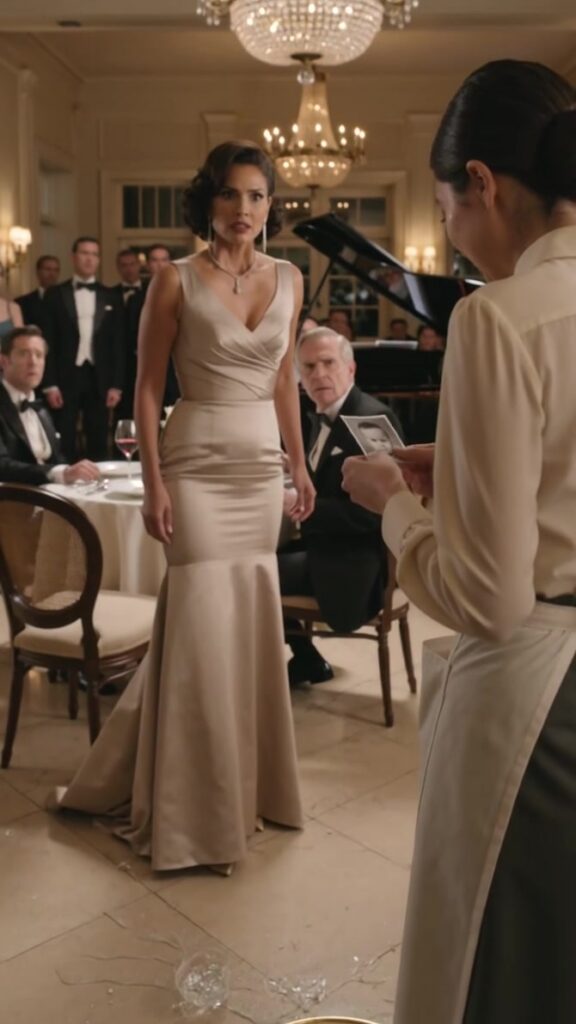
The restaurant was glowing with wealth, the kind that made sound feel expensive. Crystal chandeliers hung like captured constellations, and their light slid over white linen and polished silver until even the shadows looked curated. At the far wall, a pianist in a black suit poured velvet notes into the room. The guests—men with watches heavy as small anchors, women with diamonds arranged like punctuation at their throats—laughed as if laughter itself could insure them against disaster.
Mara moved between tables with the practiced invisibility of a waitress trained to disappear. Her shoes pinched; her back ached. Every step was measured so the tray didn’t wobble, so the champagne didn’t betray her trembling hands. She had watched the evening’s centerpiece arrive: Lucien Vale, whose name was printed on buildings and charities and whispered by bankers with reverence. He sat near the window where the city’s lights framed him like a portrait. Beside him sat his wife, Celeste, resplendent in a dress that looked poured onto her body, hair pinned with an almost violent precision.
Mara had not come for tips. Her apron pocket held a small envelope that felt like a hot coal. She touched it once, just to make sure it was still there, just to remind herself that she had crossed a point of no return the moment she stepped through the doors and let the maître d’ lead her into this glowing world.
When Mara approached their table, Celeste’s gaze snapped to her like a blade finding its sheath. Lucien didn’t look up at first. He was mid-sentence, gesturing softly, as if his hand had been trained to move in boardrooms the way conductors move in concert halls.
“Excuse me,” Mara said, setting down two flutes of champagne with a careful smile.
Lucien glanced up then. His eyes—gray, unreadable—rested on her face for half a second longer than a stranger’s should. Mara felt something inside her tighten, a thread pulled taut. She looked away before she could do something foolish like beg.
Celeste’s hand tightened around her napkin. “Don’t,” she said, not loud enough for anyone else to notice, but sharp enough that Mara froze.
“Ma’am?”
Celeste rose so quickly that her chair scraped the floor, a sound like a match struck in a room full of gas. The conversation nearby faltered. The pianist’s melody thinned, uncertain.
Celeste stepped into Mara’s space and struck her.
The slap cracked through the restaurant like a gunshot. Mara’s head snapped to the side; her cheek flared with heat. The tray tipped, champagne arcing in glittering streams. Glass met marble and exploded into fragments that skittered beneath tables. Forks hovered midair. A laugh died halfway out of someone’s throat. Every face turned at once, drawn by the irresistible hunger of spectacle.
Celeste’s breath came quick, her eyes bright with something that looked like triumph until it didn’t. “Stay away from my husband,” she hissed, loud enough now that the nearest tables heard. “I’ve seen you—your little looks. Your lingering.”
Mara steadied herself by gripping the edge of a chair. One hand rose to her stinging cheek, as if she could press the humiliation back into her skin. She tasted metal where her teeth had cut her lip. The room swam with expensive perfume and outrage.
“I wasn’t—” Mara began, but the words tangled.
Celeste leaned closer, almost savoring the power. “You thought I wouldn’t notice? In my own city, in my own world?”
Mara’s eyes burned. Not from the slap alone. From the long road that had led here, from nights spent staring at a ceiling in a rented room, from a name repeated like a curse by the woman who raised her. Don’t let him build another family without knowing. Don’t let them bury the truth again.
Instead of pleading, Mara reached into her apron pocket. Her fingers shook so badly she almost dropped the envelope. A murmur rolled across the tables like wind through dry leaves.
She pulled out a small, faded photograph and held it up with both hands, as if it weighed more than a lifetime. “I came to give him this,” she said, her voice splitting on the last word.
Lucien’s chair moved. He stood so abruptly that his glass tipped, a thin ribbon of champagne spilling onto the cloth like pale blood. His face had drained of color. He reached for the photo before he seemed to realize he was moving, and when his fingers closed around it, his hand began to tremble.
The pianist stopped mid-note.
Silence expanded, swallowing the restaurant’s careful music. The old man at the piano rose slowly, as if his bones protested. His eyes were fixed on the photograph in Lucien’s hand with an intensity that didn’t belong to an employee.
“That blanket,” the pianist whispered, his voice cracking with age and fear. He stepped closer, past the edge of the stage, past the line of tables. “I remember it.”
Lucien didn’t blink. He stared at the image: a newborn wrapped in an old blanket with a stitched blue border. Near one corner, a tiny gold crest caught the light—an emblem so small it could be missed by anyone who hadn’t spent years mourning it.
“I wrapped the baby in that,” the pianist continued, almost to himself. “Years ago. The night they said the nursery went up like tinder.” His hand lifted to his mouth, fingers shaking. “They told me she was gone. They told me to forget.”
Celeste’s posture shifted, a fraction at first. The angle of her chin faltered. The smile she had worn like armor began to peel away. “What are you talking about?” she demanded, but there was a thinness to it now, a threadbare edge.
Mara’s tears finally spilled over, hot and unstoppable. “My mother kept it,” she said. “She kept the blanket and the photo. She told me if I ever heard his name—if I ever saw him—then I had to bring him proof before he promised his life to someone else.” She swallowed, forcing the next words out. “Before the truth died with her.”
Lucien’s eyes lifted from the photograph to Mara’s face. The chandeliers threw light into her irises, and for the first time in her life she saw recognition form in someone else’s expression—not recognition of her as a waitress, not as a stranger, but as a shape that fit an old absence.
A tremor passed through his jaw. “How did you get this?” he asked, though the question sounded like it was directed at the universe.
The pianist stood beside the table now, his shoulders hunched. “Elena,” he whispered. The name drifted through the air like ash. “She had eyes like that. God help me… she has Elena’s face.”
Celeste stepped back, heel catching on the leg of her chair. “Stop,” she said. “Don’t—don’t say that name.” Her hands opened and closed at her sides as if she were trying to grab control of the room again and finding nothing solid.
Lucien inhaled, but it was shallow, as if the air had become too heavy. “Elena was buried,” he said, more to convince himself than anyone else. “They told me she couldn’t survive the grief. They said…” His voice failed. His gaze sharpened on Mara, brutal in its hope. “How old are you?”
“Twenty-four,” Mara whispered. “The fire was twenty-four years ago.”
A sound came from Lucien that was not quite a sob and not quite a laugh, something torn from him by pressure too long contained. He looked at Celeste, and whatever he saw there—fear, calculation, a history of rehearsed stories—made his face harden.
Celeste lifted her chin, but it wobbled. “This is some kind of scam,” she insisted, too quickly. “A pathetic little performance. Who would believe—”
“I would,” the pianist said, and the certainty in his frail voice cut deeper than shouting. He stared at Celeste as if seeing her clearly for the first time. “Because I was there. Because I remember men carrying buckets too late. Because I remember Elena screaming for her baby until someone pulled her away.” He swallowed. “And because I remember being paid to forget.”
The restaurant’s wealth suddenly looked like costume jewelry under harsh light. Conversations did not resume; no one dared. Phones were held low beneath tables, recording in secret. A woman at a nearby table pressed a hand to her mouth, eyes wide, as if witnessing a murder in slow motion.
Mara wiped her cheek with the back of her hand, smearing tears and the faint print of Celeste’s palm. “I don’t want your money,” she said, voice shaking. “I don’t want your name. I just want you to know what they did. What they took.”
Lucien stared at the photo again, then at Mara, as if trying to reconcile the infant wrapped in blue-threaded cloth with the woman standing before him. His lips parted, but no sound emerged.
Celeste’s eyes darted toward the entrance, toward the guards near the door, toward the exits as if mapping a battlefield. “Lucien,” she said softly now, changing tactics with the ease of someone used to steering storms. “Whatever this is, we can handle it privately. Not here.”
Lucien didn’t look at her. He looked at Mara, and the grief in his face was ancient and sudden at once. “If you’re lying,” he said, voice low, “you’ve chosen the worst possible lie.”
Mara met his gaze without flinching. “Then test it,” she said. “Ask for records you never saw. Ask the people who swore the fire took everything. Ask why the crest on that blanket exists at all.” Her breath hitched. “Ask why your daughter was declared dead but no one ever showed you her body.”
The pianist’s hands trembled at his sides. “I can tell you one more thing,” he murmured. “The night after the fire, I saw Elena alive. Not dead. Not buried. Alive.” His eyes lifted to Celeste. “And she was afraid.”
Celeste’s face went very still.
In the chandelier light, Lucien’s world rearranged itself. The locked drawer in his father’s study. The charred scent that never quite left the estate’s east wing. The portrait of Elena that had vanished from the hallway as if removing her image could erase her.
Mara’s knees threatened to buckle, but she held herself upright with sheer will. She had expected rejection, security dragging her out, laughter, dismissal. She had not expected this moment of terrible possibility—this widening crack in a story that had been sealed shut for decades.
Lucien closed his fist around the photograph, careful not to crease it, as if it were a relic. When he spoke, his voice carried to the farthest table without rising. “No one leaves,” he said. Not as a command to the guests, but to the past itself. “Not until I understand what happened to my child.”
The restaurant that glowed with wealth now glowed with something else—exposure, threat, the electric promise that a carefully built life was about to detonate again. And Mara, still tasting blood, realized the slap had been only the opening note.
The real music was about to begin.