The boutique on Marrow Street was all angles of glass and warm light, designed to make every passing glance feel expensive. Diamonds lay in rows like captured stars. People spoke softly, as if money itself might shatter. On a Saturday afternoon, it was crowded with elegant couples and polite sales associates who never seemed to blink.
Clara Wynn stepped inside as if she had wandered in from a different life. Her coat was too thin for the season, her shoes scuffed, her hair pinned up in a hurry. She held something small to her chest—a battered ring box with worn velvet and a clasp that refused to stay shut. It looked like a relic that had survived fire.
She had taken only three steps toward the nearest counter when a sharp voice cut through the hush.
“There she is.”
Vivienne Harrow, wrapped in cream cashmere and certainty, moved like she owned the air. She crossed the space in a few quick strides and seized Clara’s wrist. The touch was not strong, but it was public, and that was what mattered. Heads turned. A salesperson stilled mid-smile. Somewhere, someone’s phone lifted with practiced curiosity.
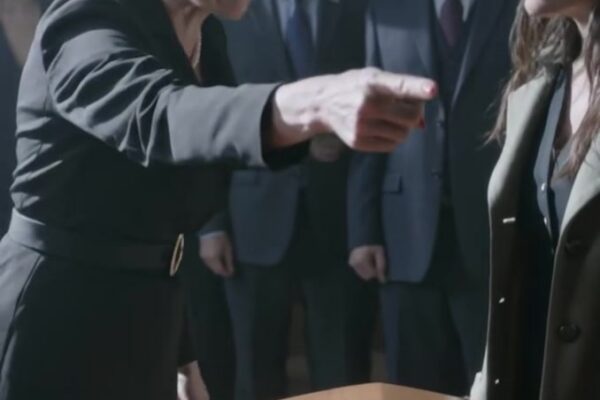
“Call security,” Vivienne said, loud enough for the watches in the cases to hear. “This is the woman who’s been harassing my fiancé. She keeps showing up with props and stories, demanding money.” Vivienne’s manicured finger jabbed at the ring box. “And there it is—her latest little performance.”
The room tightened. A few customers edged closer as though scandal were another display. Clara’s face had gone wet and red, her mouth opening and closing without words. When she tried to pull away, Vivienne only twisted her wrist a fraction higher, turning the gesture into a lesson.
At Vivienne’s side, Julian Harrow—tall, handsome, the kind of man whose suit fit like a promise—stood with an expression that aimed for boredom and missed, landing in something like nausea. He didn’t look at Clara. He stared at the floor between them as if he could will it to open.
“Please,” Clara managed. Her voice broke on the single syllable. “I didn’t come to—”
“Show them,” Vivienne insisted, smiling as if she were being generous. “Open it. Let everyone see what you’re trying to sell.”
Clara’s fingers trembled so hard the box rattled. Yet she lifted it anyway, and for a moment the whole boutique waited, poised on the edge of whatever cheap trick they had been promised.
When the lid finally sprang open, there was no glittering new diamond inside. Instead, a ring lay in the velvet like something rescued from earth: a plain gold band with a modest stone set low, dulled by time. It wasn’t the kind of ring people came to Marrow Street to admire. It was the kind of ring people kept because they couldn’t bear to throw it away.
Clara swallowed as if her throat were full of gravel. “This ring was buried with my mother,” she said. “I found it in the soil when I helped close her grave. It was in the box. The box had her name on the underside.”
The air changed. A couple near the sapphire counter went still, their expressions shifting from entertainment to discomfort. Vivienne’s grip loosened by instinct, as if grief were contagious.
Julian’s head lifted. He finally looked at the open box. The color slipped from his face so fast it seemed to drain into his collar.
Behind the nearest counter, the store’s owner, Mr. Dax, had been moving toward the commotion with the weary authority of someone used to smoothing problems into profit. He stopped short when he saw the band. His eyes narrowed, not in judgment, but in recognition. He reached out without asking, palms up, like a man approaching a wounded animal.
“May I?” he asked, softer now.
Clara nodded, and he took the ring between two fingers. He turned it, squinting at the inside. His lips moved as he read an inscription worn but legible. Whatever he saw made his hand freeze.
“No,” Mr. Dax whispered, the word leaving him like breath in winter. “That cannot be.” He looked up at Julian, then at Vivienne, then back at the ring as if trying to disprove his own memory. “This… this is one half of a set.”
Vivienne’s brow creased. “What are you talking about?”
Mr. Dax set the band on the counter as carefully as if it were evidence. “Fifteen years ago, my father owned this shop. He commissioned a pair of bands for a wedding—custom engraving, a matching stone cut from the same rough. The bride never showed. There were rumors. Police came. A missing persons report. Then the family paid to make it disappear.” His gaze snapped to Julian. “We were told she ran away.”
A low sound rippled through the boutique—half gasp, half rumor beginning. Phones rose higher. A salesperson backed away as if the counter itself had become dangerous.
Clara lifted her chin, and in that motion she looked older than her years. “My mother didn’t run away,” she said. “Her name was Elspeth Wynn. She died last month. She kept this ring buried with her like a secret she couldn’t swallow.”
Vivienne stared at Julian as though she had never truly seen him until this moment. “Julian?” she asked, and the question was small, almost childlike.
Julian’s mouth opened. Nothing came out. His eyes flicked toward the door, toward the security guard who had begun to approach and now hesitated, unsure which side to stand on.
Clara reached into the ring box and, from beneath the ring’s velvet cradle, drew out a packet tied with a faded ribbon. The paper was yellowed, the edges softened by years of handling. She held the bundle out not to Julian, but to the room, the way a priest might lift a relic.
“She kept his letters,” Clara said. “All of them. She hid them in a tin behind the kitchen wall. I found them after the funeral when I went through her things.” Her eyes glistened, but her voice had steadied into something like steel. “I didn’t want money. I wanted the truth. I wanted to know why my mother woke screaming some nights like she was still trapped somewhere.”
Julian made a sound then, a quiet strangled protest. “Don’t,” he said, and it was the first word anyone had heard him speak.
Clara’s gaze locked on his. “You recognize your handwriting,” she said. It wasn’t a question.
Mr. Dax swallowed hard. “If those are real—”
“They are,” Clara cut in. “And there’s one she never opened.” She untied the ribbon with fingers that no longer shook. From the bundle she withdrew a single envelope, sealed, the flap pressed down as if by a determined thumb. On the front, in ink that had bled slightly with time, was her mother’s name, and beneath it: Do not read until I am gone.
Vivienne took a step back, her face blanching. The people around her watched Julian now, not Clara. It wasn’t curiosity anymore. It was calculation—the instant instinct to measure danger.
Clara held the sealed envelope up so Julian couldn’t look away. “This one was dated three days after the cemetery records say my mother was declared dead to the world,” she said. “Three days after the funeral my grandmother held with an empty coffin because my mother never came home.”
Julian’s jaw worked, tendons straining. “I was young,” he whispered. “It wasn’t—”
Clara’s laugh was short and broken. “Young enough to write her for years? Young enough to promise her you’d ‘fix it’ if she stayed quiet?” She turned the envelope over and tapped the date with her finger. “Young enough to send a letter after you knew she’d been put in the ground?”
The boutique seemed to shrink around them. Every bracelet and necklace in the cases looked suddenly like a shackle. Mr. Dax’s hands were rigid on the counter as if he needed the glass to keep himself upright.
Vivienne’s voice came out thin. “Julian, tell me what she means.”
Julian stared at the envelope like it could bite. “I didn’t kill anyone,” he said too quickly, the sentence shaped like panic rather than truth. He looked at Vivienne as though pleading for her to save him from what she had just witnessed. “She’s twisting it. She always twists it.”
Clara leaned forward, the old ring box open between them like a small coffin. “Then let me read it,” she said softly. “Let everyone hear the words you chose when you thought the dead couldn’t answer.”
Security finally reached them, but stopped when Mr. Dax lifted a hand. The owner’s voice, when it came, carried a strange authority—the weight of a family business, a long memory, and a sudden dread of complicity. “No one touches her,” he said. He looked at Julian with open disgust. “If that ring is from our shop, then this is not a customer dispute. This is history walking back in through my door.”
Clara broke the seal. The sound was tiny, almost polite, but it cut through the boutique like a blade. She unfolded the letter, and in the silence that followed, Julian Harrow finally understood what it felt like to be the one on display—watched from every angle, reflected in every pane of glass, with nowhere left to hide.
Clara lifted the paper, eyes scanning the first line, and her voice dropped into a steady, terrible calm. “Elspeth,” she began, and the name alone made Julian flinch as if struck.
Outside, traffic moved as usual, indifferent. Inside, among the diamonds and velvet trays, the past rose up—soil-cold and patient—until even the brightest stones couldn’t distract anyone from the question now hanging in the air: what, exactly, had Julian Harrow buried, and how long had he been wearing the weight of it like a ring?