The boutique on Alder Row was the kind of place where even the air felt expensive. Light spilled from recessed fixtures like warmed champagne, catching on every facet of crystal and every polished edge of glass. Customers spoke in soft, careful tones, as if loudness might scratch the diamonds. Behind the counter, a row of attendants in charcoal suits moved with practiced grace, their smiles arranged like brooches.
Mara stood just inside the door, her coat still damp from the drizzle outside, the hem frayed, the buttons mismatched. She had paused because she needed to steady her breathing, because she needed to remind herself of the one thing she knew: she was not here for revenge. She was here for proof.
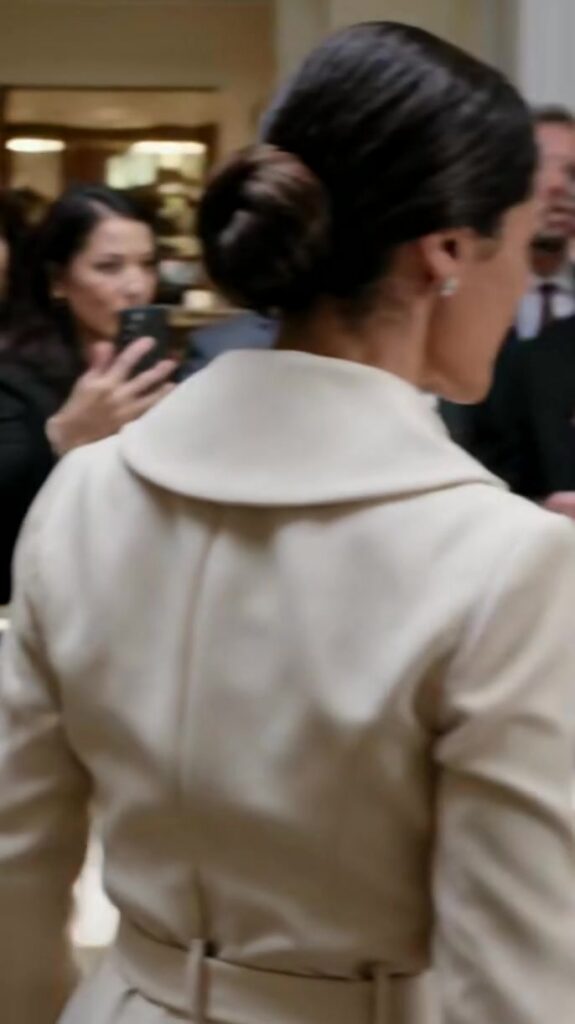
At the far counter, a woman in pearl-white silk laughed into the mirror as an attendant fastened a necklace at her throat. It was a glittering river of diamonds that narrowed into a teardrop at the center, the kind of piece that didn’t just announce wealth—it demanded it. Beside her stood a man in a dark suit, posture immaculate, the type that could pass for kind at a distance. His hand rested lightly at the small of her back, the touch more possessive than affectionate.
Mara took a step forward before she could second-guess herself. The necklace caught her eye like a hook. The clasp—an old-fashioned latch, not the modern magnetic type—was wrong for such a modern display. Her mother had described that clasp, once, in a voice that trembled between warning and prayer.
“Excuse me,” Mara said, forcing the words past the tightness in her throat. “That necklace—could I see the clasp?”
The woman turned. She was elegant in the way of someone who never had to apologize for taking up space. Her gaze swept over Mara—wet coat, cheap shoes, trembling hands—and her expression sharpened into something entertained and cruel.
“Are you lost?” the woman asked, loud enough that the nearest customers looked over. “This counter isn’t for repairs.”
Mara’s cheeks burned. “I’m not here for repairs. I—”
The woman’s eyes narrowed, then recognition seemed to strike her like a spark. Her chin lifted. “Of course,” she said, her voice turning syrupy. “It’s you.”
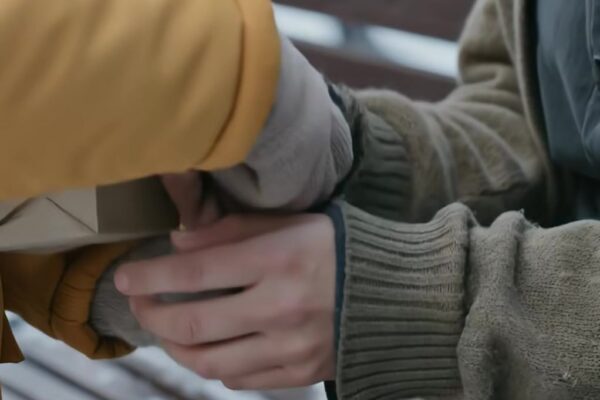
Before Mara could step back, the woman reached across the glass and seized her wrist. Her nails were manicured into pale crescents that bit into skin. The suddenness of it cracked through the boutique like a dropped tray.
“Stop lying,” the woman snapped, and her words ricocheted off the marble and mirrors. “You came back to steal my husband again!”
Gasps rose like startled birds. Staff froze behind the counters, their hands hovering mid-motion. A few customers lifted their phones, the subtle click of recording beginning, tiny red dots appearing like judgment.
Mara’s stomach lurched. “I didn’t come for him,” she said, but her voice shook and she hated that it did. She tried to pull free. The woman’s grip tightened.
“Then why are you here?” the woman demanded, leaning in with a smile that didn’t reach her eyes. “To beg? To cause a scene? That’s what you do, isn’t it?”
Mara’s vision blurred with heat and humiliation. She could feel the room deciding what she was: poor, disruptive, desperate. She stared at the necklace because it was the only thing that didn’t feel like a weapon.
“I came,” Mara said, swallowing hard, “because that necklace is mine.”
The woman laughed and touched the diamonds at her throat, fingers grazing them like pets. “You hear that?” she called to the room. “Now she wants my jewelry too.”
A ripple of amusement moved through the crowd—small, cruel, comfortable. Mara’s shoulders curled inward, as if she could fold herself small enough to disappear. Her wrist throbbed. Her eyes stung. She thought of her mother’s face the last time they spoke about it, the way her mother had gripped Mara’s hand and said, You don’t know what they did to keep it quiet.
“Celeste,” the man beside the woman murmured, voice low. “Let her go.”
The woman—Celeste—did not. “No,” she said, louder. “I want everyone to see what she is.”
Then an older man emerged from the back room, drawn by the commotion. His suit was worn at the seams, his hair silver and combed back, a magnifying loupe hanging from his neck like a cleric’s pendant. His eyes took in the scene with irritation that turned instantly to wary focus when he noticed the necklace.
“Madam,” he said, stepping closer. “Please. There’s no need—”
“This stranger is harassing me,” Celeste announced, loosening her hold only enough to gesture dramatically. “She claims my necklace is hers.”
The jeweler’s gaze fixed on the clasp. “May I… inspect it?” he asked, more to himself than to anyone else. Without waiting, he leaned forward and, with careful fingers, lifted the teardrop pendant to see the underside of the latch.
In the bright boutique lights, something tiny glinted inside the clasp: an engraving, so faint it looked like a flaw until you knew to look.
The old jeweler’s face changed. The annoyance drained away, replaced by a pallor that seemed to pull the blood from his skin. His hands began to tremble. His mouth opened once, then closed as if the air had turned thick.
“Sir?” one of the attendants whispered. “Are you all right?”
The jeweler swallowed. His voice, when it came, was thin and stunned. “Madam… that necklace was registered to the first wife.”
Silence fell like a curtain. Even the phones held steady, the crowd sensing a turn in the story and leaning toward it.
Celeste’s smile faltered. “What are you talking about?”
The jeweler stared harder, as if he could force the engraving to become a different truth. Then his eyes lifted—slowly, reluctantly—to the man beside Celeste.
“To Mrs. Helena Ward,” the jeweler continued, and the name sounded like a bell tolling in a chapel. “The one they said died before the wedding night.”
A murmur rose, then strangled itself. Celeste’s hand flew to her throat, to the diamonds, as if the necklace might suddenly burn her.
Mara felt the room tilt. She looked at the husband—the man who had spoken her mother’s married name like it was nothing, who had introduced himself at a charity event last year with a warm smile and no flicker of recognition. Now his face was draining, gray overtaking tan, his jaw working as if words were lodged behind his teeth.
Mara’s voice came out quieter than she expected, but it cut through the hush. “Then tell them,” she said, eyes locked on him, “why my mother hid your name until she died.”
All heads turned toward the husband at once, as if Mara had physically pushed them. Celeste turned too, disbelief widening her eyes. “What is she saying?” she demanded, but it sounded less like outrage and more like fear.
The husband’s lips parted. No sound came.
Mara’s hands stopped shaking. She reached into her coat, fingers finding the worn edges of an envelope she had carried for months like a second heartbeat. She drew out a photograph, its corners bent, its surface glossy in a way that proved it belonged to another decade.
She held it up so the nearest phones could catch it, so the boutique’s mirrors would multiply it, so there would be no private corner left to hide in. The picture showed a funeral in the rain: a muddy patch of ground, a cheap coffin being lowered, and at the edge of the frame—a man in a dark coat, face turned away but unmistakable in profile.
Mara met Celeste’s gaze for the first time. “Or should I show them,” she said, steady now, “who was standing beside her the night they buried her?”
Celeste’s grip finally left Mara’s wrist. The diamonds at Celeste’s throat seemed suddenly heavy, less like a prize and more like a shackle. The old jeweler stood rigid, as if afraid that moving would make him complicit.
The husband took one step back, then another, his polished composure cracking at the seams. His eyes went to the photograph, then to Mara, then to the exit—as if he could simply walk out of the truth. But the boutique had become a courtroom without walls, its witnesses dressed in linen and cashmere and holding their verdicts on glowing screens.
Mara didn’t need to shout. She didn’t need to beg. She only needed to stand there, breathing, and let the question hang in the air where no amount of money could buy it down.
“Say her name,” Mara whispered. “Say what you did after you stole her life.”
And for the first time, the entire jewelry store wasn’t looking at the woman they’d been invited to ridicule.
They were looking at the man who had built his fortune on a grave.