Adrian Voss told himself, for the hundredth time, that a lie wasn’t always a betrayal. People hid things. They sanded their histories smooth. They dressed their fear in smaller words so it could be carried.
He could forgive Celeste for the altered dates on her résumé, for the evasive answers about an ex, for the tight smile whenever his mother asked about “her people.” Those were the ordinary lies of survival, and Adrian had built an empire on watching men survive.
What he couldn’t forgive, he didn’t yet have a name for.
The afternoon he came home early, rain had followed him from the city like a rumor. The driver offered to wait, but Adrian waved him off, wanting the quiet of his own foyer before the evening’s rehearsal dinner and the manufactured warmth of toasts.
The house greeted him with the kind of perfection that made staff invisible: bright floors, the faint scent of lemon polish, silence arranged like expensive art. A place designed to convince anyone who entered that cruelty could not fit through the doors.
Then he stepped inside and saw the child.
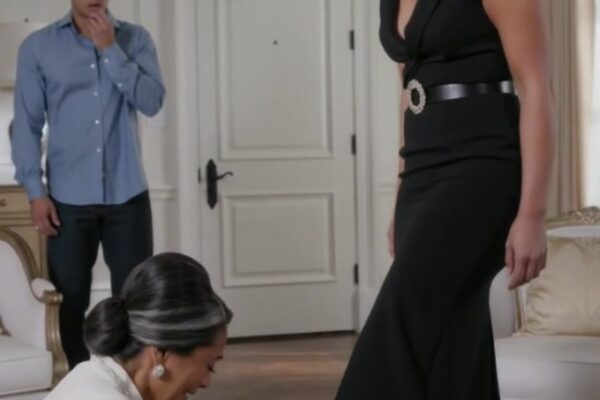
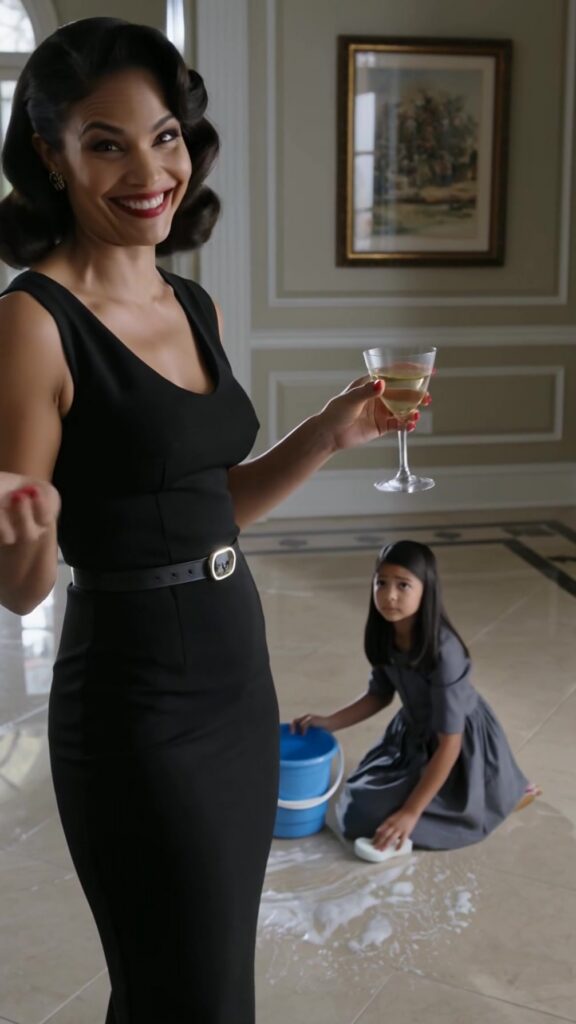
She was on her knees on the marble, small enough that her shoulders nearly disappeared into a gray dress that looked borrowed from a school uniform. A bright plastic pail sat beside her, the kind you’d take to the beach, filled with sudsy water. Her hands were red from scrubbing, fingers pruned, moving a sponge over an already gleaming surface as if the floor had offended her.
Adrian stopped so sharply his briefcase swung forward, thudding against his leg. He didn’t speak at first. He couldn’t decide what word belonged in his mouth: hello, stop, who are you, why.
The girl’s head lifted slowly. Her eyes were not wide with panic. They were flat with resignation, and underneath that, something worse—an adult’s humiliation lodged in a child’s face. She looked at him as if bracing for punishment for not scrubbing fast enough.
Before Adrian could cross the threshold, a heel clicked behind him. A woman emerged from the corridor, dressed in black as though the house were a stage and she was the only actor worth lighting. Celeste held a coupe glass by the stem, champagne trembling but not spilling. Her hair was pinned with casual precision, the way she wore it when she wanted to seem effortless.
She saw him. Her mouth curved. Not with joy. With ownership.
“You’re home early,” she said, as if he’d interrupted her rehearsal.
Adrian’s gaze flicked from her glass to the child’s raw knuckles. “Who is that?”
Celeste followed his eyes and shrugged. “Mara. She’s helping.”
“Helping,” he repeated, tasting the word like it had gone sour.
The child stiffened, sponge hovering above the wet stone.
Celeste took a delicate sip. “She’s good at it. Some people are.” Her voice softened in a way that only sharpened the cruelty, a lullaby sung through teeth.
Adrian felt a shift inside himself, a quiet rearranging. It was not the hot bloom of anger he recognized from boardrooms. It was colder. Cleaner. The kind of decision that closed doors without slamming them.
He stepped closer to the girl and crouched, careful not to touch her yet. “Mara,” he said, keeping his voice low. “Does it hurt?”
Mara stared at the floor. Her throat worked once. “I’m almost done,” she whispered, like that was the only acceptable answer.
Adrian’s eyes fell to what she’d been trying to erase. The suds had thinned, and beneath them was a streak of white frosting, mashed into the marble. Someone had smeared cake into a message and then ordered it destroyed. One word remained legible through the wet blur.
Welcome.
It sat there, half-ghosted, as if the house itself had tried to speak before being scrubbed into silence.
Adrian straightened slowly. He didn’t look at Celeste at first. He looked at the bright bucket, the sponge, the little hands that had been made to do penance for somebody else’s mess.
“Welcome,” he said quietly. “Who was welcomed here?”
Celeste’s smile faltered—just a hairline crack. “What are you doing?” she asked, too quickly. “Adrian, don’t be dramatic.”
He reached into his coat, not for a weapon, not for a ring, but for his phone. His thumb moved with practiced certainty. When his assistant answered, Adrian didn’t bother with pleasantries.
“Cancel everything,” he said. “The venue, the catering, the string quartet. Tell my mother it’s off. Effective now.”
On the other end, a shocked pause. “Sir—tonight is—”
“Now,” Adrian repeated, and ended the call.
Celeste laughed, a short, brittle sound that tried to pass for amusement but couldn’t hide the tremor. “You can’t call off a wedding because of a mop and a tantrum. What is this, a morality play?”
He finally faced her. The calm on his face seemed to unsettle her more than shouting would have. “I’m not canceling it because you lied to me,” he said. “Though you have.”
Her eyes narrowed. “Excuse me?”
“I’m canceling it because you did this,” he said, gesturing toward Mara as if the air itself should be able to point. “In my home. In daylight. With witnesses you thought didn’t count.”
Celeste’s lips parted, then pressed together. Her gaze cut to the child, not with guilt but with annoyance, like Mara had failed to disappear fast enough.
“She’s not a witness,” Celeste said. “She’s—”
“A child,” Adrian finished, and the word came out like a verdict. “Not a tool. Not a punishment. Not something you can kneel into obedience.”
Celeste’s cheeks flushed. “Don’t pretend you’re some saint, Adrian. You bought this house with the same hands that sign severance packages. You don’t get to act outraged.”
“You’re right,” he said softly. “I’m not a saint. That’s why I know what monsters look like when they think they’re untouchable.”
She stepped toward him, glass still in hand, as if proximity could reassert control. “This is insane. People will talk.”
“They can,” Adrian replied. “Let them.”
He walked past her, not hurried, not shaking, and opened the front door wide. Rainwind rushed in, ruffling the papers on the console table. It made Celeste’s perfume falter, diluted by something honest.
“This house is no longer yours,” he said, and the sentence landed with a finality that made even the marble seem to listen. “You can take what you came with. Nothing else.”
Celeste’s eyes flashed. “You’re throwing me out?”
“I’m returning you to the world you keep trying to decorate,” he said. “Without my name as your frame.”
Behind him, Mara’s sponge stopped moving. The silence that followed was thick, waiting to see who would be punished for it.
Adrian turned back to Mara and knelt again, this time close enough that she could see his hands were steady. He picked up the sponge and set it gently in the bucket. “You don’t have to finish that,” he said.
Mara’s eyes darted to Celeste, then back. “I’ll get in trouble.”
“Not here,” Adrian said. He took off his suit jacket and draped it around her shoulders, the expensive fabric too large, smelling faintly of rain and the city. “What’s your last name?”
She hesitated, then whispered it. “Hale.”
Adrian repeated it as if committing it to an oath. Then he stood and called toward the hallway, voice carrying with a new authority. “Mrs. Ortega,” he said, summoning the housekeeper. “Come to the foyer. Now.”
Footsteps approached, fast and frightened. Celeste’s posture shifted from contempt to calculation.
“Adrian,” she warned, lowering her voice, “if you do this, you’ll regret it.”
He looked at her one last time, and in his gaze was the terrible clarity of a man who had discovered what he truly owned: not stone, not shares, not reputations, but choices.
“The only thing I regret,” he said, “is that she had to scrub ‘Welcome’ off the floor to learn she wasn’t.”
When Mrs. Ortega arrived, face pale, Adrian spoke without anger. “Call Child Protective Services,” he said. “And call my attorney. And call the police if she”—he nodded toward Celeste—“tries to take the girl.”
Mara’s breath hitched. Celeste’s glass trembled hard enough that a bead of champagne ran down her hand like a tear she didn’t deserve.
“You’re choosing a stranger over me,” Celeste hissed.
“I’m choosing a child over a future built on her knees,” Adrian said.
Outside, the rain intensified, tapping the threshold like impatient fingers. Adrian guided Mara gently toward the sitting room, away from the bucket and the smeared frosting, away from the word that had survived long enough to accuse them all.
Behind them, in the ruined perfection of the foyer, Celeste stood very still, finally understanding what she had lost.
Not a wedding.
Control.
And for the first time since Adrian Voss had bought his way into every room, he let the world talk, while he made the only kind of vow that mattered: that no one would ever be forced to earn their welcome in his house again.