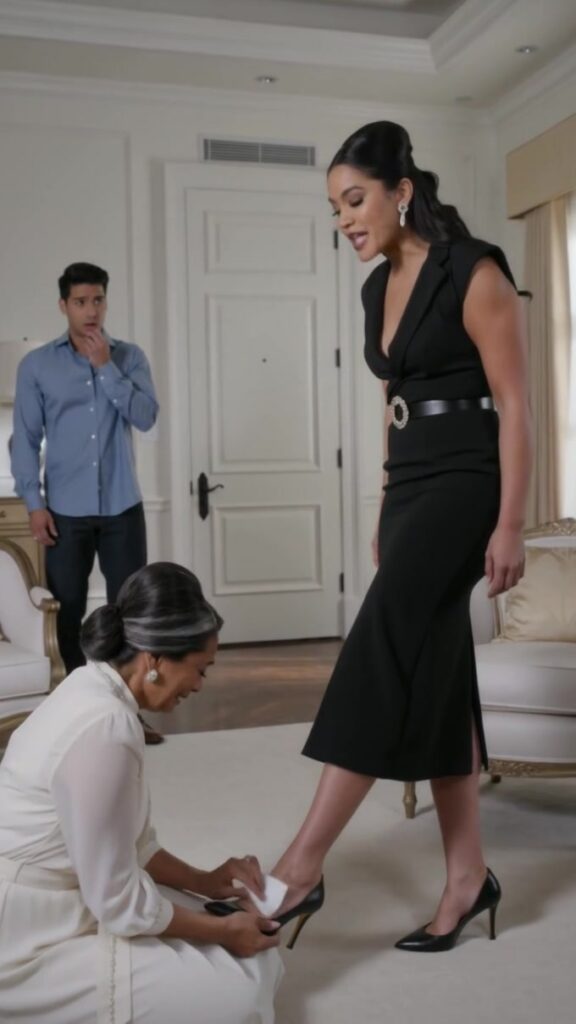
The sitting room looked staged for a magazine spread—pale rugs that never saw mud, glass tables that reflected the morning like water, curtains that softened the sun into something expensive. Even the air felt curated, scented faintly with citrus and varnished wood. In a house like this, silence didn’t mean peace; it meant rules. And on the rug, where no one should have been, Elara Wren knelt with a cloth in her hands as if she’d been born to the position.
Her knees ached through the fabric of her dress. The cloth was damp from the polish she’d been forced to fetch from the pantry—an old tin, kept for the staff before there was no staff. Elara’s fingers shook with a tremor that came and went since her husband’s funeral, a quiet betrayal of her body when she needed it most. She pressed the cloth to the toe of a cream-colored heel that hovered above her like a verdict. Tears dropped onto the rug in slow, humiliating beads, darkening the fibers in spots she knew she would later try to scrub out, if she was still allowed to be here later.
Vivienne Hart sat back on the sofa as though she were at a performance staged for her amusement. She wore a fitted dress the color of bone and pearls that caught the light every time she moved her chin. Daniel stood a few feet away, Elara’s son, his shoulders locked, his mouth half-open, the muscles in his jaw twitching as if words were trying to fight their way out. But no sound came. His hands kept opening and closing at his sides. A man holding his own spine like it might crack.
“Go on,” Vivienne said, gently at first, as if coaxing a timid pet. Then her voice sharpened. “You’ve made it your hobby to act like you’re in charge. Consider this a lesson. Shine them properly.” She lifted her foot, turning the shoe slightly so Elara could see the tiny scuff Vivienne claimed was an insult. “If you insist on behaving like royalty in a house you don’t understand, you can at least learn how servants work.”
Elara’s throat closed. She tasted iron where she’d bitten her tongue earlier, trying not to cry. “This isn’t—” Her voice broke on the second word. She tried again, softer, to no one in particular. “Harold built this place. For us.” She could still see her husband’s hands—broad, ink-stained from signing contracts, then roughened from weekends spent sanding trim because he never trusted anyone to do the finishing touches. The library shelves, the hearthstone, the window seat where Daniel used to read—Harold had pointed to each one and said, one day this will outlast me. Elara had believed him.
Vivienne’s laugh was quiet, practiced. “People build lots of things. It doesn’t mean they own them forever.” Her eyes slid to Daniel, searching for the compliance she’d been cultivating for months. “Tell her. Tell her she’s being dramatic.” Daniel swallowed hard. He looked at his mother’s bent head, the thin line of her spine, the way her fingers clutched the cloth like it was the only solid thing left in the world. His lips moved once, but his courage failed him. The silence widened between them like a fissure.
Elara rubbed the shoe until the leather shone, until her wrists burned and her tears made the polish streak. She could feel her dignity thinning, dissolving, becoming something she couldn’t hold onto. Somewhere behind Vivienne, the hallway to Harold’s study remained closed, the oak door shut as it had been all morning. Daniel had said an attorney was coming, “just formalities,” and Vivienne had smiled and told Elara to stay out of the way. Elara had tried—she really had—but Vivienne had found her in the kitchen, had taken the tin of polish from her hands, and had walked her into the sitting room like a demonstration.
The doorknob turned.
The study door opened with a slow, decisive hinge-creak, and a man stepped out who seemed to carry winter with him—gray hair, sharp suit, narrow eyes that missed nothing. He held a thick stack of documents in both hands, bound with clips and stamped in more places than Elara understood. Behind him the study looked dimmer, its shadows heavy with books and secrets. The man paused in the doorway, taking in the tableau: Vivienne’s foot extended, Elara on her knees, Daniel pale and pinned to the floor by his own indecision.
“Mrs. Wren,” the man said, and his voice was not cruel, but it was precise in a way that made cruelty unnecessary. “Please stand.”
Elara’s hands went still. Her cloth hung from her fingers. She could not make her body rise, as if the carpet had grown roots around her knees. Vivienne’s smile tightened. “She’s busy,” Vivienne said, as if speaking for a child. “We can do paperwork after.”
The man’s gaze moved to Vivienne with the slow patience of someone who had witnessed many performances and never confused them for reality. “Ms. Hart,” he corrected, and the small emphasis made Vivienne’s nostrils flare. Then he lifted the top page of the stack, just enough for the stamped seal to catch the sunlight and shine. “I am Martin Kline, notary and executor for the estate filings connected to Harold Wren.” He turned slightly so Daniel could see as well. “And I’m afraid we cannot do this ‘after.’”
The room seemed to lose air. Daniel’s eyes flicked to the papers, then to his mother, then back. “What is this?” he asked, and his voice finally arrived, thin and hoarse, like he’d been underwater.
Kline didn’t answer Daniel immediately. He spoke to the room like a judge delivering a decision. “This property,” he said, “was transferred into Elara Wren’s sole name on the morning your engagement contract was signed.”
Vivienne’s face changed so quickly it looked like the mask slipped before she could catch it. The smugness collapsed first, then the confidence, leaving something sharp and frightened. “That’s impossible,” she said, too fast. “Daniel told me—”
Daniel looked as though someone had hit him. “What do you mean transferred?” He took a step forward, then another, drawn toward the papers like they were magnetic. “I thought… I thought Dad wanted—”
“Harold wanted his wife protected,” Kline said, cutting through Daniel’s sentence with the clean edge of fact. “He anticipated several outcomes. Including the one currently unfolding.” He glanced down at Elara, and something like pity crossed his features, quickly hidden behind professionalism. “Mrs. Wren, your husband left instructions that these documents be executed only if Daniel entered an engagement agreement that included shared residency in this house.”
Vivienne’s hands tightened on her lap. Her pearls trembled with the movement. “Shared residency is standard,” she snapped. “That’s—”
“Standard for whom?” Kline asked, and his tone stayed calm, which made it worse. He raised another page, the paper thicker, the stamp darker. “There is a clause,” he continued, “that revokes any implied occupancy rights for future spouses or partners if they engage in coercion, humiliation, or the attempt to displace the legal owner.” He looked directly at Vivienne. “It is specific. It is enforceable. And it was written by a man who knew exactly how easily a family can be persuaded to hand over its spine.”
Daniel’s face drained. “Dad put that in?”
Kline nodded once. “He also stipulated that any party attempting to remove Mrs. Wren from this residence would trigger an immediate injunction request from my office and a full review of financial access connected to the estate.” He let the words settle, then added, almost gently, “Mrs. Wren can stay. She can decide who enters. She can decide who leaves.”
For a moment, no one moved. Even the clock on the mantle seemed to hold its breath. Elara realized her hands were still holding the cloth, still sticky with polish, still trembling. The absurdity of it—kneeling like a stranger in the home where she had set out Harold’s coffee for twenty-five years—rose in her chest and burned away her shock.
Elara placed the cloth on the floor as if setting down a burden she had carried too long. She pressed her palms to her knees and pushed herself upright. Her joints protested, but she stood anyway, tall enough to meet Vivienne’s eyes. Tears still tracked down her cheeks, but now they felt less like weakness and more like weather passing through. “Daniel,” she said quietly, and he flinched at the sound of his name in her steadier voice, “your father didn’t build this house so I could be reduced to a floor.” She turned her gaze to Vivienne. “And I won’t be.”
Vivienne rose too, fast, her composure scrambling back into place like a curtain pulled over a window. “You can’t do this,” she hissed, but the words were already too late. In them was the knowledge that her leverage had vanished. “Daniel, say something.”
Daniel looked at his mother as if seeing her for the first time in months—not the grieving widow who apologized for taking up space, but the woman who had balanced accounts, held their family together, and kept Harold’s laughter alive even when he wasn’t there. His eyes glistened. “Mom,” he said, voice breaking. “I didn’t know. I swear I didn’t.”
Elara didn’t answer the apology. She didn’t have to. She stepped past Vivienne, toward the doorway, toward the study where Harold’s books still smelled like him. She paused beside Kline, who offered the papers with both hands like an offering of truth. Elara took them, feeling the weight of ink and intention. Behind her, Vivienne’s sharp breathing filled the room, and Daniel’s quiet sob tried to become a sentence.
Elara turned back once, not to gloat, not to punish, but to speak the only thing that mattered. “In this house,” she said, her voice low and clear, “no one kneels for cruelty again.” Then she looked at Vivienne, and the finality in her gaze was its own signature. “Ms. Hart,” she added, “collect your things. You are a guest here only as long as I allow it—and today, I don’t.”
The expensive daylight still poured through the windows, unchanged, indifferent. But the silence had shifted. It no longer belonged to the rich; it belonged to the rightful. And as Vivienne stood rigid, as Daniel stared at the floor where his mother’s tears had fallen, the room understood what Harold had known all along: elegance can hide monsters, but paper—properly signed—can lock them out.