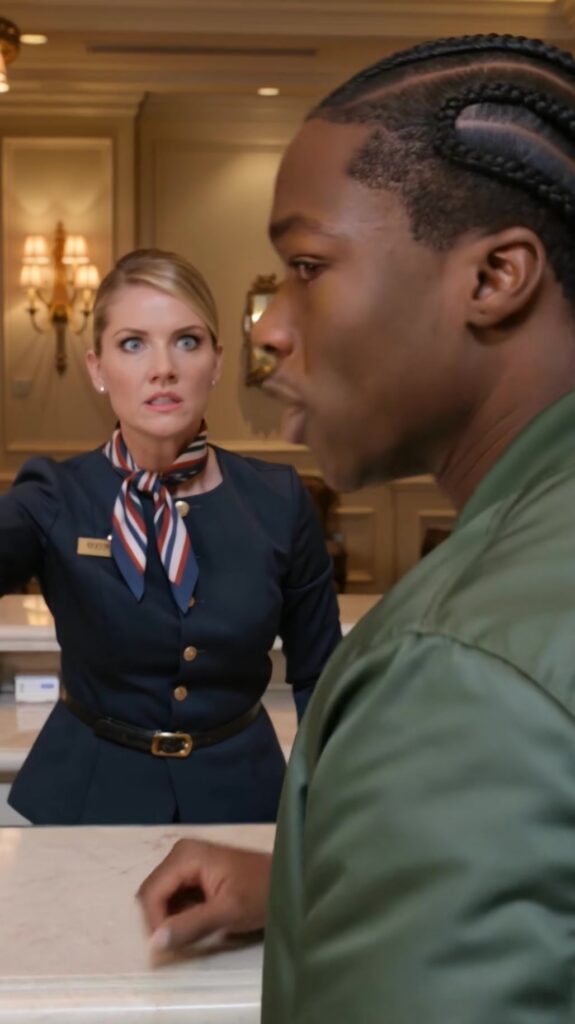
The lobby of the Aster Meridian was designed to make ordinary people lower their voices. Marble that held the day’s light like frozen honey. Brass that never dulled. Carpet so thick it swallowed footsteps and arguments alike. Even the air smelled curated—citrus and cedar and something faintly floral, as if money itself had a perfume.
Lena Hart liked it that way. She ran the front desk like a gate, and the gate was her power. On nights when the city’s weather turned mean, the Meridian became a warm island for the people who could afford islands. Lena watched them arrive—silk scarves, leather luggage, credit cards that didn’t flinch—and she loved the little tilt of their mouths when they said their names. Important, and certain the world agreed.
So when the man in the green bomber jacket crossed the threshold, she felt the temperature of the room shift in a way that had nothing to do with the automatic doors. He didn’t carry luggage. His hair was damp at the edges, as though he’d walked through rain without caring about the rain. He moved with a calm that was almost insolent, stopping briefly to take in the chandelier, the potted palms, the quiet pianist in the lounge corner. Like he was checking the work of people he’d hired.
Lena’s eyes caught on the jacket—clean, yes, but plain. Her mind did what it had learned to do in this building: it made a story before the person could tell their own. A man who didn’t know his place. A man who would ask for favors, demand exceptions, argue about deposits. A man who would turn the desk into a scene. And on top of that, there was the recent memo from management about “vagrancy deterrence,” stapled to the staff board like a moral commandment.
She felt, more than heard, the attention of the guests in the seating area. She hated the thought of them watching her handle a problem badly. Her fingers went into the drawer beneath the register, past the spare key cards and the roll of receipt paper, to the small metal cylinder she’d been told was “for emergencies only.” The can was heavier than she expected, cool against her palm. She thought of herself as a shield.
The man was still three steps from the counter when she lifted the can and pressed the nozzle.
The hiss snapped through the expensive quiet. A sharp, chemical bite filled the air. The man jerked back as if struck, hands flying to his face. His breath broke into a rasp. His eyes, wide and suddenly human, flooded with tears that spilled down his cheeks in streaming lines. He staggered, blinking hard, jaw clenched so tight a muscle jumped at his temple.
Lena’s own heart kicked once, hard. She shoved the tremor away and pointed, turning her fear into authority. “Security!” she called, her voice bright and ringing, meant to reassure the room. “I need security at the front. Now.” Then, louder, as if volume could justify her: “Get him out. He can’t come in here like that.”
The pianist missed a note and recovered too late. A bellman near the luggage stand froze with a suitcase half-lifted. A couple waiting for the elevators glanced at one another as though they’d just been handed a secret they didn’t want.
The man lowered his hands. His face was wet, eyes bloodshot, but his posture had not collapsed. He looked at Lena the way a person looks at a locked door that used to open for them. Not panicked. Not pleading. Something colder, held behind the ribs.
“You’re making a mistake,” he said, voice hoarse from the spray. It didn’t come out loud. It didn’t need to.
Lena lifted her chin. “I’m protecting the hotel.” The words sounded practiced even to her ears.
He took one slow step forward. Another. The distance between them shrank until Lena could see the tiny tremor in his eyelid, the sting in his reddening skin. His voice dropped, controlled to the edge of cruelty. “Protecting it from who?”
Before Lena could assemble an answer, he delivered the sentence that changed the shape of the room. “From the man who pays for this lobby to glow like a church,” he said. “From the man whose name is on the deed. I own this hotel.”
Lena’s throat went dry so fast it felt like swallowing cloth. She stared at him, searching for a tell—some grin, some theatrical reveal. But his expression didn’t ask to be believed. It expected obedience.
Two security guards arrived at a jog from the side corridor, hands near their belts, faces set in the neutral mask of people trained to remove trouble. They slowed. Then stopped entirely, their eyes flicking from Lena to the man, recognition landing like a weight. One of them, Marcos, went pale beneath his buzz cut. The other lowered his hand as though it had been burned.
From near the elevator column, the elderly concierge—Mr. Dellen, who had worked the Meridian since before Lena was born—stepped into view. His hands trembled around the silver-topped cane he used more for dignity than necessity. His mouth moved without sound at first, then he whispered something Lena barely caught: “No… not him. Not tonight.”
The owner—because Lena’s mind could no longer refuse the word—turned his head toward Mr. Dellen. Tears still cut lines down his cheeks, catching the lobby’s gold light. “Why would tonight matter?” he asked softly, as if asking about the weather.
Mr. Dellen’s eyes darted to Lena, then away, as though he couldn’t bear to look at what she’d done. “Sir,” he said, voice breaking, “there are things in this building—rules we follow. It isn’t superstition. It’s… survival.”
Lena’s hand, still holding the can, began to cramp. Her fingers loosened. The cylinder slipped, bounced once on the marble, and rolled to a stop at the man’s feet. It spun slowly, like a coin deciding someone’s fate.
He looked down. Then he crouched, picked it up, and turned it over with care that felt more frightening than anger. The hotel crest—an eight-pointed star and a meridian line—was engraved neatly on the bottom, the kind of mark reserved for internal inventory. Not a retail can. Not something a receptionist should have at the desk. His thumb traced the emblem as if reading a bruise.
He straightened, and in that movement the entire lobby seemed to lean back, bracing. “This isn’t yours,” he said to Lena, not asking. His gaze cut past her to the wall behind, where the manager’s office door sat closed, discreet and confident. “This comes from a locked drawer.”
Lena’s lips parted. She wanted to say she’d been issued it, she wanted to say she’d been told, she wanted to say she’d been trained to fear. But all of those sentences sounded like excuses spoken after the damage was done.
The man’s eyes found Mr. Dellen again. “Tell me,” he said, voice steadying, turning dangerous in its calm. “What ‘rules’ are we following? And who decided that my own hotel needs to be defended from me?”
Mr. Dellen swallowed, his knuckles white around the cane. The guests had begun to drift backward as if an invisible tide was pulling them away from the desk. Even the bellman set down his suitcase quietly, like a person trying not to wake a sleeping predator.
“Because,” Mr. Dellen whispered, and the word seemed to carry old dust and old fear, “the last time you came here unannounced, sir… the Meridian closed for three days. And two people never came back to work.”
The owner’s jaw tightened. For a moment he stared at the crest on the can, then at Lena—at her rigid posture, her defensive chin, the shallow rise and fall of her breath. His voice was low enough that only the front desk could hear it, but the meaning traveled anyway, as if the marble itself translated it. “Then someone has been using my name like a weapon,” he said. “And tonight, I’m going to find out who.”
He placed the can on the counter with a gentle tap that sounded louder than the spray. “Lock the doors,” he told the guards, not raising his voice. “No one leaves until I have answers. And bring me the manager.”
Lena stood trapped behind her polished desk, surrounded by gold light and expensive silence, understanding too late that the story she’d written in her head had never been about him at all. It had been about the comfort of believing she could tell who was dangerous by looking. And now the danger had a key to every room.