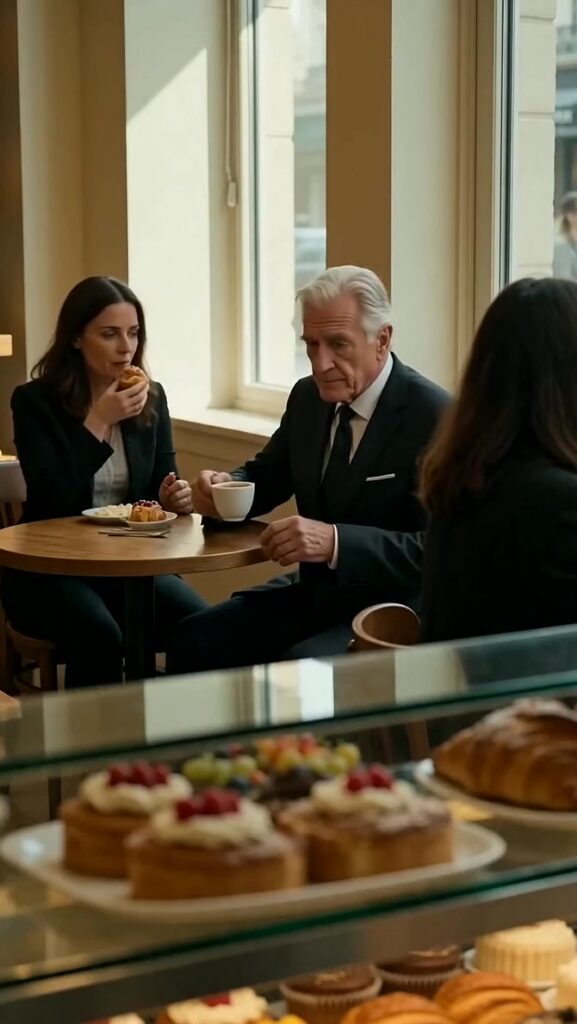
The bakery smelled like warm bread, sugar, and butter—the kind of scent that could make a person believe, for one soft second, that the world was gentle. Morning light spilled through the wide front windows and turned the glass case into a gilded stage. Croissants lay in neat rows, glazed fruit tarts winked under sugar crystals, and loaves sat with their crusts split like smiles. The shine was almost insulting, like treasure displayed where hunger wasn’t allowed to touch.
At the edge of that light stood a boy who looked too small to carry what he carried. His hoodie, a washed-out gray-green, swallowed his wrists and drooped over his narrow shoulders. A smear of street dust darkened his cheekbone, and his hair was the pale color of straw left out in rain. In his arms, a toddler clung to him with a desperation that didn’t belong in a room that smelled like comfort. She had the same fair hair, tangled and sticky, and a beige dress wrinkled into surrender.
Her gaze never left the bread. When her lip quivered, her whole body followed. “I’m hungry,” she breathed, the words small as a crumb.
The boy squeezed her closer and pressed his mouth to the crown of her head in a kiss that was more promise than affection. He approached the counter like someone walking into court. The woman behind it wore a crisp black uniform and a name tag that caught the sun; her fingers were powdered faintly with flour, and she smelled of coffee and rules.
“Do you have… anything from yesterday?” he asked. “Anything cheaper?” He tried to keep his voice steady, the way he’d heard adults do when they were asking for mercy without saying the word.
For a flicker, her expression softened. It was there and gone, replaced by a practiced firmness that sat like a locked door. “We don’t sell old bread,” she said, as if the sentence were printed somewhere she couldn’t disobey. “Everything gets donated. That’s policy.”
The boy’s face didn’t harden into anger. It simply emptied. He nodded once, stiffly, and turned as if leaving were another task he could complete correctly. The toddler’s quiet whimper swelled into a sob. He rocked her, murmuring something wordless into her hair, and his eyes shone with the effort of not breaking in front of strangers.
At a small table near the window, an older man in a black suit set his coffee down with careful precision. The cup clinked against the saucer like a starting bell. He’d been watching the children with an attention that wasn’t pity, not curiosity—something sharper, as if he were reading a page he’d been afraid to open.
His chair scraped back, loud enough to slice the hush. People looked up. The suited man adjusted his tie out of habit, then walked toward the display case like he owned the floor beneath it.
“Box it all,” he told the worker, his voice calm in a way that made it difficult to refuse. “Every loaf, every pastry. All of it.”
The woman blinked as though the air had changed pressure. “Sir?”
“Everything,” he repeated, not raising his tone, only tightening it. Around them, a woman paused mid-sip, a man with powdered sugar on his lips forgot to chew. The bakery’s sweetness suddenly had teeth.
Then the suited man turned toward the boy and the toddler. He took one measured step closer and said, “Come with me.”
The boy reacted the way you’d expect a child who had learned too early: he retreated. His arms locked around the girl, and his shoulders rose as if he could shield her with bone and cloth. He didn’t say thank you. He didn’t ask questions. He watched for the trap.
The man’s voice lowered. “You don’t need to be afraid.”
That gentleness made the boy’s suspicion flare. Soft voices, he knew, could still bite. “Why?” he demanded, and the word shook despite his effort to sound older.
The man didn’t answer immediately. His gaze had slid past the boy’s face to something at the toddler’s throat. A tiny silver pendant, worn dark with time, peeked from under her dress. The chain looked too fine for the street, too deliberate to be random. The suited man’s expression changed with a speed that made the room tilt—authority draining out, replaced by shock so raw it looked like pain.
His hand lifted halfway, stopped midair as if an invisible wire held it back. “Where did she get that?” he asked, voice suddenly hoarse.
The boy tightened his grip and backed up another step. “What are you talking about?”
“The pendant,” the man insisted. His eyes were fixed on it with a kind of reverence that didn’t match his suit. “That charm—where did it come from?”
The toddler hiccupped through her tears and shifted, and the pendant caught the window light. For a heartbeat it flashed, revealing a tiny engraved mark on the back. The suited man’s face went pale, as if the blood had decided to hide.
“It was my mom’s,” the boy said carefully, the words loaded with warning. “She put it on her.”
The man inhaled like he’d been underwater too long. “Your mother,” he whispered, the syllables breaking. His eyes were wet now, and the shine in them was not kind; it was terrified. “Where is she?”
The boy’s chin lifted in defiance, but it couldn’t quite cover the tremor. “She told me to take Leni and run. There were… men. At the motel. She said she’d come back.” His voice cracked on the end. “She didn’t.”
The bakery worker stood frozen, pastry boxes stacked like bricks in her arms. The suited man’s gaze flicked to her. “Call the police,” he said, and the command returned to his voice like a blade sliding into its sheath. “Tell them it’s about Elise Hart.”
The name made him flinch as he said it, as if it burned his tongue.
“Who are you?” the boy demanded, shifting the toddler higher on his hip. Leni’s crying had dwindled into frightened breaths. She stared at the man with wide eyes, her small fingers curled around the pendant as if it were a handle keeping her from falling.
The man swallowed. “My name is Julian Hart,” he said. “And that pendant—” His voice caught. “I had it made for my wife. For Elise. Before she disappeared.”
The boy blinked, refusing the implication. “My mom’s name is Mara,” he said, fierce. “She’s my mom.”
Julian’s shoulders sagged as if the suit had suddenly grown heavy. “Mara,” he repeated softly, tasting the name like something he should have known. He stared at the toddler’s pendant again and then at the boy’s eyes—gray-green, the same shade as his own. The room seemed to go quieter, as if even the ovens were listening.
“How long have you been on your own?” Julian asked.
“Since winter,” the boy said. He tried to say it like it was a season, not a sentence. “I keep us moving so nobody notices.”
Julian’s jaw tightened, grief and rage braided together. “She must have been protecting you,” he said, and it sounded like both a realization and a prayer. “She must have changed her name. She must have thought it was safer if I never found you.”
The boy shook his head hard, as if shaking could scatter the man’s words. “Don’t say things,” he warned. “Don’t make her a story. She’s real.”
Julian nodded, and the motion was careful, like approaching a skittish animal. “You’re right,” he said. “She’s real. And if those men came for her, they’ll come again. But you don’t have to carry this alone anymore.”
Sirens were distant but growing nearer, a thin wail threaded through the warm bakery air. The worker’s hands trembled as she set the phone down and slid the boxes across the counter. No one spoke; no one dared, as if the wrong word might topple whatever fragile bridge had formed between a starving child and a man whose world was cracking open.
The boy stared at the boxes of food, then at Julian, then down at Leni’s pendant. His fingers brushed the chain at his sister’s throat, and something in his face—still guarded, still wounded—shifted the tiniest amount, like a door unlatched but not yet opened.
“If you’re lying,” he said, voice rough with a child’s final courage, “I’ll run.”
Julian’s eyes held his. “Then I’ll spend the rest of my life looking for you,” he answered. “But I’m not lying.” He reached into his jacket and drew out a worn photograph in a leather sleeve. In it, a woman with bright, tired eyes smiled while holding that same silver pendant between two fingers. The smile looked like someone trying to be brave for the camera.
The boy’s breath caught. His knees didn’t buckle, but his certainty did. He looked at the picture until his eyes watered, and he didn’t wipe them away.
Outside, the sirens drew closer. Inside, beneath the scent of sugar and butter, the truth rose like yeast—slow, unstoppable, filling every corner where emptiness had lived.
Julian spoke again, softer now, as if afraid of waking a nightmare. “What’s your name?”
The boy swallowed, and when he answered, it sounded like stepping over a threshold. “Noah.”
Julian repeated it like a vow. “Noah,” he said. “Hold on. We’re going to find her.”