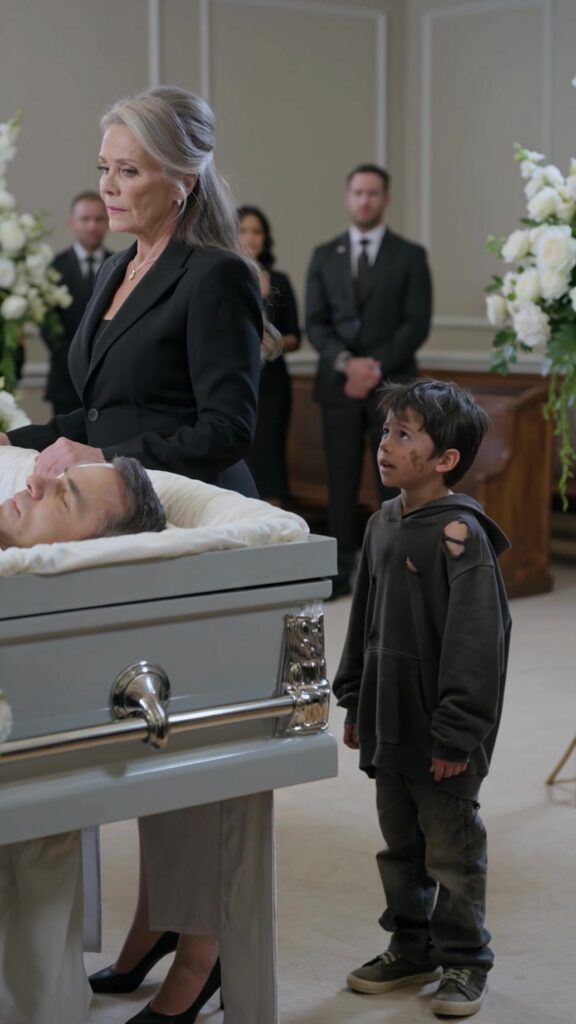
The funeral room was so quiet it felt wrong to breathe too loudly. Even the air seemed to have manners, hovering politely above the carpet, refusing to stir the lilies arranged like pale sentries around the open casket. Under the amber lights, black coats and dresses melted into one another until faces became the only proof that anyone was there at all. The scent of polished wood and cut flowers pressed against the back of the throat—sweetness with a sharpened edge, the kind that made grief look tasteful while it hollowed you out.
Victor Halloway lay inside the casket as if he had dressed himself for this, immaculate in a charcoal suit that looked new enough to deny the last months of illness. Someone had combed his silver hair away from his forehead, revealing the familiar scar at his hairline that had once, in another lifetime, been a secret shared in laughter. His hands were folded over his chest, and the stillness made him seem less like a body than an argument the room was too afraid to continue.
Margot stood at the head of the casket with the rigid posture that had kept her afloat through boardrooms, scandals, and the kind of social storms that flattened other women. A delicate chain lay at her throat, the single pendant catching light whenever she swallowed. People greeted her softly, touched her arm as if she were a statue that might crack. She accepted condolences the way she accepted applause: with practiced gratitude and a face carefully unruined.
She would not have noticed the boy if a woman in the back hadn’t hissed his presence under her breath like a warning. He was small, no older than kindergarten, swallowed by a dark hoodie that hung past his fingers. One sleeve was torn as if it had been caught on a nail and yanked free. His shoes were thin and dirty, their laces mismatched. There was soil in the creases of his knuckles and smudged along his cheek, as though the world had already asked too much of him and he’d answered by digging in his heels.
He didn’t fidget. He didn’t cry. He stood beside the casket with the solemn patience of someone who had learned not to waste effort on adults. When he finally lifted his gaze toward Margot, his eyes were dark and steady in a way that did not belong to a child. His voice, when it came, trembled only once—like a small bell struck and quickly stilled.
“He said… if he died, you would take me.”
The sentence cut through the room with such bluntness that a few heads turned. Margot’s composure did not shatter so much as tighten, as though a band had been pulled around her ribs. “Take you?” she repeated, careful, clipped. There were rules for what grief could contain in public, and none of them included stray children making claims at a coffin’s side. “Take care of you?”
The boy nodded once. He didn’t look frightened of her; he looked as if fear had already done its worst and left him with only a plan. Margot’s gaze dropped to his face, and something in her changed. Not softness—recognition, which is far more dangerous. The shape of his mouth. The faint notch in his left eyebrow. A certain stubborn set to his jaw that Victor had always disguised under charm. The room seemed to lean closer, lilies and all, waiting for her to choose which truth she could survive.
“Who are you?” Margot asked, and her voice had gone low enough to be almost intimate.
The boy glanced at Victor’s still face, as if asking permission from someone who could no longer give it. Then he reached into the pocket of his oversized hoodie and drew out a folded card. It was one of the memorial programs—cream paper, Victor’s photograph, dates printed like bookends around a life. The boy turned it over and held it up with both hands.
On the back were words written in uneven, hurried handwriting, the letters wobbling as though the pen had been guided by a hand that couldn’t afford to shake. Margot read them once, then again, and the blood drained so quickly from her face that she felt cold behind the eyes.
Bring him the watch you hid.
The pendant at her throat suddenly felt too heavy to be decorative. She tasted metal, the memory of it—gold warmed by skin, ticking softly in a dark drawer like a trapped heart.
Years ago, she had hidden a watch. Not out of greed, though people would have believed that of her; not out of sentiment, though sentiment was what she pretended not to have. She had hidden it because Victor had come to her with a confession and a plea wrapped together: a child he had helped create, a woman he had loved briefly and recklessly, and a promise that the boy would never be publicly acknowledged. The company. The legacy. The family name. Margot’s marriage. All of it would have become kindling if the truth caught fire.
“He told you?” Margot whispered, because the room had narrowed to the boy, the coffin, and the fragile paper between them.
The boy’s fingers tightened on the card. “He said you’d understand,” he murmured. “He said you know who I am.”
Margot heard her own breath, loud and indecent in the hush. Behind her, someone shifted, and the soft scrape of a shoe against carpet sounded like thunder. She wanted to snap the card away, to deny him, to tell the room this was some sick mistake. But she was staring at Victor’s face—calm, unreachable—and realizing he had arranged this moment with the only power he had left: the power to leave a mess he didn’t have to clean.
She forced her hands to move. “Come with me,” she said, sharper than she meant to, and the boy stepped closer without hesitation. They moved down the aisle between rows of mourning strangers. Margot felt their eyes on her back, felt their curiosity gather like a storm cloud. In the hallway outside the funeral room, the air was cooler and smelled less like flowers, more like disinfectant and old stone. The boy looked up at her, waiting.
Margot led him through a side door into a small office where coats were hung and documents were kept—an anteroom for those who needed privacy to weep or to conspire. She closed the door and leaned against it for a moment, her chest tight. Then she reached into her handbag and withdrew a key on a plain ring. Her fingers found the hidden zipper pocket inside the lining, the one even her assistants didn’t know existed. She had carried the key for years like a splinter that proved she still bled.
From the pocket she pulled a small velvet pouch. She did not open it immediately. The boy’s gaze was fixed on her hands, not greedy, not pleading—simply certain. Margot swallowed. “What’s your name?” she tried again, softer now, as if the right name might make the situation less impossible.
“Jonah,” he said, and for the first time his voice wavered longer than a single note. “But he called me… Jay.”
Victor’s nickname for the letters on a birth certificate he was never supposed to see. Margot closed her eyes, and for a brief moment, she hated Victor with a clarity that felt like relief. Then she opened the pouch and tipped the contents into her palm.
The watch lay there, gold dulled by time, its face small and elegant. The engraving on the back caught the light: a name Victor had never used in public, carved years ago by someone who believed in forever. Margot held it out to Jonah. Her hand was steady, but her throat burned.
“He said you’d keep it safe,” Jonah whispered, not reaching for it yet. “He said it proves I’m not… nothing.”
Margot’s laugh came out wrong, close to a sob she refused to let exist. She looked at the child’s torn sleeve, the dirt under his nails, the way he stood like someone who had learned to be small to survive. And she understood what Victor had done. The watch was not just proof; it was a key. A lever. A demand.
Margot pressed the watch into Jonah’s palm and curled his fingers around it. The metal disappeared inside his small fist, but its weight seemed to change the room. “You’re not nothing,” she said, and the words felt like a confession she was making to herself as well. “And you’re not leaving this building alone.”
Jonah watched her carefully. “You’ll take me?” he asked, as if the answer might cost him.
Margot looked back toward the door, toward the funeral room beyond, where Victor lay surrounded by flowers as if beauty could forgive him. She saw, in her mind, the life she had curated—clean edges, controlled narratives, sealed drawers. Then she looked at the child again, and at the watch’s faint imprint on his skin.
“Yes,” she said, tasting the word like a risk. “But listen to me, Jonah. If you’re coming with me, the world will ask questions. People will be cruel. They will try to make you a scandal and me a villain. We will not let them.”
Jonah’s chin lifted a fraction. “He said you don’t let people,” he replied, and something like trust—fragile and fierce—flickered in his eyes.
Margot exhaled slowly. The quiet was still there, waiting like a judge, but it no longer belonged to the funeral room. It had moved into her chest, into the space where she had hidden the watch and every truth it represented. She reached out, hesitated only once, and then took Jonah’s hand.
Together they opened the door and stepped back into the corridor, toward the murmuring crowd and the lilies and the open casket. Margot walked as she always had—straight-backed, composed. But now there was a child at her side with dirt on his face and Victor’s stubborn brow, and in his fist a watch that ticked softly, as if time itself had decided to start again in the middle of a goodbye.