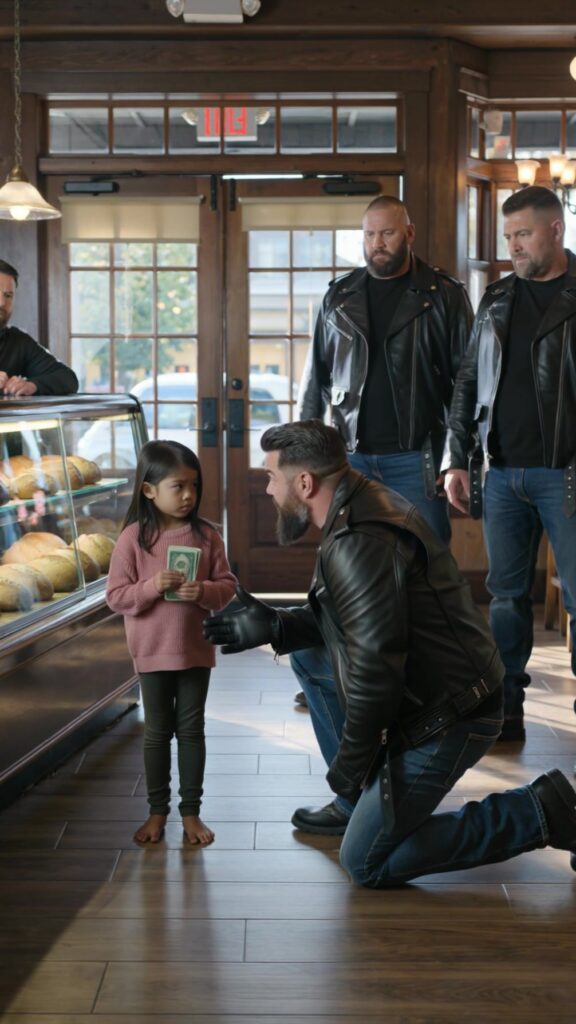
The little girl was not holding the money like she planned to spend it. Her fists were locked around the bills so tightly the corners cut pale crescents into her palms, as if the paper itself could tether her to whatever promise had been pressed into her ear. She stood on the bakery’s honey-colored floorboards, barefoot, in a pink sweater that had begun to pill at the elbows. The room smelled like yeast and cinnamon and the ordinary mercy of heat, but it could not soften the sharp set of her shoulders.
Behind the counter, the baker—an older woman with flour on her cheek—kept her hands on the register and her eyes on the child, breathing carefully like any sudden movement might shatter the girl into quieter pieces. Near the pastry case, four men in leather occupied the space with the cautious stillness of people who understood what fear sounded like even when it was silent. Their jackets carried patches darkened by road grime and years. They looked like trouble only to those who had never learned how trouble sometimes arrives to stop something worse.
The biggest of them lowered himself to a knee, letting his weight settle slowly so the boards wouldn’t creak. His beard was iron-gray at the chin, and the knuckles of his right hand bore scars that didn’t come from bar fights as often as people imagined. He held both palms open, empty, the universal sign for I’m not here to steal.
“Hey,” he said, voice low enough to keep from echoing. “What’s your name?”
The girl’s eyes flicked to the door, then to the cash, then to his face like she was taking measurements for a jump. “I’m… I’m Lacey.” The name came out thin but clean.
“Lacey.” He repeated it with care, like it mattered. “Did you come here by yourself?”
She hesitated, lips pressing together. Then she whispered, “He found me.”
The biker’s expression shifted, not into confusion but into the hard recognition of a person hearing a code word from an old nightmare. One of the men behind him—taller, younger—lifted his chin, eyes sharpening. Another moved a fraction closer to the windows without seeming to. The bakery’s warmth suddenly felt like a blanket thrown over a trap.
The bell over the door chimed.
Sunlight cut a bright blade across the floor as a man stepped inside, his shoes too polished for this neighborhood, his jacket too clean. He carried a smile that was practiced enough to be useful and calm enough to be dangerous. He let the door close behind him with the gentle patience of someone who believed the world would wait.
Lacey’s whole body tightened. She didn’t run. She didn’t cry. She simply turned her head the smallest amount, as if trying not to be seen doing it, and her voice fell out of her in a breath: “That’s not my dad. He just says he is.”
The kneeling biker didn’t look back right away. He stayed facing Lacey, like if he turned his eyes away even for a second she might vanish—either by running or by being taken. “You’re safe,” he told her, though he didn’t yet know if he could make it true. “Keep holding that money. Don’t let anybody touch it unless you decide.”
In the reflection of the pastry case glass, he saw the man’s hands: empty, yes, but held at a careful angle, as if they wanted to show how harmless they were. Harmless people rarely need to advertise it.
“There you are,” the man said, voice bright with rehearsed relief. “Lacey, sweetheart. You scared me half to death.” He took two steps forward, stopping at the edge of the biker’s peripheral vision. “Looks like you made some friends.” His eyes scanned the leather jackets and lingered on the patches. “This is a misunderstanding.”
The biker rose to his feet in a fluid motion that kept his body between the man and the girl. Up close he was enormous, but he didn’t inflate himself; he simply occupied the truth of his size. “Maybe,” he said. “Or maybe you came looking for the wrong kid.”
The man’s smile tightened. “That’s my daughter.”
“What’s her birthday?” the biker asked, like it was casual. Like he was asking what kind of bread she liked.
The man blinked once. “March—”
Lacey flinched at the sound, and the biker caught it. He didn’t look at her, but he heard it, filed it away. He leaned his head toward the girl without turning. “Lacey,” he murmured, “do you remember the rule you were given?”
She nodded, a quick jerk. “Don’t let go until I find the right men.”
The biker felt the phrase hit his ribs like a fist. He glanced at the man now, finally, and the air between them went cold. “Who gave you that rule?” he asked Lacey.
Her eyes stayed locked on the polished shoes. “My mom. Before the bad man came to the house.” She swallowed. “She said… she said to find the men with the black wing. The ones who help when cops don’t.”
Behind the biker, one of the others—a woman with a shaved undercut and a chain hanging from her belt—touched the patch on her shoulder: a dark wing stitched above a road. Her jaw clenched as if biting down on rage.
The man cleared his throat, a soft, annoyed sound. “This is ridiculous. She’s confused. There’s been a custody issue—”
“Custody doesn’t come with hush money,” the baker said suddenly from behind the counter, surprising everyone including herself. Her voice shook but held. She nodded at the bills in Lacey’s hands. “Honey, where’d that come from?”
Lacey’s grip tightened further. “Mom put it in the cereal box. She said it was for the wing men. She said if I gave it to anybody else, they’d take me back to him.” Her eyes darted up to the biker’s face for one brave second. “Are you the wing men?”
The biker’s throat worked. He could taste old asphalt and blood and the memory of a case that never reached court because the wrong people wore the right badges. The club had been born out of that failure—ex-firefighters, laid-off mechanics, one former deputy who’d quit when the sheriff sold the town. They’d done deliveries and funerals and quiet rescues no one posted online.
“Yeah,” he said, soft as a vow. “We’re them.”
The man’s smile collapsed into something harder. His gaze flicked to the girl, then to the cash, calculating. “Listen,” he said, voice lowering, “you don’t want to do this. Hand the child over and no one gets hurt.”
The younger biker at the window shifted, revealing the shape of a phone in his hand. He was already dialing, already speaking in a calm murmur to someone on the other end, giving an address, a description, the kind of details that could become a lifeline if they arrived in time.
Lacey took a small step backward until she felt the counter against her spine. Her eyes shone but she still didn’t cry. Tears, she’d learned, were for later.
“What’s your name?” the biker asked the man, and it wasn’t a polite question. It was a gate slamming shut.
“Mark Bennett.” The answer was quick, too quick. The man’s gaze slid toward the door as if he was already planning his exit.
“No,” Lacey whispered. The word shook. “That’s not his name.”
The biker held one hand out behind him, palm open without looking, trusting the girl to choose. “Lacey,” he said, “if you want, put the money in my hand. Not because I’m taking it. Because you’re giving it.”
For a heartbeat the bakery hung between breaths. The world narrowed to a child’s decision.
Lacey’s fingers loosened with a painful slowness, like prying open a clenched truth. She set the stack into his palm. The biker closed his fingers around it, not as a prize but as evidence. He lifted it slightly, letting the man see the corner where a bank strap had been torn away. Underneath, in faint ink, was a number—an old club trick for tracking bills, a trail for anyone paying attention.
“You walked into the wrong oven,” the biker said.
The man’s face went pale with sudden understanding. His hand moved toward his jacket.
Four leather-clad bodies shifted at once—silent, trained not by academies but by consequences. The woman with the chain stepped sideways to block the aisle. The younger man at the window spoke louder into the phone: “He’s reaching. Now.”
The baker ducked behind the counter with a sharp intake of breath. Lacey pressed her back against the wood and squeezed her eyes shut, as if darkness could make her smaller than the danger.
The biker didn’t draw a weapon. He didn’t need to. He took one step forward and let his voice turn to gravel. “Hands where I can see them,” he said. “And don’t you dare move toward that child.”
For a fraction of a second, Mark Bennett looked like he might try anyway. Pride can make a man stupid. Desperation can make him worse. Then, from outside, came the rising wail of sirens—more than one. Too fast to be coincidence. Too close to be ignored.
The man’s eyes darted, then he made his choice. He spun for the door, shoving it open hard enough to rattle the glass. Sunlight swallowed him as he bolted into the street.
The biker didn’t chase. Not yet. He turned, crouched again, lowering himself back into Lacey’s level as if returning to the only thing that mattered. “Look at me,” he said gently.
Lacey opened her eyes. They were wet now, finally, but the fear inside them had shifted into something else: the aching uncertainty of hope.
“Your mom did a brave thing,” he told her. “And you did, too.” He glanced at the money in his hand and then at the door where sirens screamed closer. “We’re going to tell the truth. And we’re going to keep you where the truth can reach.”
Lacey’s voice trembled. “Will he come back?”
The biker’s jaw tightened, and behind it the whole club’s history tightened with it—every time the world tried to take a child quietly. “He’ll try,” he said honestly. “But you found the right men.” He extended his gloved hand, palm up, an invitation rather than an order. “Can I walk you outside when it’s safe?”
She hesitated only long enough to prove she still belonged to herself. Then she placed her small fingers into his, and for the first time since she’d entered the bakery clutching paper like a lifeline, her shoulders lowered by an inch—as if the warmth in the room had finally learned how to reach her.
Outside, the sirens swelled, and the bell over the door trembled in its frame, ringing not like a welcome anymore but like a warning the whole street could hear.