The wrought-iron gates of Hollowmere Mansion opened as if they were sighing. Elias slipped through before they could change their mind, a skinny barefoot boy with road dust on his shins and a sack clutched to his ribs like a second heart. Behind him, the city’s noise faded into trimmed hedges and quiet stone. The driveway’s gravel bit his soles, but he kept walking anyway, toward the brightness of money and the shadow it cast.
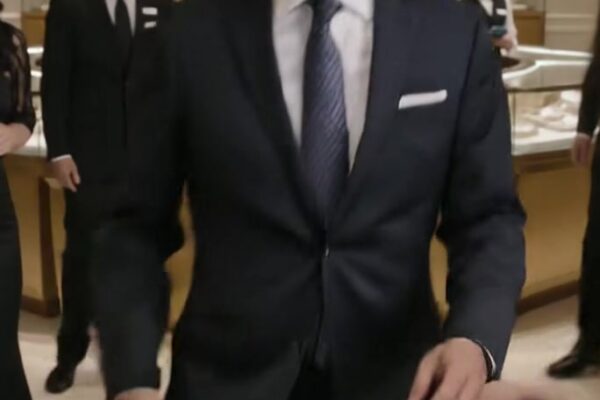
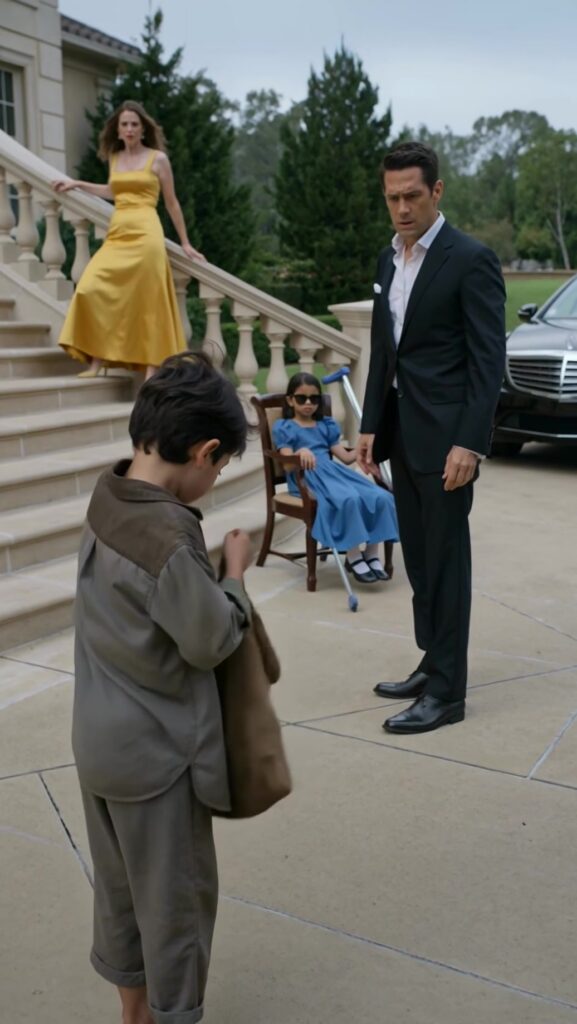
They were staged in the courtyard the way portraits were staged: the man in a linen shirt, expensive watch catching the morning sun; the woman on the steps in a yellow dress that looked like a warning; and between them, the little girl in blue, dark glasses hiding her eyes. A crutch lay across her lap as neatly as ribbon. She sat still enough to fool anyone who wanted to be fooled.
Elias didn’t come to shout at a stranger. He came to fracture a story that had been delivered with breakfast, poured over cereal and swallowed with orange juice. The kind of lie that didn’t announce itself as a lie—because it pretended to be care.
He opened his mouth and his voice flew out of him, raw and unpolished. “She’s been lying to you!” The words snapped across the driveway, startling birds from the cypress trees. A guard took a step, then another, and stopped when the man lifted a hand without taking his eyes off Elias.
The man’s irritation rose first, practiced and effortless, the reflex of someone used to being obeyed. Then something shifted in him—an unease like a crack in glass. His gaze slid to the girl. She tilted her head, small and delicate, chin lifting at an angle that could have been learned. The woman on the steps went rigid, as though the fabric of her dress had suddenly stiffened into armor.
Elias swallowed the copper taste of his own fear. “Your daughter isn’t blind,” he said, and the sentence came out flatter than he expected, because if he let it shake he might not say it at all. The man’s jaw tightened, not in belief—Elias could see that. In something worse: recognition of a suspicion he had trained himself not to touch.
The girl’s fingers tightened around the crutch. Not a dramatic clutch, just a small reflex, too quick to be planned. And then, as Elias shifted his weight, the girl’s face turned toward him—toward his exact spot—with a precision that didn’t belong to someone following sound alone. The movement was tiny, but it landed like a stone in a still pond, sending rings through every watching eye.
“Who are you?” the man asked. His voice was calm, but Elias heard the strain under it, the way calm can be used like a leash on panic.
“Someone who heard her crying,” Elias said, nodding toward the woman in yellow, “not because she was sad. Because she was scared she’d be caught.” He hugged the sack tighter and stepped forward once, feeling the gravel bruise him. “I was outside your kitchen window two weeks ago. I was looking for food. I heard the cook arguing with her about the juice.”
The woman’s mouth opened, then closed again as if her own breath had betrayed her. “This is—” she began, and the word snapped off under the weight of the man’s stare.
Elias plunged his hand into the sack and pulled out a bottle. It was small and plain, without a label, like something meant to vanish in the clutter of a pantry. The liquid inside was pale, almost innocent. Elias held it out with both hands. For a second no one moved. Then the man crossed the gravel and took it, his fingers careful as if it might burn.
He turned the bottle, reading what wasn’t there. Elias watched his face change as memory supplied its own label: a medicine he had once trusted because it had been delivered with a smile. Something bitter, something daily, something explained in gentle terms. The man’s thumb rubbed the glass as if he could erase the past with friction.
“It tastes bad,” the girl whispered, and the softness of her voice made the confession feel like a bruise being touched. “Every morning.” Her head dipped, and for a moment she looked less like a portrait and more like a child trapped inside one. “Mama says it’s for my eyes. So they won’t hurt.”
The woman took one step backward up the stairs. It was slow, controlled—too controlled. Like she was trying to retreat without anyone noticing she was running. The guard glanced at the man for permission to move, but the man didn’t look away from his wife. His face had gone strangely still, the way water goes still before it freezes.
“You told the cook not to forget,” Elias said, and the words felt dangerous leaving his mouth, as if they might summon something. He remembered the kitchen’s warmth and the smell of citrus. He remembered a woman’s voice, sharp as a knife through cloth: Don’t miss a morning. If he notices, we’re finished. “You said if she missed even once, he might see.”
The woman’s eyes flicked to the girl. In that glance Elias saw it—calculation, fear, and something he didn’t want to name. “Don’t listen to him,” she said quickly, voice brightening in the wrong direction. “He’s a thief. He’s—he’s trying to extort you. It’s a setup.”
“Then let her take off the glasses,” Elias said. “Right now.”
Silence spread through the courtyard, thick as syrup. The man looked down at his daughter as if she were suddenly a stranger wearing his child’s face. “Lena,” he said, and his voice broke in the middle of her name. “Sweetheart. Can you… can you look at me?”
Lena’s hands trembled. Not much. Just enough to make the crutch rattle against her lap. She lifted her face toward him, and Elias watched her try to perform blindness the way she’d been taught—eyes unfocused, head tilted, smile practiced. But fear makes actors clumsy. Her gaze snagged on her father’s eyes for a fraction of a second, clear and direct, before she tried to drop it into haze.
The man inhaled sharply. It sounded like a wound opening. He reached out and took the sunglasses off, gently, as if he were removing a bandage. Beneath them were eyes—wide, brown, wet at the edges—not blank with darkness, not searching. Just eyes, seeing everything they weren’t supposed to see.
The woman made a sound like laughter strangled into a sob. “I did it for us,” she said, and there it was at last: the truth dressed in justification. “Do you know what happens to an inheritance when you remarry? Do you know what your board would do if they thought you were weak? She needed to be… protected. And we needed—”
“You needed,” the man corrected, and his voice went low enough to terrify. He held the bottle up between them. “You drugged our child so she would play a part.” He looked at Lena again, and his anger faltered, crushed by grief. “So I would feed a lie to her every morning.”
Lena’s mouth opened. “Mama said it was a game,” she whispered. “She said Daddy would love me more if I was brave. And brave meant… not telling.”
Elias felt something twist inside him, a knot of rage and pity so tight it made his ribs ache. He hadn’t come for revenge. He hadn’t even come for money, though the hunger in him was real. He had come because he knew what it was to be used, to be told that survival required silence.
The man looked at Elias then, truly looked, as if he were finally seeing the boy’s thin ankles and cracked feet, the dirt under his nails, the way his sack hung heavy with proof instead of belongings. “How did you get that bottle?” he asked.
“The cook threw it out,” Elias said. “I took it because I didn’t know what it was, but I knew it was important. People don’t whisper over harmless things.” He hesitated, then added, “I came back when I heard you were having a… family breakfast in the courtyard. I thought if I said it where everyone could hear, she couldn’t make it disappear.”
The woman’s breath hitched. The guards moved now, not toward Elias but toward her, and the sound of their shoes on stone was the first ordinary noise that had dared enter the moment. The man didn’t watch them. He crouched in front of Lena, taking her hands as if he could steady the world through her fingers.
“It’s over,” he said, and the words were not only for his wife. They were for the lie, for the mornings, for the bitter taste. “No more games.” He glanced at Elias again, and there was something like shame in his eyes. “And you—why didn’t you go to the police?”
Elias let out a humorless breath. “Because they don’t come when boys like me knock,” he said. “And because I didn’t know if you’d believe them either. But I saw you once, on the news, talking about truth like it was a brand. I thought… maybe you’d want it when it hurt.”
The man stood slowly, bottle still in his hand, as if it weighed as much as the mansion itself. “What’s your name?” he asked.
“Elias.”
“Elias,” the man repeated, tasting the name like it mattered. “You came here to break something.” His gaze lifted to the house, to its windows like watching eyes. “You succeeded.”
For the first time since Elias had entered the gates, the air seemed to move again. Somewhere far inside the mansion, a clock chimed the hour. Lena’s small fingers tightened around her father’s, not in performance this time, but in instinct. Elias held his sack against his chest, feeling the ache in his feet and the strange lightness in his lungs. He had come to the mansion carrying proof. He left the driveway carrying something heavier: the knowledge that a lie, once spoken aloud, could no longer pretend it was love.