The bucket was heavier than it looked, and the water inside it smelled like coins and bleach and the underside of the city. Jonah carried it with both hands as he ran, knuckles whitening around the plastic handle. The cold sloshed up over the rim and soaked his sleeves, but he didn’t slow down. He wasn’t hunting a headline. He was chasing a face that had lived in his mother’s final stare—sharp as a thorn even when her voice had gone soft.
The restaurant sat at the corner like a promise. Warm light poured through tall glass panes, turning every laughing mouth and clinking glass into something golden. Valets in black moved like chess pieces around polished cars. People stepped out onto the sidewalk with the easy confidence of those who believed their mistakes were private property.
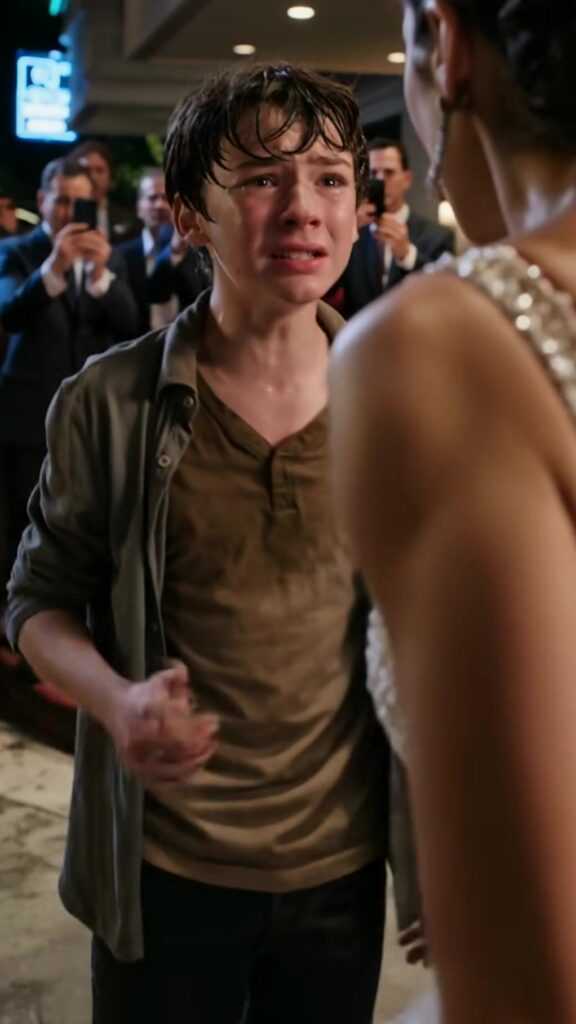
Jonah cut through them like a thrown stone. The first shout went up too late. Before anyone could grab his shoulder, he swung the bucket in a single arc, and the dirty water spread in a grim fan across the spotless entrance. It struck the doors and windows with a wet slap, leaving streaks that crawled downward like bruises. Jonah’s voice tore out of him, raw and cracked. “You did this!”
The sidewalk paused. A man with a valet tag froze mid-step. A woman in pale heels recoiled as if the water might stain her from across the air. Phones rose, screens brightening, capturing Jonah’s shaking arms and the dripping glass. The restaurant’s laughter thinned into a hush, the kind that arrives when the world senses blood.
Then the black sedan at the curb released a quiet click, and the rear door opened. A woman unfolded herself from the leather interior as if she were stepping onto a stage. She was immaculate—coat tailored, hair pinned, mouth set in the practiced line of someone used to being obeyed. The warm restaurant light and the street’s blue neon fought over her face, but neither could soften the fury in her eyes.
“Are you out of your mind?” she demanded, voice ringing. “Who are you?”
Jonah didn’t answer immediately. His throat was packed with grief, with the smell of antiseptic rooms, with his mother’s breath running out. He could still feel her fingers on his wrist the night before she died, how she had held him as if trying to anchor him to the world. He wiped his cheek with his sleeve, smearing water and tears together. “You let her stand outside a hospital in the rain,” he said, each word pushed out like a stone. “You watched her and turned away.”
For an instant, the woman’s expression faltered, the way a flawless mask shifts when a strap snaps. Confusion slid through her anger, and then something else—recognition, quick and unwelcome. Jonah saw it and felt a hard, terrible satisfaction, because that flicker meant his mother hadn’t been imagining a ghost.
He reached into his pocket with fingers that wouldn’t stop trembling and pulled out a photograph folded so many times the creases had become permanent. The paper was soft at the edges, the image dulled by years of handling. Jonah had found it taped beneath the drawer liner after the funeral, hidden under a stack of old receipts and a dried lavender sachet. He unfolded it carefully, as if it might dissolve.
The crowd leaned closer, the phones angling for a clearer shot. In the picture, a younger version of the woman stood out in harsh hospital lighting, sitting on a vinyl bench. Her hair was messier, her eyes hollow with exhaustion. In her arms was a newborn wrapped in a striped blanket, a tiny face turned toward the camera. Jonah’s own face—before he had words, before he had a name that belonged to him.
He held the photograph up between them like a blade. “She said you were my birth mother,” he said. The word mother caught in his mouth like a bone. “She told me on her last night because she didn’t want me growing up with only half the truth.”
The woman’s lips parted. The color thinned in her cheeks, as if someone had drained it with a syringe. Her gaze locked onto the photo, then onto Jonah’s face, searching for something she couldn’t deny. She glanced at the dripping entrance, the phones, the staring strangers, but none of it mattered the way Jonah’s eyes did. Her voice, when it came, was smaller. “Where did you get that?”
Jonah laughed once—no humor, only disbelief. “From under my mother’s drawer.” He swallowed hard. “She kept it like a confession.”
The woman’s jaw tightened, a tremor moving along the line of it. “I don’t know what she told you,” she said, but the words were too careful, the way a liar arranges sentences like furniture. “That was a long time ago.”
Jonah stepped closer. He was aware of the valet’s hand hovering as if uncertain whether to stop him. He was aware of security shifting near the door. But he’d spent too many years being careful for anyone else’s comfort. “She told me why,” he said, his voice low now, almost calm from the sheer force of it. “She said you didn’t give me away because you couldn’t love me. You gave me away because loving me would have ruined you.”
A ripple went through the watchers. The woman’s eyes flicked, as if trying to locate an exit that wasn’t there. Jonah continued, the words coming faster, because once he started he couldn’t stop. “She said you were married. That you were building something expensive with a man who didn’t know the first thing about you. She said when you went into labor, you told her you’d rather lose a child than lose a life you’d already paid for. And she—” Jonah’s voice broke. He steadied himself. “She said she took me because you couldn’t. Because you wouldn’t. And when she got sick, she went looking for you. Not for money. Not for pity. She went looking for the truth.”
The woman’s shoulders rose and fell once, as if she’d been struck. “I was nineteen,” she whispered. “I didn’t have—” Her throat tightened. “You think I didn’t see her?”
Jonah’s fingers clenched around the photograph. “You saw her,” he said, and hatred flared bright enough to warm him. “She stood by the hospital entrance with my medical papers in a plastic bag. She told me she waited for hours. She said you got out of a car just like that one. You looked at her like she was a stain. She said you told her to go away.”
The woman’s gaze dropped to the wet streaks on the glass, to the dirty water crawling down like time. When she looked up again, her eyes glistened in the unforgiving light. “I told her not here,” she said, and it sounded like an excuse that had been rehearsed for years. “I told her I would call. I panicked. I didn’t want anyone to see us together. I thought—” Her voice shook. “I thought I could fix it later.”
Jonah felt the old rage surge, then something underneath it, deeper and more terrifying: the hollow space where he had stored every unanswered question. “There is no later,” he said. “She died calling your name like it was a prayer she didn’t believe in anymore.”
The sidewalk was silent now, even the restaurant behind the glass holding its breath. The woman looked at Jonah as if he were both a stranger and a mirror. Her hands, elegant and steady a moment ago, hovered near her coat pockets, unsure what to do with themselves. “What do you want from me?” she asked.
Jonah stared at her and realized the answer was not a clean thing. He wanted her to hurt. He wanted her to kneel beside a hospital bed and feel helpless. He wanted an apology that could resurrect the dead. But he also wanted something simpler, something a child wanted before the world taught him to aim his longing like a weapon.
He lowered the photograph and tucked it back into his pocket. “I want you to say her name,” he said. “Out loud. Here. Where everyone can hear. I want you to admit she existed. That she wasn’t just someone you could wipe away.”
The woman’s eyes darted to the phones, to the faces hungry for scandal. Her pride fought her like an animal caught in a trap. For a moment Jonah thought she would turn, climb back into the sedan, let security handle the mess and let money bury the rest.
But the damp glass behind her reflected her own face, fractured by streaks of grime. She drew a breath that seemed to pull something loose inside her. “Marisol,” she said, the name trembling as it left her. “Her name was Marisol.”
Jonah’s chest tightened painfully. It wasn’t justice. It wasn’t enough. It was only a word. And yet it was the first time he had ever heard anyone outside his small apartment speak his mother’s name as if it mattered.
The woman took one step forward, cautious, as if Jonah might shatter. “I can’t undo it,” she said. “But I can stop pretending it didn’t happen. I can—”
Jonah backed away before she could offer him something that would feel like another transaction. He didn’t want to be purchased by regret. He wanted the truth, and he had dragged it into the light with a bucket of filthy water.
He turned and walked into the night, leaving behind the dripping entrance, the frozen crowd, the golden glow that now looked less like warmth and more like a fire behind glass. Somewhere behind him, he heard the woman say his name—his name, the one Marisol had given him—and for a second Jonah hated how much it hurt to hear it from her. He kept walking anyway, because grief didn’t end when the truth finally spoke. It only changed shape, and he had no choice but to carry it forward.