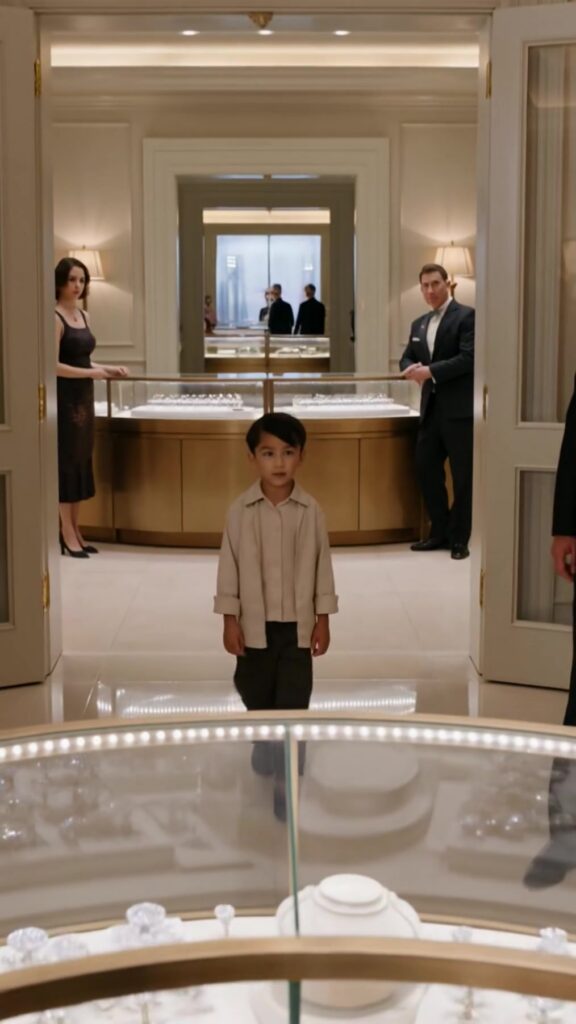
The boutique had been designed to make people whisper. Crystal chandeliers warmed the air like captured sunlight, and the cases—long, low, immaculate—held diamonds that looked less like stones than like frozen sparks. In the hush, even money learned to speak softly.
So when a man in a black tuxedo climbed onto the small platform usually reserved for champagne toasts and engagement announcements, every head turned with polite irritation. Then the irritation dissolved. His hands were gripping the glass counter as if it were a ledge above a drop, and his face was wet, not from a spill, but from tears he wasn’t bothering to hide.
He drew a microphone close, the metal trembling against his knuckles. “My daughter has not spoken in two years,” he said, voice cracking like thin ice. “If anyone can help her, I will give anything.” The words didn’t float; they fell, heavy, into the quiet. Even the security guard by the door stopped shifting his weight.
Beside him stood the child. She was too small for the room’s grandeur, in a pale blue dress that might once have been bought for a celebration. Now it hung like an apology. Her eyes were overfull, though no tears dropped, and her lips looked as though they’d forgotten the shape of sound. She held her father’s sleeve with both hands, not clinging, but anchoring, the way someone might touch a wall in a storm.
People in the city recognized her without needing an introduction. Two years ago her mother had vanished—no goodbye, no note, no ransom demand, no evidence except a door left ajar and a single earring on the kitchen tile. The girl had been the last to see her. That night, she’d spoken one sentence—short, precise, chilling—and then, as if the sentence had emptied her, she never spoke again. Doctors called it a protective silence. Specialists called it a locked trauma response. The father called it a prison he couldn’t unlock.
He had tried everything that could be purchased. Therapists with framed diplomas. Retreats in quiet forests. Hypnotherapists and neurologists and people who promised miracles behind closed curtains. He sold his watch collection, then his car, then shares in the company that had once made his name. He’d moved out of the house where the disappearance happened and into a smaller place with fewer corners to remember. Still, his daughter’s voice stayed somewhere beyond reach, as if she’d buried it in the same place her mother had gone.
Tonight had begun as one more attempt at impossible hope. The boutique owner owed the father a favor, and the owner’s clientele included people who could buy solutions—private investigators, influential doctors, specialists flown in on private jets. The father had imagined a benefactor in silk, someone with a phone full of names, stepping forward. He had not imagined a child.
A little boy emerged from the back, from the corridor leading to staff rooms and the safe. He wore simple clothes—plain trousers, a buttoned shirt with frayed cuffs, shoes polished but old. He was too young to be an employee and too unadorned to be a customer. The guard stiffened, ready to escort him out, but the boy’s expression stopped him. It wasn’t boldness. It was certainty, as if the boy were walking a path only he could see.
He came forward between the cases, passing reflections of himself in the glass: small, unglittering, steady. In the center of the room he stopped, meeting the father’s eyes without flinching. “I can help her,” he said, softly enough that it should have vanished under the chandelier hum, yet somehow the words cut through everything.
Disbelief rippled like a gust through the boutique. A woman in pearls made a sound that was half laugh, half insult. The father’s grief hardened into anger so quickly it seemed to change the lines of his face. “Stop this,” he snapped. “You don’t belong here.” His hand tightened around the microphone, and for a second it looked as if he might use it as a weapon against hope itself. “This is not a show.”
The boy didn’t retreat. He lifted one hand, and between his fingers something glinted. Not a diamond. Something older, warmer in color, threaded on a fine chain. A pendant shaped like a small starburst with a tiny blue stone at its heart, the kind of sentimental piece a mother might wear every day without thinking.
The boutique seemed to inhale as one. The father’s mouth opened, then closed, as if language had become too blunt to hold what he was seeing. The pendant had been reported missing. It had been the mother’s—always at her throat, even in photographs from before she met him, a piece she’d claimed was “good luck.” The last time he’d seen it was the evening she disappeared. He had searched the house for it until his hands bled from moving furniture.
The girl’s reaction was instantaneous and violent in its quiet. Her eyes widened, the pupils tightening as if they’d been struck by light. Her small body jerked forward. Her fingers loosened from her father’s sleeve, and her lips parted, shaping something that wasn’t yet sound. A tremor moved through her throat. The boutique’s polished world held its breath, waiting for the impossible.
The father stumbled off the platform, forgetting the microphone. He grabbed the boy’s wrist, not gently. “Where did you get that?” he demanded. There was more than rage in his voice now. There was fear—the fear of being tricked, the fear of being right. “Tell me. Right now.”
The boy let his wrist be held. His gaze flicked to the little girl, and for the first time his certainty looked like sadness. “I didn’t steal it,” he said. “She gave it to me.” He nodded toward the pendant. “The woman with the tired eyes. She said if I ever saw you, I should bring it. She said your daughter would recognize it, and that’s how you’d know I’m telling the truth.”
At the mention of tired eyes, the father’s grip faltered. He had forgotten, in all the stories he’d told himself, that his wife had been exhausted in the months before she vanished. Not unhappy, not exactly—just worn down by something she never named. He had been too busy building a life to notice the cracks in her voice.
The girl took one step, then another, her shoes whispering on the marble. She reached for the pendant with a careful hand, as if it might vanish like smoke. When her fingertips touched the starburst, her face changed again—pain and longing, yes, but also a flicker of anger, as though a door inside her had been flung open to reveal a room she’d been forced to keep locked.
A sound escaped her. It wasn’t a word. It was a raw, broken breath, the beginning of speech dragged up from a deep place. The father turned toward her so fast his tuxedo jacket flared. His eyes widened, and tears returned, but this time they didn’t look like defeat. They looked like terror at what might finally be revealed.
The boy’s voice dropped lower. “She isn’t gone the way you think,” he said. “But if you want her back, you can’t buy it with diamonds. You’ll have to trade something else.”
In a room built to measure worth in carats, the father stared at the child he’d never seen before, holding the one object that could pull his family’s past into the present. Around them, the wealthy customers stood frozen, their hands hovering over luxury they suddenly couldn’t remember wanting. The father’s earlier promise—anything—hung in the air, no longer a dramatic plea but a binding vow.
He knelt in front of the boy and the girl, lowering himself until the diamonds behind the glass were at eye level, as if to remind himself how little they mattered. His voice came out rough. “Tell me what you need,” he said. “Tell me what I have to give.”
The girl clutched the pendant to her chest, and her mouth moved again. This time, a syllable formed—thin, trembling, undeniable. It sounded like the start of a name.
The boutique’s lights glittered above them, indifferent and brilliant, while the father listened to his daughter’s first broken piece of sound in two years and realized that whatever story had begun the night his wife vanished was about to finish in public, in front of strangers, with a boy who carried secrets like they weighed nothing at all.