The marble lobby of the five-star Paris hotel glowed like a palace that night. Light poured from chandeliers like molten gold, sliding over fluted columns and a staircase that curved upward with the confidence of old money. A tower of champagne flutes glittered beside a pianist in a black suit, and the air smelled of white roses and winter truffles. It was the sort of gathering where laughter sounded rehearsed and grief was something done privately, behind closed doors with velvet curtains.
In the flow of tuxedos and silk gowns, Léa moved like a shadow trained to be invisible. Her uniform was crisp but cheap; the hotel crest on her breast was less a badge than a warning. She carried a linen bag with her cleaning cloths and a small bottle of lavender disinfectant, and she kept her eyes down, because eyes invited questions and questions invited trouble. Tonight, there were more guests than usual—an engagement gala, someone said, for a man with a title and a woman with a face that magazines loved.
The bride-to-be, Delphine Arnaud, arrived like a storm dressed as a woman. Her black couture gown held its shape as if it hated gravity. Diamonds blinked at her throat. She smiled at the cameras, accepted kisses on both cheeks, and treated the lobby as a stage built solely for her. Léa only saw her in fragments—heels clicking, a flash of pale hand, a perfume sharp as crushed petals—until Delphine’s gaze snagged on her like a hook.
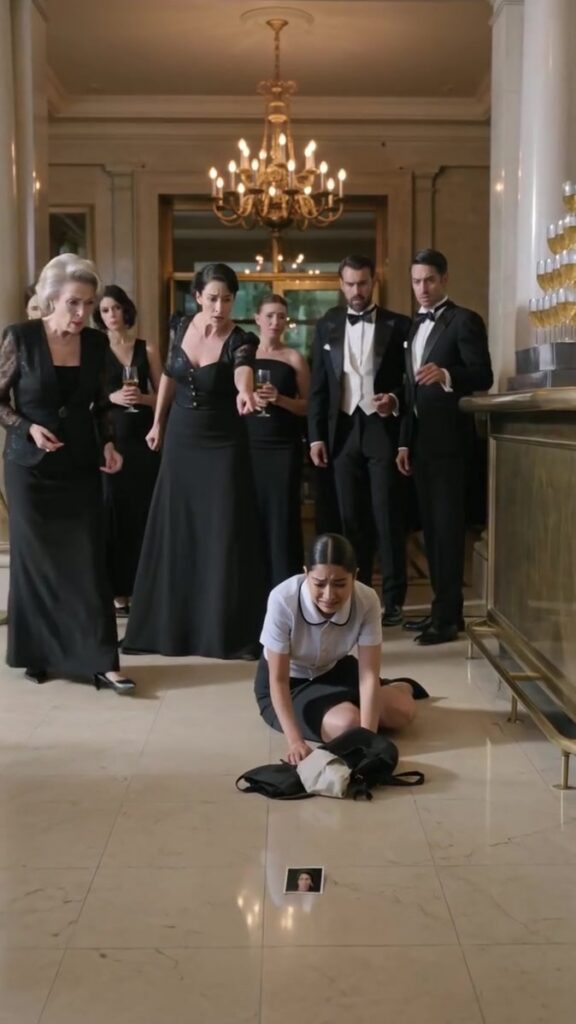
Delphine’s steps altered, her smile collapsing into something harder. She crossed the lobby in a straight line, the way people cross a room when they already know they will not be stopped. The pianist’s melody stumbled. Delphine’s fingers closed around Léa’s upper arm, then shoved her back against the cold edge of the reception desk. The sound was small, but it split the room. “You,” Delphine hissed, loud enough for every ear within a chandelier’s glow. “You were in the VIP corridor. Don’t pretend you weren’t. Where is it?”
Léa’s mouth opened and nothing came out. She had been in the corridor, yes, replacing towels and soap in suites whose guests never remembered her name. But her hands were empty except for cloth and disinfectant. “Madame, I—” She felt the heat of attention like lamps aimed at her skin. Phones rose. A few guests leaned in as if scandal were a dessert course.
Delphine grabbed Léa’s bag and yanked it free. The strap burned across Léa’s shoulder, and a thin cry escaped her before she could swallow it. “If you steal from me,” Delphine said, “you steal from the man I’m marrying. And you will learn what that costs.” She overturned the bag onto the marble with a gesture that made even the concierge flinch. A comb skittered. A folded hand towel slid like a surrender flag. Coins chimed softly and rolled beneath a low table.
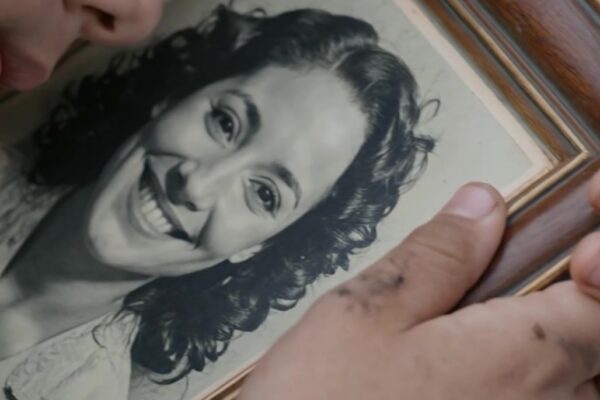
Then an old photograph fell as if it had been waiting for this moment. It landed face-up, catching chandelier light in its worn gloss. In the image, a young woman stood in a hotel corridor holding a baby. The corridor was unmistakable—carpet pattern, wall sconces, the curve of a doorframe—frozen in a time before the lobby had been renovated into this gleaming palace. The young woman’s smile was strained, as if she had heard something in the distance. The baby’s face was turned toward the camera, round-cheeked and solemn.
Near the elevators, a dignified older lady had been watching with the stillness of someone accustomed to being obeyed. She wore pearls that sat at her throat like a promise, and her hair was pinned with the precision of an era that didn’t apologize. She stepped forward, ignoring the murmurs, and bent with surprising ease to pick up the photograph. Her hand trembled before she even saw it properly, as though memory had reached out and grabbed her wrist.
“This…” Her voice thinned. She stared at the picture, then at Léa’s face, then back again. “That corridor—those doors—this is the fourth floor.” She swallowed, and the lobby seemed to inhale with her. “My daughter disappeared from a suite on that floor twenty-five years ago.” Her gaze snapped to Delphine, then to the guests as if they might be accomplices. “Why is this baby in my daughter’s arms?”
Delphine’s mouth opened, closed, and opened again as if she were searching for a script that had suddenly been rewritten. Her fiancé, Étienne de Valois, paused mid-step, one hand still holding a champagne flute. The laughter had vanished; only the soft drip of melting ice from a display bowl could be heard. Léa’s tears slid soundlessly down her face. She didn’t wipe them away. “My mother kept that photograph,” she said, the words coming out like a confession she had rehearsed in nightmares. “She told me if I ever got dragged into shame in this building, I should stop hiding. She said I was brought here before I could walk. She said the truth was inside these walls.”
The older woman’s eyes shone with something that wasn’t only sorrow. It was anger that had aged into a sharp, enduring blade. “Your mother’s name,” she demanded gently, terribly. Léa hesitated, then answered, “Nadia.” The older woman rocked back as if struck. “Nadia,” she repeated, tasting the name. “My daughter’s nursemaid. She left without a word the morning after…” Her voice broke, and she steadied it with force. “After the door was found open and the window latch undone and everyone insisted it was a kidnapping. Everyone insisted it could have been anyone.”
A cough sounded from the far end of the desk. The concierge—old as the building’s bones, his uniform immaculate, his face lined with the patience of decades—had not moved all night. Now he stepped forward, eyes fixed on the photograph as if it were a mirror. “Room 417,” he said quietly, and the numbers landed like stones. He looked at Léa with a grief that seemed personal. “They told the police the room was empty after midnight. That no one entered, no one left. But it was not empty. I saw Nadia carrying a child wrapped in a hotel blanket. I saw her walking fast, not toward the stairs but toward the service lift.” His throat worked. “And behind her, someone else. A woman in a black gown. A woman wearing a brooch shaped like a starburst.”
Delphine’s hand flew to her chest, where a small clasp should have been. The color drained from her face so swiftly it looked like a magic trick. Étienne lowered his glass slowly, as if he feared the sound of it touching the table would shatter what remained of his life. The older woman’s gaze pinned Delphine with a mother’s ferocity. “That brooch,” she said, voice low. “It belonged to my family. It was in my daughter’s jewelry case the night she vanished.” She pointed at Delphine, and her finger did not tremble. “You accuse a maid of stealing what you have been wearing like a trophy.”
Delphine tried to laugh, but it came out strangled. “This is absurd,” she whispered. “I was a child then.” The concierge’s eyes hardened. “Children grow,” he replied, “and they inherit more than money.” Léa looked at Delphine with a dawning horror, as if she were finally seeing the shape of the story her mother had tried to outrun. “My mother told me,” Léa said, voice small but steady now, “that the woman who ordered her to take the baby promised her protection. A job. Papers. Silence.” She swallowed. “She also said the woman’s family would ruin her if she spoke.”
The older woman’s expression shifted, not toward mercy, but toward resolve. “Then tonight we will stop letting rich people edit what happened,” she said. She turned to the desk and addressed the manager as if he were a servant. “Call the police. Call the archives department. Secure the service elevator logs if they still exist. And bring me the guest registry from that week.” Her eyes returned to Léa, softening in a way that made the lobby feel suddenly less cold. “And you,” she said, almost pleading, “tell me everything your mother remembered. Every detail. Every name.”
Léa nodded, shaking. In her mind, the fourth-floor corridor from the photograph stretched into the present like a tunnel. She could see it: the worn carpet, the muffled panic, the hush that followed. She had believed her life began in anonymity, in back hallways and locked storage closets. Now she understood it began in a room someone had tried to erase. As sirens in the distance began to thread through Parisian night, Delphine backed away, eyes darting for an exit that suddenly seemed too narrow.
Under chandeliers that had watched a hundred private sins glitter and vanish, the truth did not vanish. It pooled on the marble between scattered coins and a forgotten towel, bright as the reflection of gold. Léa stood upright at last, no longer pressed against the desk, no longer a shadow. She looked at the photograph in the older woman’s hand—the young mother, the baby, the corridor—and felt, for the first time, that humiliation could become a doorway instead of a sentence.