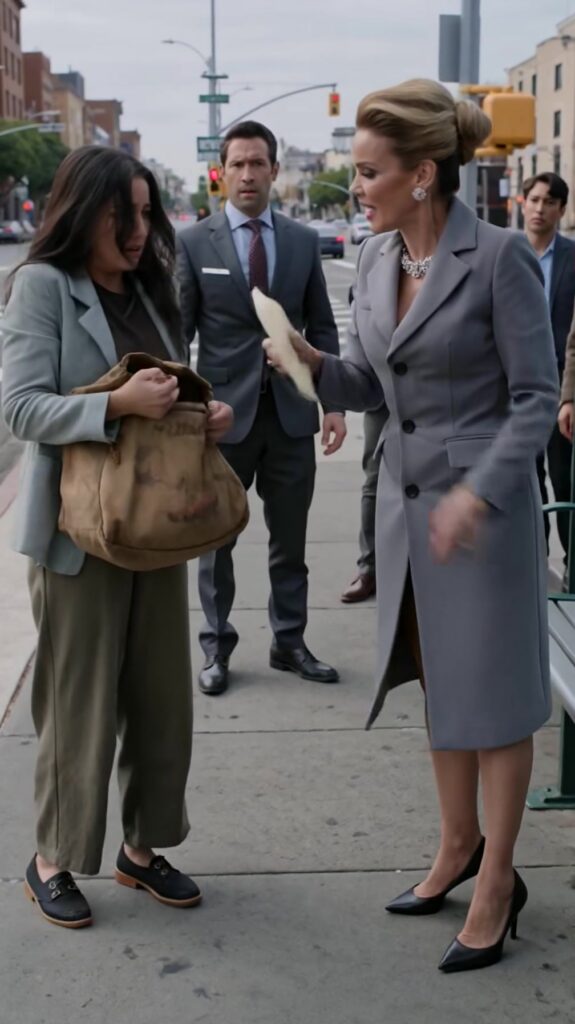
The rain had been falling long enough to erase the chalky advertisements on the sidewalk and make the city smell like rusted coins. At the bus stop on Mercer Street, the bench gleamed with water, and the people waiting stood in uneasy angles—shoulders tucked, eyes down, phones glowing like small private fires.
Marin kept both hands on her bag as if it might float away. It wasn’t a fashionable bag, or even a sturdy one. The zipper had lost half its teeth. The strap had been stitched back together with thick thread. But it was hers, and it held the only thing she had carried through three weeks of borrowed couches and the last of her pride.
She sat on the edge of the bench because standing made her knees shake. Her shoes were damp through the soles. Her hair clung to her cheeks. She tried to make herself small, invisible, just another tired commuter waiting for a late bus.
The woman who arrived at the stop made invisibility impossible.
She stepped out of a silver sedan that paused in the no-parking zone like the law was a suggestion. The driver held an umbrella above her head as she emerged, immaculate in a pale coat that looked too clean for weather. Her heels clicked on the wet pavement with the confidence of someone used to doors opening before she touched the handle.
She glanced at the bench, then at Marin, and her face tightened as if she’d caught a smell. There was a brief, sharp inhale—more offended than surprised.
“Move,” she said, as if speaking to a piece of trash caught in a gutter.
Marin looked up, blinking rain from her lashes. There was space on the bench. Marin was barely taking any of it. Still, she shifted her bag to her lap and edged inward, offering room without confrontation.
The woman didn’t sit. She stared at Marin like Marin had committed a private act in public. Then, without another word, she put a hand on Marin’s shoulder and shoved.
It happened quickly—so quickly that no one intervened in time. Marin’s hip slid on the slick bench. Her feet scrambled for traction and found none. She fell sideways onto the pavement, her palm hitting first, then her elbow, then her cheek close enough to the ground that she tasted grit and rainwater.
The air around the stop snapped taut. A man near the schedule board stopped mid-step. Two teenagers lowered their phones from their faces, uncertain whether to record or help. Across the intersection, a delivery driver leaned out of his cab window, staring.
Marin tried to push herself upright. Pain shot up her wrist. She drew her arm close and sucked in a breath that trembled. Her bag hugged her chest like a shield. Humiliation burned hotter than the bruise forming on her skin.
“You don’t sit next to me,” the woman said, voice rising. “Not like that. Not with—” Her hand fluttered, seeking the right insult. “With whatever you brought.”
“I’m sorry,” Marin managed, though she didn’t know for what. Apologizing was a reflex. It had kept her safe more than once.
The woman’s gaze locked on the bag. “Open it.”
Marin’s throat tightened. The words stayed trapped behind her teeth. The bag was pressed against her ribs; she could feel the paper inside, a flat weight that seemed to pulse with its own heartbeat.
“Open it,” the woman repeated, louder. “Let everyone see what you’re hiding.”
Marin shifted, trying to stand without letting go. The strap slipped on her wet sleeve. Something inside the bag slid free. A sealed envelope, thick and cream-colored, skittered across the pavement like it had its own destination.
It came to rest near a pair of polished shoes belonging to a man who had been waiting with quiet patience. He wore a dark coat buttoned to the throat, his hair peppered with gray. He bent down, careful not to wrinkle the envelope, and turned it over in his hands.
Marin’s face went pale in a way the cold couldn’t explain. “Please,” she whispered. “Don’t.”
The woman let out a brittle laugh. “Oh, now it’s private?”
The man hesitated. There was no return address. Only a name written with measured pressure, each letter deliberate, as if the writer had practiced keeping their hand steady: ELIAS ROWAN. Beneath it, another line: For the attention of the Board, should anything happen to me.
The name moved through the crowd in a silent ripple. Several people turned their heads toward the intersection as if the letters had pulled their gaze on invisible strings.
Across the street, beside a black car that looked more like a statement than a vehicle, stood a well-dressed man with a long face and a stillness that didn’t belong in a rain-soaked city. He had been watching the bus stop with the calm of someone who believed he could not be noticed. When the envelope appeared, his posture changed by a fraction—his chin lifting, his shoulders tightening.
The man with the polished shoes broke the seal.
Paper whispered open. The rain muffled traffic, turning horns and engine noise into a distant wash. The reader’s eyes moved down the page. At first his expression held only mild curiosity. Then the muscles in his jaw tightened. His mouth opened slightly, not to speak, but as if his breath had been taken away.
He looked up. Not at Marin. Not at the woman. Across the street—directly at the man beside the black car.
The reader held the letter with both hands as if it had suddenly become heavy enough to bend metal. In a low voice that carried anyway, he said, “This is Elias Rowan’s handwriting.”
The woman on the curb stiffened. Her superiority faltered, replaced by a quick alarm she tried to mask with disdain. “So what? It’s a letter. Anyone can write a letter.”
The reader ignored her. He continued, eyes scanning lines that seemed to darken as he read. “He says there are accounts not disclosed. Funds moved through shell charities. Names.” He swallowed. “He says if this reaches the Board, it means he was threatened. It means he’s…”
Marin’s knees pressed into the wet pavement. She had known the letter would sound like a bomb if it ever opened. That was why she had kept it sealed, why she had walked with it against her ribs, why she had promised a dying man she would not let it disappear.
The well-dressed man across the street took one step forward, then stopped. His hand went to his coat pocket in a gesture too smooth to be casual. The driver of the black car started to open the back door, eyes scanning for exits.
“Read the rest,” Marin said, surprising herself with the steadiness in her voice. She wiped rain from her mouth with the back of her good hand. “Please. Out loud.”
Several heads turned toward her. The woman who had pushed her looked as if Marin had spoken above her station.
The reader took a breath and raised the page slightly, as if presenting evidence in a courtroom. “He names Victor Kline as the one who arranged the pressure campaign.” The name landed like a stone. “He says Kline used private security to follow him. He says he was forced to sign documents. He says the accident that was supposed to make him ‘quiet’ was scheduled for—”
A bus roared past in the near lane, sending a wave of spray over the curb. No one flinched. The entire stop had become a single held breath.
Across the street, Victor Kline’s face emptied. Not anger—calculation. He scanned the crowd, the phones now raised openly, the delivery driver now out of his cab, the wet-eyed commuters suddenly awake with purpose.
“Give me that,” the rich woman snapped, stepping toward the reader as if she could reclaim control through volume. But her voice was thinner now, fraying at the edges.
“Don’t touch him,” someone said. Another voice: “Call the police.” Another: “Record.”
Marin pushed herself up, pain flashing through her wrist, and stood anyway. She was shaking, but she was standing. The bruise on her cheek throbbed like a second heart.
“He wrote it for daylight,” she said, looking past the woman, past the bench, to the street where Victor Kline remained frozen beside his black car. “He said it was the only thing they couldn’t buy. The only thing they couldn’t lock in a drawer.”
The reader folded the letter carefully, not to hide it but to protect it, then held it up where every camera could see. “Everyone heard,” he said to the crowd. “Everyone saw.”
Cars slowed at the intersection, not because the light demanded it but because the scene had changed the rules. Pedestrians stopped mid-crosswalk. The city, usually eager to rush past other people’s pain, paused as if the street itself had decided it would not allow this to be swallowed whole.
Victor Kline’s driver shut the car door with a sound like a warning. Kline moved again, but not toward the bus stop. He stepped backward, eyes fixed on the letter as though it were a weapon pointed at his chest.
Marin watched him retreat, rain sliding down her face, and realized the shove had done something the woman never intended. It had torn the secret out into open air. It had forced witnesses into existence.
The bus still hadn’t come. No one cared. The whole street belonged to the letter now, and for the first time in weeks, Marin felt something sturdier than fear settle inside her: the weight of truth, held up where it could not be buried again.