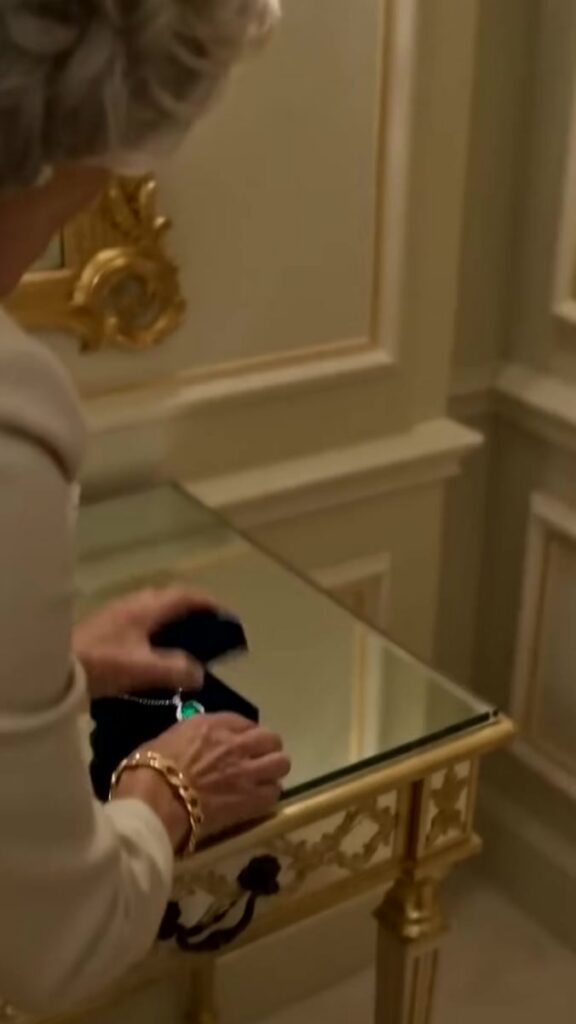
The hallway was too beautiful for a moment like this. It held its breath in soft gold, as if it had been designed to flatter secrets—cream-paneled walls, a runner rug that muted footsteps into confessions, and a chandelier whose crystals scattered light the way diamonds scattered blame. The air smelled faintly of beeswax and lilies, a curated calm that promised nothing ugly could happen here.
Lina moved down the corridor with a tray balanced on her palm, her other hand steadying the silver teapot. She had learned the mansion’s rhythms quickly: when doors were likely to open, which floorboards complained, how long it took the security cameras to sweep from one end to the other. She kept her eyes down, as the house preferred its staff—polite, invisible, replaceable.
At the far end, near the mirrored niche that made the hallway seem twice as long, Althea Mercer appeared. The lady of the house did not stride so much as glide, her posture held together by will and old money. Lina prepared to step aside, to become part of the decor, but Althea’s gaze snagged on something that didn’t belong to the palette of pale fabrics and controlled silences.
A glint of green at Lina’s throat—bright as a leaf after storm. The emerald lay against the stark white collar of her uniform, too alive for the rules of the place. Althea’s face changed so quickly it looked like a mask cracking. Her hand shot out, fingers clamping down on Lina’s shoulder with the instinct of someone catching a falling heirloom.
The chain tightened. For one sharp second, Lina felt the necklace bite into her skin, felt her breath snatched away by surprise. The tray wobbled; the teapot lid rattled like a warning. Lina’s eyes widened, not with indignation, but with the particular terror of a servant being accused in a house that did not forgive.
“Where did you get that?” Althea asked. The words weren’t merely harsh. They carried something jagged underneath—fear dressed up as authority. Lina tried to answer, but her throat closed as if the mansion itself had a hand around it. She managed only a small, broken sound.
Althea released her shoulder, not gently, but as though the contact burned. Lina steadied the tray against the wall and lifted trembling fingers to the emerald as if she could hide it with her palm. “I—I didn’t take it,” she forced out, the syllables scraping. “It’s mine. I’ve had it since… since I can remember.”
Althea stared at the stone like it was a ghost that had walked in under the chandelier. Her composure, always immaculate as pressed linen, began to fray at the edges. “Who gave it to you?” she demanded, but her voice had softened into something that sounded dangerously close to pleading.
Lina swallowed. A memory rose—warm hands brushing hair from her face, the smell of flour and soap, the kitchen of a small apartment far from this polished corridor. “The woman who raised me,” Lina said. “She told me it was the only thing my parents left. She said it would keep me from disappearing completely.” Her eyes stung, because saying it aloud made the loss real again.
Althea took a step back, as though the story had shoved her. The mirrored niche reflected her twice: two Altheas, both suddenly unsteady. She turned on a heel and moved toward a side table beneath the mirror, hands fumbling with a drawer that looked like it had not been opened in years. When she pulled it out, the scent of old velvet and perfume escaped like trapped time.
She produced a dark blue jewelry box and set it on the table with reverent care. For a moment her fingers hovered, trembling, as if she feared what she would find. Then she opened it.
Inside lay another necklace. Same delicate chain. Same cut of stone, vivid and alive, a green that seemed to hold a forest captive. Even the tiny flaw near the lower edge—the faint inclusion like a thread—was identical. Lina’s breath stopped. The hallway’s beauty suddenly felt obscene, as if it were smiling while something terrible unfolded.
“No,” Althea whispered, and the word was not a refusal. It was a prayer that failed mid-syllable. She looked from the necklace in the box to the one at Lina’s throat, her eyes shining with a wetness she did not allow anyone to see. “That can’t be.”
Lina took a cautious step forward, drawn by shock more than bravery. She kept her hands visible, as if she expected guards to materialize. “I didn’t steal anything,” she said again, quieter this time. “I swear it.”
Althea’s gaze snapped up to Lina’s face, searching it with sudden hunger, as though she were reading features the way one reads handwriting on an old letter. “What was her name,” Althea asked, voice breaking at the edge. “The woman who raised you.”
“Maris,” Lina said. “Maris Hale.”
Althea’s knees seemed to soften. She caught herself on the table, knuckles whitening against polished wood. “Maris…” she breathed, and the name rolled out like something once loved and long buried. “She worked for my mother. When I was a girl, she was the only person who ever—” Althea stopped, as if the confession threatened to shatter what remained of her.
Lina’s pulse hammered. “You knew her?”
Althea closed her eyes, and when she opened them, her anger was gone—burned away by recognition. In its place was grief, raw and startling on a face accustomed to command. “There were two necklaces,” she said, voice thin. “A matched pair. My father had them made—one for each of his daughters.” She swallowed hard. “But only one of us was meant to exist.”
Lina felt the words land, heavy as the silver tray at her side. “I don’t understand.”
Althea reached toward Lina’s throat, not to seize this time, but to hover, careful as a person approaching a wound. Her fingers didn’t touch the emerald; they trembled in its green light. “The night my mother died,” she said, “the house caught fire. They told me my baby sister didn’t make it out. They told me there was nothing left to bury.” Her voice cracked. “I believed them because it was easier than living with the question.”
Lina’s mouth went dry. She saw, suddenly, how Maris had watched her on birthdays with a sadness too big for candles. How she had insisted Lina never remove the necklace, even for sleep. How she had once whispered, in a moment of fatigue, that some people would rather erase a mistake than admit it ever happened.
Althea’s eyes overflowed. “If Maris had you,” she said, each word shaking loose like glass, “then she saved you. She took you away from here.” Her gaze locked onto Lina’s, fierce and devastated at once. “Then you are my sister.”
The hallway seemed to tilt. Lina gripped the edge of the tray to keep herself upright. Sister. The word felt both impossible and painfully logical, clicking into place like a key that had been waiting her whole life. She touched her emerald, then glanced at the twin stone resting in Althea’s velvet box—two pieces of the same story that should never have been separated.
“Why would anyone lie about me dying?” Lina whispered.
Althea looked away, toward the mirror that made them appear doubled and trapped. Her reflection was a woman of wealth, but her eyes were the eyes of a child backed into a corner. “Because my father needed a single heir,” she said. “Because scandal is more frightening to people like us than fire.” She lifted the second necklace with shaking hands, the emerald catching chandelier light like a warning flare. “And because the Mercer name has always been built on what we choose to hide.”
Lina felt tears spill, hot and uninvited. She had spent years believing she was a leftover, a girl with no origin except a story told at a kitchen table. Now a chandelier watched her discover that her absence had been arranged.
Althea stepped closer until only a breath separated them. “I don’t know what to do with this,” she confessed, voice low, stripped of superiority. “I don’t know how to be anything but what this house trained me to be.” She glanced at Lina’s uniform as if it were an insult carved into fabric. “But I know what I’ve done. I put my hands on you like you were a thief.”
Lina’s laughter came out as a sob. “Everyone here looks at me like that,” she said. “Like I’m always one mistake away from being thrown out.”
Althea’s expression hardened—not at Lina, but at the invisible architecture of lies around them. She closed the jewelry box with a soft snap that sounded final. “Not anymore,” she said, and there was steel beneath the ruin in her voice. “If they buried you once, they won’t do it again. Not while I’m breathing.”
In the too-beautiful hallway, under the chandelier that had never witnessed truth without trying to soften it, the sisters stood facing each other—one in silk, one in white cotton—both wearing the same green heart of a family that had tried to split itself in two. And in the mirror, the house reflected them not as servant and mistress, but as the beginning of an undoing.