The waitress knew she was hurt before she hit the floor. Not from the sting that blossomed across her ribs when a shoulder slammed her sideways, and not from the slice of air she lost when the breath fled her lungs. She knew it from the sound of the dining room—how it inhaled as one body and then held that breath, tight and selfish, as if silence could make the moment belong to no one.
Mara had been balancing a tray of water glasses through the warm honey of the dining room lights, threading between tables like she’d done every night for three years at Bellamy’s. The floor was a dark lacquer that showed everything: footprints, droplets, the sheen of spilled champagne. It was the kind of place that asked you to move gracefully, even when you were exhausted. It was the kind of place that made you apologize for existing.
She was halfway to the booth by the window when a man rose too quickly from a table near the bar. Bald head, leather jacket, a wristwatch that flashed like a warning. Mara tried to pivot around him, polite instinct overriding common sense, and that was when his palm struck her shoulder with a casual brutality, as if swatting away a fly.
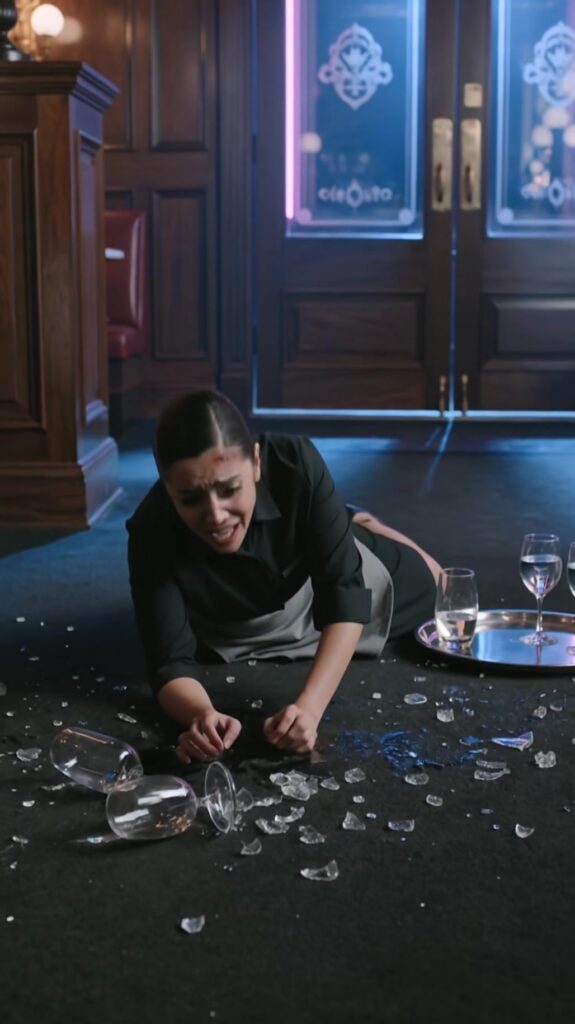
The tray tilted. Time slowed into sharp, cold frames: a line of water arcing from a glass; the rim of a tumbler catching the light; Mara’s fingers reaching for balance and finding only air. She didn’t so much fall as get rejected by the room. The tray slammed the floor. Glasses detonated. Water ran like quicksilver under the tables.
Mara landed hard, the impact stealing her voice. The pain came second. The humiliation came first—a thick, hot wave that poured over her cheeks as the restaurant stared. She felt the cut along her hairline warm and wet, but she didn’t look for blood. She looked for movement. For a chair to scrape back. For a hand reaching down. For a manager stepping in. For anyone deciding that a person on the ground mattered more than the comfort of their evening.
Nothing happened.
She saw it in fragments: a man with a linen napkin paused midway to his mouth; a woman with pearls staring at her plate like it had suddenly become important; the bartender pretending to check a receipt; a couple holding hands so tightly their knuckles blanched, not in solidarity but in fear of being noticed.
The bald man stood over the wreckage long enough for everyone to understand that he meant what he’d done. His mouth curled in a half smile—not joy, not rage, something worse: indifference performed like power. Then he stepped away, careful not to get his shoes wet, as if Mara were an inconvenience that would be cleaned up.
Mara tried to sit up without pressing her palms into the glittering teeth of glass around her. Her hands shook so badly she couldn’t tell whether the tremor came from shock or something older. She tasted copper. Her throat burned.
“Help,” she managed. The word sounded too small for the room it entered.
Her manager, Lionel, stood near the host stand with his hands clasped in front of him. He looked as if he’d been carved into place. His eyes flicked to the bald man and then away, like a child refusing to look at a storm. Lionel’s lips moved, silently shaping a sentence Mara had heard before in a hundred tiny ways: Don’t make this harder. Don’t cause a scene.
Mara’s voice cracked open. “Please. Somebody help me.”
The door at the entrance didn’t open so much as swing, wide and uninvited, letting in a wedge of neon-blue light that didn’t belong to the street outside. It was winter, and the cold that entered with it had an edge, like it had been sharpened somewhere else. The blue light painted the polished wood, the white tablecloths, the watching faces. It made everyone look briefly like ghosts.
Two men stepped inside. Their coats were dark, clean-lined, not flashy—expensive in the way of things that never needed to announce themselves. They didn’t scan the room like tourists or predators. They walked as if the room had been waiting.
The first man, the one in front, had a fade cut and a close beard that made his jaw look carved. His eyes were calm, but not soft. He paused just beyond the threshold, taking in the scene with a precise, almost clinical attention: the broken tray; the spread of water; the scattered glass; Mara on the floor trying not to bleed onto someone else’s décor.
The second man stayed half a step behind, quiet in the way of someone who didn’t need to speak to be heard. His gaze moved to the exits, the corners, the bar—cataloging. Planning.
“Who did this?” the first man asked. His voice wasn’t loud. It didn’t need to be. The air carried it as if the room wanted to obey.
No one answered. The dining room stayed wrapped in its chosen helplessness.
The bald man’s smile faltered, as if he’d expected the universe to keep indulging him. “Mind your business,” he said, but his tone was suddenly uncertain, the swagger thinning at the edges.
Mara lifted her head, blinking against tears she refused to release. The blue light made her cut look black. The man in front met her eyes, and something in his expression tightened—an emotion controlled so fiercely it might have been anger, might have been grief.
He took one step toward her, then another, and with each step the room seemed to remember how to breathe. He crouched at a distance that didn’t crowd her. He didn’t touch her right away. He looked at the glass, the water, the jagged edges near her hands like he was measuring the danger without making a show of rescuing her.
“Can you move your legs?” he asked.
Mara nodded, a small motion that sent sparks through her side.
He slid his coat off with a practiced motion and laid it on the floor beside her like a dark mat, creating a safe patch away from the shards. “Shift onto this,” he said. “Slowly.”
The second man moved then, not toward Mara, but toward the bald man. He didn’t threaten. He simply stood close enough to make the space around the bald man shrink, like the walls had leaned in.
Mara inched onto the coat. Pain flared under her ribs, and she hissed.
The first man’s eyes sharpened. He looked past her, past the frightened diners, and found Lionel at the host stand. “You,” he said, and Lionel’s shoulders jolted. “Call an ambulance. Now.”
Lionel opened his mouth. His gaze darted to the bald man, an old reflex of permission. The first man watched that reflex with a cold patience that made the room feel smaller. “Now,” he repeated, and this time Lionel’s hands moved as if pulled by a wire.
The bald man gave a short laugh that didn’t convince anyone. “You her boyfriend?” he asked. “White knight?”
The first man stood, unfolding like a blade. He turned fully then, and Mara saw it—how the calm in him wasn’t peace but restraint. His eyes went from the bald man’s jacket to his fists to the smug line of his mouth.
“No,” the man said, and his voice had changed, deeper, edged with something that made Mara’s skin prickle. He glanced once at Mara, not for permission, but to anchor himself. “I’m her brother.”
The bald man’s face twitched. “Brother,” he repeated, tasting the word as if it were a joke.
“Sister,” the man corrected softly, and Mara realized with a strange jolt that he knew more than the room ever had. He knew what Mara was. He knew what it cost her to exist. He knew what it meant that no one had moved.
He took a step closer to the bald man. His coatless silhouette cut through the blue light like a shadow made solid.
“You didn’t just shove her,” he said. “You tested the room. You wanted to see if anyone would stand up.” He glanced around at the diners, the staff, the faces that had chosen quiet. “They failed.”
The bald man straightened, trying to summon his earlier confidence by force. “Get out of my face,” he said, and his hand twitched toward his pocket.
The second man’s hand was already there, stopping him with a grip that looked gentle until the bald man’s knuckles whitened. He made a small sound, surprised by pain.
Mara’s breath came shallow. She watched the room finally shift, chairs scraping, a few people rising—not to help, but to retreat. The spell of indifference had broken, not because Mara had bled, but because someone with authority had entered and named what happened out loud.
“I don’t want a scene,” Mara whispered, hating how the words sounded like apology.
The man—her brother, whatever that meant in the tangled truth of her life—looked back at her. His gaze softened at the edges, just enough to hold her. “You already had a scene,” he said. “You didn’t choose it.”
Sirens began to wail somewhere far off, growing closer. Lionel hovered with his phone in hand, pale and sweating. The bartender finally grabbed a towel, moving as if waking from a trance.
The bald man tried to pull away, but the second man kept him still without raising his voice.
“What do you want?” the bald man snapped, eyes darting.
The brother’s expression didn’t change. “I want you to understand something,” he said. “In a room full of people, you decided she was alone.” He leaned in, close enough that the bald man could hear him even if the sirens swallowed everything else. “She isn’t.”
Mara felt the words land somewhere deep, where loneliness had been living like a second heartbeat. She pressed trembling fingers against her cut, and for the first time since she hit the floor, she didn’t feel like an object waiting to be swept away.
The neon-blue light still spilled across the entrance like a doorway to another world, but now Mara thought maybe it wasn’t another world at all. Maybe it was just the world where people didn’t look away.
When the paramedics finally burst in with their bright jackets and brisk hands, the room moved aside quickly, eager to be useful now that usefulness had become safe. Mara let herself be lifted. She held on to her brother’s coat, clutching it like proof that someone had stepped through the silence for her.
As they wheeled her out, the brother walked beside her, his eyes never leaving the bald man until the door swung shut and the blue light vanished. The restaurant returned to its amber glow, but it felt different—dimmer, exposed, like the truth had been turned on and no one could pretend they hadn’t seen.
Mara stared up at the winter sky and tasted blood and cold air. She was hurting. She’d known it before she hit the floor. But now she knew something else, too: the worst wound wasn’t the cut on her forehead. It was the moment the room chose not to help—and the moment it was forced to remember what that choice meant.