Nora had learned how to disappear while standing in plain sight. In the mirrored walls of Lark & Pine, she could watch herself move without being seen: a woman in black linen and pinned hair, gliding between candlelit tables with the practiced ease of someone who’d stopped expecting kindness. The room smelled like truffle butter and money. Voices floated in soft layers—executives laughing, anniversaries clinking, strangers leaning toward each other as if the world were gentle. Nora’s smile was trained to fit into that softness, to blur her edges until she became part of the décor.
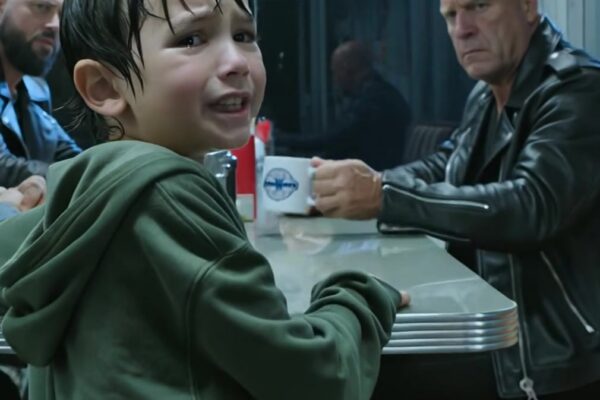
She remembered everything because remembering was safer than asking. Sparkling for table six, still for nine. No onions for the woman in pearls. Extra bread for the boy who ate like his stomach had once known emptiness. And then the other kind of remembering—the dangerous map in her head: which men drank too much and thought a server’s body was a suggestion; which ones sat with their backs to the exit; which ones stared too long at the security camera above the bar. The worst was Viktor, a bald man in a black leather jacket who arrived like he owned the air. He never bothered with a menu. He never waited his turn to speak. He looked at Nora the way a boot looks at a cigarette on the pavement.
Two nights earlier, she’d seen him outside her apartment building. The street had been wet with recent rain, the city’s neon smeared across puddles. Viktor stood under the awning as if the cold belonged to him, smoking in the dark and staring up at her window. Nora hadn’t turned on a light. She’d stood behind the curtain, breath held, and watched the ember bloom and fade as he took his time. When he finally left, it wasn’t relief that settled in her bones—it was a certainty. He knew where she lived. He wanted her to know he knew.
So when the host whispered, “Your friend is here,” and Viktor walked through Lark & Pine’s glass doors that night, the room seemed to tilt. The amber lighting still glowed. The pianist still tapped out something slow and expensive. But Nora’s hands shook around her tray as if her body had become a lie she could no longer maintain. Viktor didn’t need to scan the dining room; his gaze snapped straight to her, sharp as a hook.
Nora tried to stay moving. Motion was camouflage. Table six, then nine, then the corner booth. She kept her eyes on plates, on napkins, on anything but him. Her shoes whispered over the polished floor. The tray in her hands felt heavier with each step, as though it carried the weight of all the times she’d swallowed fear. She was passing his table when Viktor stood up. The chair legs scraped the floor with an ugly sound that cut through laughter like a blade.
“Still hiding?” he murmured, too quiet for anyone to claim they’d heard it.
Nora’s throat tightened. “I’m working,” she said, barely audible. “Please don’t—”
Viktor’s hand struck her shoulder with a sudden shove. The world leapt. Glasses slid, then flew, then shattered in a bright, violent spray across the floor. Nora hit hard—shoulder first, then her forehead—stars bursting behind her eyes. For a heartbeat, there was nothing but spinning light and the glittering teeth of broken glass.
The restaurant fell silent. Not the silence of concern. The silence of calculation. Nora’s palm pressed down to push herself upright and skidded dangerously close to the shards. Warm blood ran from her temple, trickling into her hairline. “Help,” she whispered, the word thin as paper. “Please.” No one stood. People stared and did what they always did when cruelty entered a room: they tried to make it someone else’s problem.
Viktor loomed over her, chest rising and falling, daring the room to oppose him. “Look at you,” he said softly, almost amused. “You think being quiet makes you invisible.”
Then the door slammed open with a sound that didn’t belong to fine dining. Cold spilled in—an icy blue from the streetlights outside—cutting through the amber like a blade through silk. Two men stepped inside, and the temperature in the room seemed to drop with them. The first wore a dark overcoat over a gray waistcoat; his hair was cut clean, his beard trimmed short, his expression calm in a way that felt unnatural. The second stayed a half-step behind, scanning the tables, the corners, the exit routes, as if he’d been trained to read danger like ink on a page.
Nora lifted her head, blinking blood from her lashes, and saw the first man’s face clearly. Five years collapsed into a single breath. She knew the angle of his jaw. The small scar near his eyebrow. The eyes that had once looked at her as if she were the only bright thing left in his world.
Damian Vale.
He had vanished the night he’d kissed her forehead in their cramped kitchen and said, almost gently, “If I don’t come back, forget me.” She had tried. God, she had tried. She’d packed away the photos, the letters, the foolish hope. She’d learned to eat dinner without checking the door. She’d taught herself to stop flinching at footsteps in the hall. She’d become an expert at surviving ordinary life while a hole stayed open in the center of her chest.
Now Damian walked forward slowly, not hurried, not loud, not confused—certain. His gaze swept over the broken tray, the water spreading across the floor like spilled confession, the blood on Nora’s face, the man standing over her as if the world were his. Damian stopped beside her and looked down. Something in his eyes tightened, a quiet shift that changed the air. He raised his gaze to Viktor.
“Who touched her?” Damian asked.
The words were plain. The effect was not. People who had been paralyzed moments earlier suddenly found reasons to look away. Viktor’s posture altered—just a fraction—but Nora saw it. A man like Viktor didn’t step back often. He did now, half an inch, as if his body recognized a threat his ego refused to name.
Nora’s voice shook. “You came,” she breathed, as though speaking it might make it true enough to hold.
Damian crouched beside her, his coat brushing the edge of the wet floor, his presence blocking Viktor’s shadow. His companion moved subtly, positioning himself so Viktor couldn’t reach Damian’s back. Damian’s eyes lowered to Nora’s cut, and for a moment Nora saw something behind his calm—fury kept on a leash so tight it hummed.
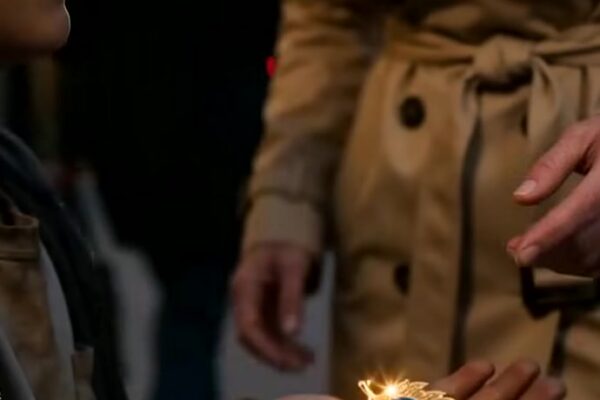
As Damian reached toward her, something slipped from Nora’s apron pocket and rolled onto the floor between them, tapping lightly against a shard of glass. It was small, ridiculous against the violence: a child’s bracelet, pink beads strung on elastic, a silver charm that caught the candlelight. An engraved letter flashed when it turned.
D.
Damian’s hand froze midair. His gaze locked on the bracelet as if it were a gun pointed at his heart. The color drained from his face, leaving him suddenly, startlingly human. He picked it up carefully, thumb brushing the tiny charm with an intimacy that didn’t belong in this room. Then he looked at Nora.
“Where did you get this?” he asked, and his voice—so controlled seconds ago—cracked around the edges.
Nora swallowed, tasting copper. The restaurant seemed to shrink until it contained only them and the thin line of fate between their eyes. “It’s not mine,” she whispered. “It’s hers.”
Damian’s breath hitched, sharp and quiet. “Hers?”
Nora’s hands trembled as she reached up, not to touch him, but to steady herself in the world. “I didn’t know how to find you,” she said, each word a struggle. “I didn’t know if you were alive. And then I—” She looked past him for a second, toward the hallway that led to the staff rooms and the back exit. “She’s here. In the office. I keep her with me on shifts because I can’t afford a sitter and I can’t leave her alone.”
Damian’s eyes flicked to the letter again, as if it might rearrange itself into a lie. “How old?” he asked.
Nora’s throat tightened until it hurt. “Four,” she said. “She knows the sound of your name like it’s a story I tell when the city is too loud and she can’t sleep.”
Viktor laughed once, harsh and disbelieving, trying to reclaim the room. “What is this? A reunion?” he sneered. “You think you can—”
Damian stood, slow as a closing door, and tucked the bracelet into his fist. When he turned, the calm returned—but it had changed shape. It was no longer restraint. It was decision.
“You’ve been watching her,” Damian said to Viktor, not as a question.
Viktor’s smile faltered. “I don’t know what you’re talking about.”
Damian took one step forward. The distance between them tightened like a noose. “You will,” he said. “Because you’re going to explain it. And then you’re going to leave this place without touching her again.” He glanced back down at Nora, and for the first time his expression softened—not into comfort, but into a vow. “Nora,” he said quietly, “I’m here. I’m not disappearing.”
Nora tried to nod, but tears blurred the room into candlelight and shadows. In that blur, she saw the truth she’d avoided for years: disappearing had never protected her. It had only made predators bolder. Damian’s presence didn’t erase what had happened, didn’t rewind time, didn’t mend the bruise blooming in her shoulder—but it altered the future by force, by sheer refusal.
And somewhere behind the kitchen door, a child waited with a pink bracelet’s twin on her wrist, humming a lullaby Nora had invented around a man who was never meant to become a ghost.
Tonight, the ghost had come back with teeth.